49 works in this view — arrow keys or swipe to move between them.
Dance in Art
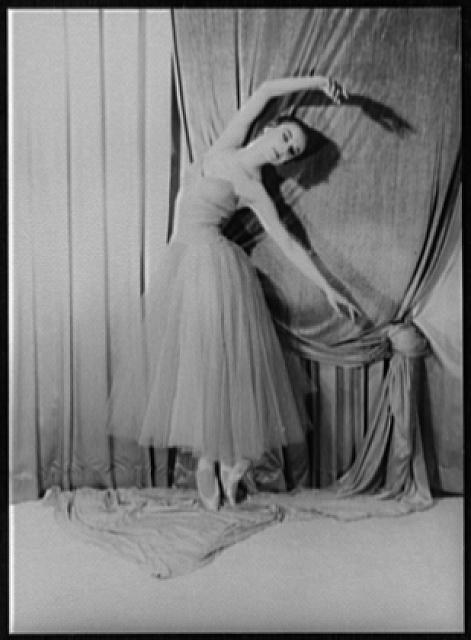
[Portrait of Violette Verdy, in Serenade]
Unknown artist
- Collection:
- Prints & Photographs
- Source:
- Library of Congress
- Rights:
- Rights vary by item — check the source record before reusing this image. Source record ↗
- Recorded as:
- Library of Congress — no known restrictions (verify per item)
Violette Verdy was a defining figure in American ballet and a muse of George Balanchine; this photograph documents her in one of his most celebrated works at a moment when Balanchine's neo-classical vision was reshaping international ballet. The image also exemplifies the role of professional dance photography in the mid-twentieth century as both promotional documentation and a tool for analyzing movement and costume.
What you are looking at
A female dancer in a classical ballet pose dominates this black-and-white photograph, captured in stark profile against draped fabric. She stands in a pronounced arabesque or attitude position, her torso extended and one leg raised high behind her body, the supporting leg straight and engaged. Her arms frame the vertical line of her body—one reaches upward in a graceful arc, the other extends sideways. She wears a classical tutu of substantial volume, rendered with fine detail that shows the multiple layers of the skirt. The setting is deliberately theatrical: heavy fabric drapes flank her on both sides, creating a studio or stage environment with strong side lighting that casts her form into sharp relief. The composition emphasizes the verticality and extension of her body; she appears to be balanced in a moment of controlled suspension. The photograph is taken from a low angle, which heightens the monumentality of her pose.
The dancing
A single female dancer extends into a fully articulated classical line. The supporting leg is straight and turnout is evident in the hip position. The raised leg extends behind, creating the characteristic geometry of arabesque or attitude. Both arms participate in the line: the upper arm reaches overhead with the elbow soft, while the lower arm extends laterally at approximately shoulder height. The dancer's frame is open and lifted; her weight is held in a way that suggests strength in the supporting leg and core. The tutu is voluminous and well-constructed, and its angle in the photograph suggests the dancer is actively engaging turnout and control.
The dance depicted
This is classical ballet, almost certainly from the Balanchine or neo-classical tradition of the mid-twentieth century based on the style of tutu, the clarity of line, and the directness of the pose. The title identifies this as a portrait of Violette Verdy in Serenade, which is a George Balanchine work premiered in 1934. Serenade is performed to Tchaikovsky and features precise, legible classical vocabulary. The photograph captures a single declarative arabesque or attitude—a moment of suspended balance that was central to Balanchine's aesthetic of clarity and efficiency of line. Verdy was a principal dancer with New York City Ballet and known for her precision and musicality; this image shows the kind of controlled, extended line that defined that company's approach.
How it was made
This is a black-and-white photograph, likely a professional studio or theatrical photograph from 1961, printed as a gelatin silver print. The lighting is carefully controlled, using side illumination to model the dancer's form and create high contrast between the figure and the draped background. The angle and framing—shot from below, slightly to the side—is deliberately composed to emphasize the height and extension of the arabesque. The photograph is sharp and well-exposed, suggesting professional studio practice. This type of portrait photograph was standard documentation of dance performances and rehearsals in mid-century American ballet, used for publicity, archival purposes, and costume records.
About this work
This photograph documents Violette Verdy, a principal dancer with New York City Ballet, in a classical arabesque from George Balanchine's Serenade. Taken in 1961, it captures the neo-classical aesthetic that defined American ballet in the post-war era: legible, extended classical line stripped of ornament, emphasizing the body's geometry rather than narrative or character. Verdy was celebrated for technical precision and musicality, qualities evident in the controlled extension and economy of the pose shown here. The photograph is both a portrait of a specific dancer and a document of how one of the twentieth century's most influential choreographers visualized classical ballet movement.
How to look at it
Attend to the precision of the line: the straight supporting leg, the extended raised leg, the soft articulation of the arms, the lift of the torso. The photographer positioned the camera to maximize the vertical extension of the body and the clarity of the arabesque's geometric shape. The moment chosen is one of suspension—not a peak or climax of action, but a held position that allows the line to be read fully. This was characteristic of Balanchine's approach: movements were designed to show the body's articulation most clearly in a single frame, a principle that influenced how his dancers were photographed.
The artist
The photographer is unrecorded in the archive. Professional dance photography in 1961 was typically produced for ballet companies' publicity departments, costume records, and theatrical documentation. Photographers who specialized in dance—such as those associated with NYCB—developed systematic techniques for capturing movement clarity and line, using controlled lighting and carefully chosen angles to show the body in its clearest articulation.
The period
This photograph dates to 1961, when Balanchine's neo-classical vision had already established itself as the dominant American ballet aesthetic. Serenade, created in 1934, had become a repertory cornerstone, performed regularly by NYCB. The mid-twentieth century saw the rise of the professional dance photograph as an art form in its own right, distinct from theatre photography—dancers were often shot in studio conditions that isolated them from narrative context and allowed the movement vocabulary itself to be the subject. This approach mirrored developments in dance criticism and pedagogy that increasingly focused on movement technique as an autonomous subject.
Where it lives
This photograph is held in the Library of Congress Prints & Photographs collection, likely acquired from the New York City Ballet archive or the photographer's records. It represents the kind of professional documentation that ballet companies generated systematically during this period.
Dance in this work
Questions about this work
Who was Violette Verdy?
Violette Verdy (1933–2016) was a French-American ballet dancer and a principal performer with New York City Ballet from 1958 onward. She was celebrated for her technical precision, musicality, and long limbs, and was a favored interpreter of George Balanchine's neo-classical works. She later became a teacher and répétiteur, passing on Balanchine's movement vocabulary to subsequent generations.
What is Serenade?
Serenade is a George Balanchine ballet created in 1934, set to Tchaikovsky's Serenade for Strings. It is one of Balanchine's most frequently performed works and a foundational neo-classical piece. The ballet has no narrative; it is structured as a series of movement phrases and formations that showcase classical technique and the geometry of the dancing body.
Why is the pose in this photograph called an arabesque?
An arabesque is a classical ballet position in which the dancer stands on one straight leg while extending the other leg behind the body at a right angle or higher, creating a long line from fingertips through the extended leg. The position emphasizes verticality, turnout, and control; it is one of the most frequently photographed positions in ballet because the line is legible and the body's alignment is clear.
What does this photograph tell us about 1961 ballet?
This photograph exemplifies the Balanchine aesthetic that dominated American ballet by the early 1960s: clarity of line, emphasis on technique over narrative, and the isolation of the moving body as the primary subject. The professional studio photograph itself became a document of this approach—dancers were shot to show movement vocabulary as legibly as possible.
More dance artwork





