49 works in this view — arrow keys or swipe to move between them.
Dance in Art
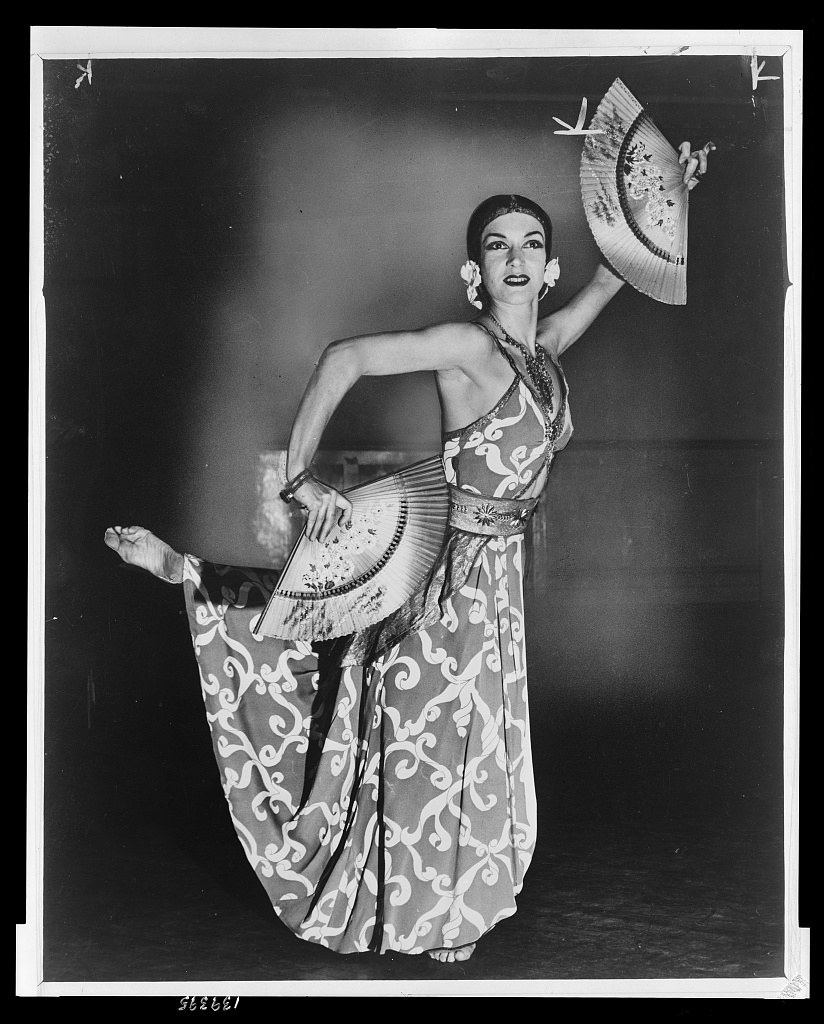
[Lisan Kay on stage at Carnegie Hall dancing with a fan]
Unknown artist
- Collection:
- Prints & Photographs
- Source:
- Library of Congress
- Rights:
- Rights vary by item — check the source record before reusing this image. Source record ↗
- Recorded as:
- Library of Congress — no known restrictions (verify per item)
This photograph documents professional theatrical dance performance in 1940s America, a period when fan dance and exotic theatrical dance were significant forms of popular entertainment. It provides visual evidence of costume construction, stage lighting, and the aesthetic conventions of mid-century American cabaret and theatrical performance.
What you are looking at
A solo female dancer poses on a dark stage in a dramatic, theatrical moment. She stands in a three-quarter stance, her body angled to the left, with her left arm extended upward holding an ornate fan with a large pleated surface decorated with intricate patterns. Her right arm rests across her torso. She wears an elaborate costume: a patterned wrap or sarong in light and dark tones with decorative motifs covers her lower body, while a matching patterned halter or bikini top with ornamental detailing adorns her upper body. A wide decorative belt cinches her waist. Her hair is styled close to her head in a sleek manner, and she wears what appear to be pearl or light-colored earrings. Her makeup is carefully applied with defined eyebrows and lips. The lighting is soft and frontal, creating a subtle glow against the dark background and emphasizing the fabric textures and her poised, statuesque bearing. The photograph is taken straight-on but her body's angle creates depth and dynamism within the frame.
The dancing
A single dancer in a strong, planted stance with weight evenly distributed. Her torso is lifted and elongated, presenting a proud carriage. The extended left arm, holding the large fan, reaches upward and outward at approximately shoulder height, creating an elegant line. Her right hand curves gently inward. The pose suggests a moment of presentation or display rather than active movement—the body is still, composed, and frontal despite the rotated angle.
The dance depicted
This appears to be a theatrical or cabaret performance from the mid-20th century, likely featuring fan dance or exotic/theatrical dance of the 1940s era. The prominent prop—a large, beautifully decorated fan—and the theatrical costume, styling, and studio lighting all point to staged entertainment performance rather than any ethnically specific dance tradition. The pose is one of display and presentation characteristic of American vaudeville or nightclub entertainment. The careful grooming, studio photography, and theatrical presentation suggest a professional performer in a commercial entertainment context.
How it was made
This is a black-and-white photograph, likely a studio portrait taken as promotional or documentary material. The professional lighting setup, careful composition, and studio backdrop indicate this was a formal session, probably for publicity purposes. The photographic medium allowed for high-quality reproduction and circulation as a promotional image for the performer or the production.
About this work
This is a studio portrait photograph of Lisan Kay, a performer, captured at Carnegie Hall in 1944 during what was likely a theatrical or cabaret performance. The image documents a moment of theatrical presentation, showcasing both the performer and the elaborate costume and prop work involved in mid-century American entertainment. The photograph is a record of professional dance theater from the Golden Age of American nightclub and vaudeville entertainment, capturing the aesthetics and performance conventions of that era.
How to look at it
Note the careful composition: the dancer is neither fully frontal nor in strict profile, but angled to present both face and body while using the fan as a compositional focus. The extended arm and the fan create a vertical accent that draws the eye upward. Observe the costume details—the patterned fabric, the decorative belt, the careful grooming—which were essential elements of the performance itself. The pose is held and presented rather than captured mid-movement, indicating this is a moment of display within the performance.
The artist
The photographer is not recorded. The image comes from the Library of Congress Prints & Photographs collection, suggesting it was either a commissioned publicity photograph or acquired as a documentary record of American entertainment.
The period
In 1944, American theatrical dance and cabaret performance were at a cultural peak. Fan dance had been popularized earlier by performers such as Sally Rand in the 1930s, and the form persisted through the 1940s in nightclubs, theaters, and variety shows. This was before the postwar shift in entertainment preferences and reflected the aesthetics of pre-television professional entertainment—highly theatrical, emphasizing costume, dramatic lighting, and posed presentation.
Where it lives
The photograph is held by the Library of Congress Prints & Photographs Online Collection, a major documentary archive. It was cataloged with minimal metadata, suggesting it may have been acquired as press material or documentary evidence of American entertainment.
Dance in this work
Questions about this work
Who was Lisan Kay?
Lisan Kay was a theatrical performer active in 1940s American entertainment. This photograph documents her performance at Carnegie Hall in 1944, indicating she performed in prestigious venues. Little additional biographical information is currently recorded in the Library of Congress catalogue.
What is fan dance?
Fan dance is a theatrical performance form that uses large, often ornate fans as a primary prop and visual element. The fan becomes both a costume element and a tool for creating visual patterns and effects on stage. The form was particularly popular in American cabaret and variety entertainment in the 1930s-1940s.
Why would this performance be at Carnegie Hall?
By the 1940s, Carnegie Hall hosted a wide range of entertainment beyond classical music, including theatrical performances, variety shows, and popular entertainers. Theatrical dance and cabaret performances were considered legitimate entertainment suitable for prestigious venues.
What do the costume details tell us?
The patterned fabric, decorative belt, and carefully coordinated halter top indicate significant investment in costume construction. The motifs and colors suggest an attempt at an 'exotic' or 'Oriental' aesthetic, reflecting the visual conventions and cultural tastes of 1940s American entertainment, where such styling was common in theatrical performance.
More dance artwork