49 works in this view — arrow keys or swipe to move between them.
Dance in Art
Hrabina-i-Wiesniaczka-colour
Henryk Hirszel (1809-1877)
- Source:
- Wikimedia Commons
- Rights:
- Public domain — free to use, share and adapt.
- Recorded as:
- cc0
The Cachucha was a signature vehicle for Romantic-era dancers and a rare case of a Spanish popular dance becoming central to European ballet repertory. This image captures the exact form and styling of that dance in a major European theater, allowing historians and dancers to see the step as it was actually performed—not as it appears in later notation or description. The print is a primary document of 1840s ballet performance and Warsaw's place in the international Romantic theater network.
What you are looking at
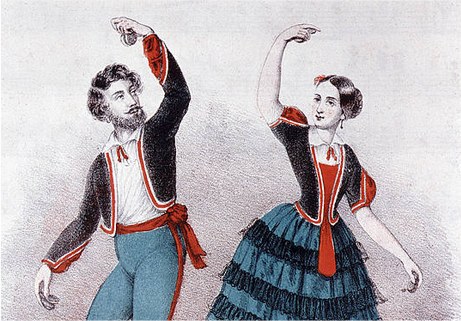
A colored lithograph depicts two dancers in mid-performance, shown in three-quarter view against a plain, light background. The male dancer on the left wears tight blue breeches, a white shirt front, and a dark jacket with red and white trim; his right arm is raised overhead in an expressive gesture while his left hand gestures outward, his body angled dynamically. The female dancer on the right wears a dark jacket matching his in color and trim, paired with a voluminous tiered skirt in shades of blue and dark fabric, creating dramatic flare. She mirrors his raised-arm pose with her right arm extended upward, her body similarly engaged in the moment. Both dancers wear their hair parted in the center in the fashion of the 1840s. The composition captures a moment of synchronized, gestural expression—neither full ensemble tableau nor static pose, but rather a snapshot of coordinated movement with considerable theatrical energy.
The dancing
Both dancers stand with weight forward, bodies angled toward the viewer's right, creating a sense of forward momentum and mutual engagement. Their raised right arms and extended left arms suggest a turn or spiral in progress. The male dancer's frame is upright and reaching; the female dancer's broader skirt suggests the figure is captured mid-twirl, with the fabric lifting to show the layered construction. The positioning and mirrored arm placement suggest a partnered moment, though they are not in a formal closed hold. The dynamic asymmetry of the pose—both bodies tilted, both arms extended at different angles—conveys the specific momentum of a particular step or transition rather than a held position.
The dance depicted
This is the Cachucha, a Spanish solo or duet dance in triple time that became one of the most celebrated showcase dances of the Romantic ballet era. The Cachucha entered European theatres via Spanish dancers in the 1820s and became a standard number in major ballet productions of the 1830s–1850s, often danced by celebrated ballerinas as a brilliant highlight. The image records a performance of the ballet *The Countess and the Peasant* (*Hrabina i wieśniaczka*) by Roman Turczynowicz, performed at the Warsaw Grand Theatre in 1847 by Aleksandr Tarnowski and Konstancja Turczynowicz. The raised arms, turned-out carriage, and upright posture reflect Romantic-era ballet technique, while the Spanish-derived vocabulary and the characteristic arm and head positions visible here were signature features of the Cachucha as performed in classical ballet.
How it was made
This is a colored lithograph (hand-tinted or printed in color), a commercial theatrical print technique that allowed rapid, relatively inexpensive reproduction and wide distribution. The precision of the figure drawing and the quality of the registration suggest professional production, consistent with the attribution to Henryk Hirszel and the design credit to Gustaw A. Sennewald. As a theater bill or playbill image, this print served both as advertisement and documentary record of the performance, preserving the appearance of celebrated dancers and the costumes of a specific production for an audience that could not attend. The technique—a printed base with hand-coloring on paper—was ideal for theatrical publicity and allowed individual impressions to vary in their coloring.
About this work
This lithograph documents a celebrated moment in 1840s Warsaw theater: the Cachucha duet from Roman Turczynowicz's ballet *The Countess and the Peasant*, performed by Aleksandr Tarnowski and Konstancja Turczynowicz. The Cachucha was among the most famous dances of the Romantic ballet era, a Spanish-derived solo or duet celebrated for its virtuosity and theatrical appeal; it appears in major ballets of the period from London to St. Petersburg. This particular print records a specific production and cast, preserving the exact costumes, poses, and moment chosen for the dance—the raised arms and turning motion characteristic of the step. As a commercial theater print, it documents both what the dance looked like in performance and how it was marketed to audiences as a highlight of the evening.
How to look at it
The artist has frozen the dancers not in a stationary pose but in a moment of turning and gesture characteristic of the Cachucha's design—both dancers airborne or mid-turn, both reaching upward and outward with the classical ballet port de bras, their bodies tilted in a way that suggests the rapid, percussive footwork underneath the upper-body movements. Notice the asymmetry and animation: this is not a bilateral symmetrical pose, but a dynamic instance of a step in progress. The costumes—the fitted jacket and breeches for the male dancer, the voluminous tiered skirt for the female—show both the Spanish-inflected styling of Cachucha costume and the silhouette of 1840s theater dress. The colored lithograph technique allows the costumes to read clearly and distinctly, which is the print's primary purpose.
The artist
Henryk Hirszel (1809–1877) was a Polish lithographer active in Warsaw during the Romantic period. Lithography was his primary medium, and he produced numerous theatrical prints, including playbills, character studies, and scene illustrations for major Warsaw theaters. His work is representative of commercial theater publishing in Central European capitals during the 1830s–1860s; the quality and finish of his signed prints suggest he was an established professional whose designs were valued for both accuracy and promotional appeal. Hirszel's practice was typical of urban printmakers of the era—closely tied to the theater and music scenes, producing topical, time-sensitive images for immediate consumption.
The period
The 1840s were the height of Romantic ballet in Europe. The Cachucha had entered European ballet repertory in the 1820s, introduced by Spanish dancers performing in Paris and London, and quickly became standardized as a solo or duet showcasing a ballerina's technique and theatrical presence. By 1847, when this print was made, the step was familiar across European theater capitals, danced in major ballets and as a standalone number. Warsaw in the 1840s was an active theater center, part of the European Romantic circuit; the appearance of major ballets and celebrated dancers in Warsaw was consistent with the city's cultural importance. Lithographic prints of theatrical stars and celebrated moments were standard promotional material, collected by theater-goers and sold at the theater or by print vendors.
Where it lives
This lithograph is recorded as a source on Wikimedia Commons; neither the holding collection nor current location is recorded in the catalogue. It is identified as a theater playbill or promotional print (a *show bill*) designed by Gustaw A. Sennewald and executed by lithographer Henryk Hirszel, consistent with commercial theater printing of the Warsaw Grand Theatre in the 1840s.
Dance in this work
Questions about this work
What is the Cachucha?
The Cachucha is a Spanish solo or duet dance in triple time that became famous in European ballet in the 1820s–1850s. It was performed as a showpiece number in major ballets and later in musical theater, celebrated for its lively rhythm, dramatic arm movements, and brilliant footwork. The step shown here—with raised arms and turning motion—is the characteristic upper-body port de bras of the classical ballet version.
Who were Aleksandr Tarnowski and Konstancja Turczynowicz?
They were dancers performing at the Warsaw Grand Theatre in 1847. Konstancja Turczynowicz was also the wife of Roman Turczynowicz, the choreographer of the ballet *The Countess and the Peasant*. Beyond what is recorded on this print, their individual histories are not documented here.
What does the print tell us about how the Cachucha was performed?
The upright posture, turned-out carriage, and classical ballet arm positions visible here show that by the 1840s, the Cachucha had been fully absorbed into ballet technique. The raised arms and the turning motion captured here are the hallmarks of the step as performed in theatrical ballet; the Spanish character of the dance is expressed through styling and costume rather than through vernacular or popular movement.
What was a theatrical playbill in the 1840s?
Playbills were printed advertisements and records of theatrical performances, sold to audiences at the theater or distributed to advertise upcoming shows. A colored lithograph like this one would be hung as a poster or included in a program, serving both to promote the performance and to preserve images of celebrated dancers and famous moments for the public record.
More dance artwork