49 works in this view — arrow keys or swipe to move between them.
Dance in Art
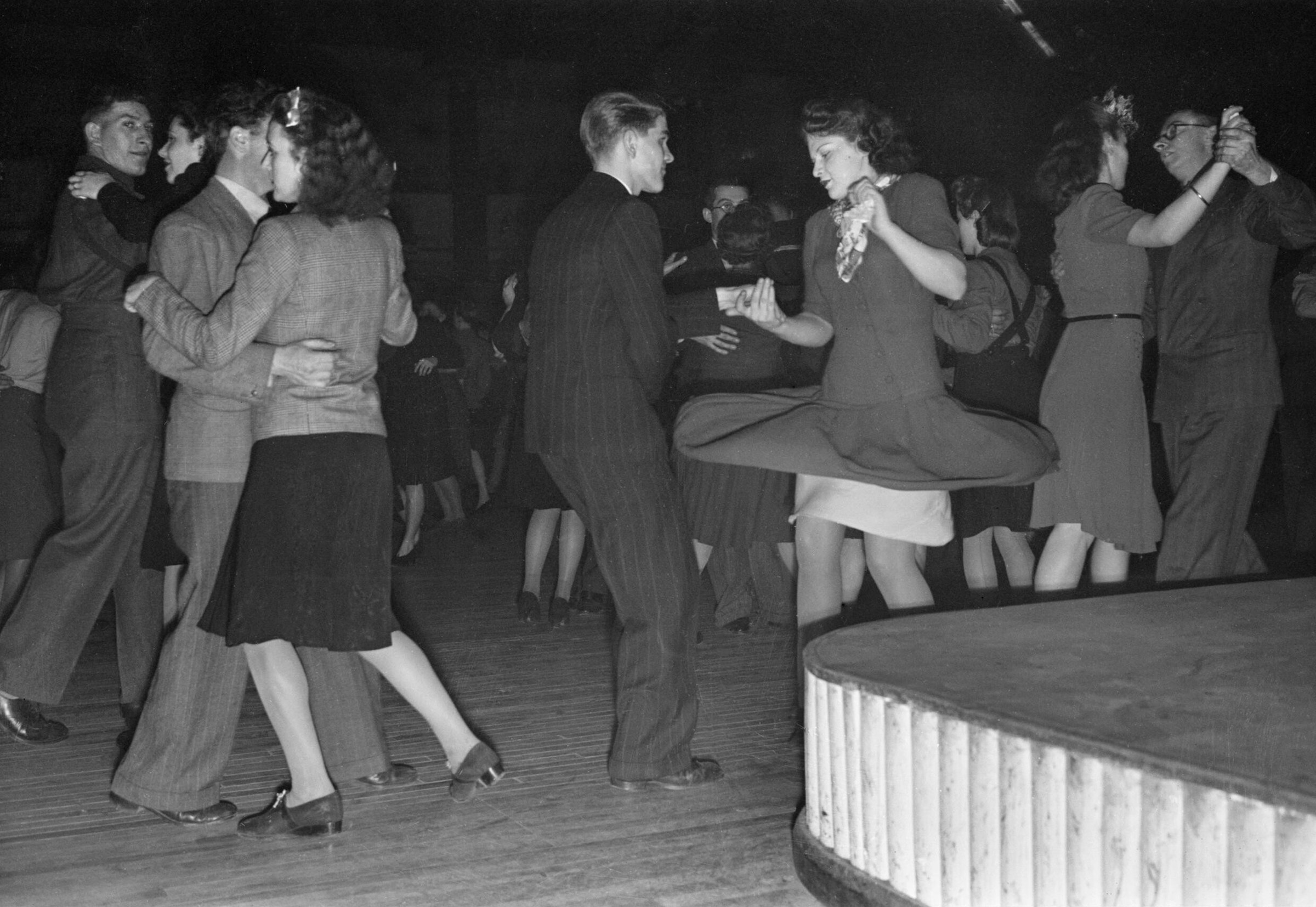
A couple at a British dance hall try out 'jive' steps in 1945. D23826
Ministry of Information Photo Division Photographer
- Source:
- Wikimedia Commons
- Rights:
- Public domain — free to use, share and adapt.
- Recorded as:
- public_domain
This photograph documents the exact moment when swing dances from America began to overturn the ballroom conventions that had dominated British social dance for decades. For dance historians and social historians, it is a rare piece of direct evidence showing how two dance styles coexisted in the same space, with the younger generation visibly adopting the freer, more athletic jive while their elders held to tradition. For dancers, it reveals the technical differences between 1940s ballroom and jive with documentary clarity: the hold, the frame, the footwork, and the social meaning each carried.
What you are looking at
A black-and-white photograph of a British dance hall in 1945, captured mid-evening under artificial light. The floor is wooden and spacious; in the foreground right, a curved white railing marks the edge of what appears to be a bandstand or stage. The hall is crowded with couples and groups in dark suits and dresses. In the centre-right, a young couple in profile demonstrates the new 'jive' style: the man in a dark suit leans back with one arm extended, the woman in a dark dress with a white handkerchief or scarf at her neck executes a dynamic, high-kicked turn with her skirt swinging outward. Around them, other dancers maintain more formal, close-hold ballroom positions—waltzes and foxtrots—creating a sharp visual contrast between the energetic, loose-limbed jive and the stiff, upright traditional ballroom frame. The photograph's depth of field pulls focus to the jiving couple while the background dancers blur slightly, emphasizing the moment as a transition between dance generations.
The dancing
The jiving couple occupies the visual centre: the man stands with weight on his back foot, one arm extended outward with a relaxed bend, body angled away from his partner in an open position. The woman executes a high kick or swing-through, her lower leg extended, skirt flared, upper body turned toward her partner but without the close embrace of ballroom. Her free arm is raised. The hold between them appears loose, possibly hand-to-hand only. Around them, traditional ballroom couples maintain closed positions—torsos upright and parallel, arms in frame. The contrast is immediate: jive shows a wider stance, more knee action, separation between partners, and freedom of movement; ballroom dancers show the upright frame, contact, and controlled line of the era.
The dance depicted
This is a documentary photograph of 'jive' or 'jitterbugging'—American swing dances that arrived in Britain with US servicemen during and after World War II. The couple on display are performing a basic jive pattern: the open position, the swinging leg action, and the separated frame are characteristic of British wartime jive, which simplified American Lindy Hop and East Coast Swing for the dance hall. The 'old-style' dancers around them—waltzing in closed position—represent the pre-war ballroom standard. The photograph captures a genuine cultural moment: jive was controversial, energetic, and youth-driven, while ballroom was formal and traditional. The image shows both styles coexisting in the same space, suggesting the slow adoption of jive by a population accustomed to strict ballroom hierarchy.
How it was made
This is a photograph, likely taken by a professional press or documentation photographer from the British Ministry of Information Photo Division, as the catalogue attributes. The black-and-white film stock and lighting suggest artificial flash or tungsten light balanced for the indoor dance hall. The composition and focus—sharp on the jiving couple, softer on the background—indicates purposeful framing to isolate and emphasize the new dance as the subject. As a Ministry of Information photograph, it was made for public documentation and propaganda, intended for circulation in newspapers and official records to show British civilian life and morale during the war period. The technical clarity and composed framing distinguish it from casual snapshot photography.
About this work
This is a documentary photograph of a pivotal moment in twentieth-century British dance culture: the arrival and adoption of American jive in 1945. It shows a young couple at a public dance hall executing the new jive style—with its characteristic open position, swinging action, and separated frame—while all around them, traditional ballroom dancers continue their formal, closed-hold waltzes and foxtrots. The photograph was taken by or for the British Ministry of Information, which documented civilian life during and after World War II; it reveals not just the technical vocabulary of a new dance style, but the social tension between youth and tradition, American and British, energetic and formal. The image is historically significant because it captures a generational and cultural transition in real time, showing how a imported American dance style began to reshape British ballroom culture.
How to look at it
Watch the legs and the frame. The jiving couple's knees are bent and active; the woman's leg swings high and free. The ballroom couples around them move from the hip and torso in an upright line; their legs are straight and controlled. Notice the handhold: jive partners hold loosely and can separate; ballroom partners maintain contact. The photographer has frozen the moment at the peak of the woman's swing-through turn, when the energy and separation are most visible. This timing choice emphasizes the dynamic, 'loose' quality of jive against the staid formality of the ballroom dancers. The depth of field—sharp focus on the jiving couple, softer on the background—uses photographic technique to make an argument: this is the new thing, and it is worth looking at.
The artist
The photograph is credited to the Ministry of Information Photo Division, a British government agency that documented civilian life, industrial output, and morale during World War II and the immediate post-war period. The division employed professional photographers whose work was circulated to newspapers, exhibitions, and official archives. These photographers were trained documentarians, not artists in the fine-art tradition, but their work has become historically invaluable as a record of everyday British life. The photograph's composition—the clarity, the focus on the dancing couple, the contextual background—shows the hand of a skilled photographer working to communicate a specific narrative about British society at a moment of cultural change.
The period
In 1945, Britain was still at war (until August) or newly at peace. American servicemen had been stationed in Britain since 1942, and with them came jazz, swing music, and jitterbugging. Jive was shocking to many British elders: it was loud, energetic, sexually suggestive, and it broke the formal rules of ballroom dancing that had been taught and refined for generations. Young Britons, especially women, embraced it eagerly. Ballroom dancing itself was a rigidly codified, class-marked tradition; the appearance of jive represented a democratization and Americanization of dance culture. The photograph belongs to the moment when this transition was visible and contested. In art and photography, documentary realism was the dominant mode; the Ministry's photographers were part of a larger trend toward social-realist documentation that would intensify in the post-war years.
Where it lives
This photograph is held in the collection of the British Ministry of Information Photo Division, a government agency. It was likely made for circulation to newspapers and official publications to document civilian life and cultural practices. The catalogue record identifies it as D23826 and notes it came to Wikimedia Commons, a digital archive of public-domain and openly licensed cultural works.
Dance in this work
Questions about this work
What is the difference between jive and ballroom dancing as shown here?
Ballroom (waltz, foxtrot) uses a closed hold, upright frame, and straight legs moving together as a unit. Jive uses a loose or open hold, bent knees, swinging leg action, and more separation between partners. Ballroom is formal and controlled; jive is energetic and loose. In this photograph, you can see both styles side by side: jive dancers occupy more space and move more dynamically, while ballroom dancers move in a narrow, parallel frame.
Why was jive controversial in Britain in 1945?
Jive came to Britain with American servicemen and was associated with youth, informality, and sexual freedom. It violated the strict rules of ballroom dancing, which was class-marked and traditionally taught. Older Britons saw it as wild and immoral; younger people embraced it as modern and liberating. The dance represented a cultural conflict between tradition and American influence.
Who took this photograph?
The photograph was taken by a photographer working for or employed by the British Ministry of Information Photo Division. The Ministry was a government agency that documented civilian life during and after World War II. The specific photographer is not identified in the available catalogue record.
What was the Ministry of Information?
The British Ministry of Information was a government agency responsible for media relations, propaganda, and official documentation during World War II. Its Photo Division employed skilled photographers to document British life, work, and culture for circulation in newspapers, exhibitions, and archives. These photographs are now important historical sources.
More dance artwork