49 works in this view — arrow keys or swipe to move between them.
Dance in Art
Rehearsal_of_the_Ballet
Everett Shinn
- Source:
- Wikimedia Commons
- Rights:
- Public domain — free to use, share and adapt.
- Recorded as:
- public_domain
The painting documents a pivotal moment in the professionalization of ballet in America: the transition from European court tradition to a pedagogical, theatrical institution governed by male experts and witnessed audiences. It is also one of relatively few visual records of the interior of a ballet studio from this period, showing costume, posture, and the spatial dynamics of instruction. For art historians, it exemplifies the American realist and Ashcan School interest in contemporary subjects and the lives of working women.
What you are looking at
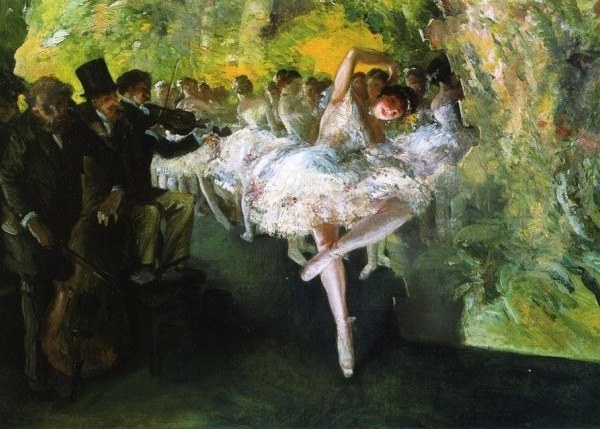
A ballet rehearsal in an interior studio, seen from a middle distance that places the viewer among observers rather than apart from the action. The composition centers on a single dancer in a white tutu, captured mid-movement with one leg extended and arms raised—the classic pose of a ballerina in flight or balance. She is spotlit by warm, diffuse light from above left that models her figure and costume. Around her stand several figures in dark formal dress—men in top hats and jackets—who appear to be watching intently. The setting is spare: a pale green or cream wall behind, suggesting a studio or rehearsal space rather than a theater. The brushwork is loose and impressionistic, with warm yellows and greens dominating the upper portion and deeper greens and shadows below, creating a sense of stage lighting and theatrical atmosphere. The moment chosen is one of arrested motion: the dancer is held in an attitude or arabesque, the men frozen in watchful poses, which gives the scene a quality of suspension rather than narrative momentum.
The dancing
The central dancer is en pointe or in a lifted position, with her body elongated vertically and her arms raised in a classical port de bras. Her left leg is extended backward or to the side; the tutu extends in a full, voluminous skirt characteristic of Romantic-era ballet costume. The male observers stand in informal groupings, some with arms crossed or gesturing, suggesting critique or appreciation rather than participation. None of the standing figures adopt dance postures; they are witnesses and perhaps instructors or patrons. The physical relationship between dancer and observers is hierarchical—she is elevated, lit, and central; they are earthbound, shadowed, and peripheral.
The dance depicted
This is almost certainly a Classical or Romantic ballet rehearsal, given the pointe work, tutu, and the formal pedagogical setting. The presence of what appear to be male choreographers or ballet masters (identifiable by their top hats and dark dress) and the isolated female dancer suggest a private rehearsal or coaching session rather than a company performance. The painting documents the social and professional context of ballet in the early 1900s: a moment of instruction, refinement, or artistic judgment. The artist has chosen to emphasize the labor and scrutiny behind the stage illusion—the dancer is not performing for an audience but for experts whose gaze shapes her technique.
How it was made
This appears to be an oil painting on canvas, executed in a loose, Impressionist-influenced style that privileges light and color over precise line. The artist has used rapid brushstrokes and a warm, limited palette (creams, pale greens, golds, and deep shadows) to suggest the quality of stage or studio lighting rather than anatomical detail. The technique allows for a spontaneity and intimacy that more formal academic rendering would prevent; the viewer is drawn into a private, fleeting moment rather than presented with a finished spectacle. This approach was characteristic of early-20th-century American realism and its engagement with contemporary social scenes.
About this work
This is a studio scene documenting ballet rehearsal in the early 1900s, a subject that appealed to progressive American artists interested in modern life and the behind-the-scenes labor of the arts. The painting captures not a performance but a moment of critique and instruction, in which a solitary dancer in classical costume is observed and evaluated by formally dressed men. The composition and technique—impressionistic, intimate, centered on the play of light—distance it from academic history painting and align it with the realist and modernist currents of its era. For historians of dance, it is valuable as visual evidence of how ballet was taught, watched, and valued in the early 20th century, and of the gendered dynamics of the rehearsal room.
How to look at it
Attend first to the isolation and verticality of the dancer's figure and to her arrested motion—the painting captures a moment of suspension rather than flow, which is appropriate to the instruction and critique implicit in the scene. Notice the contrast between her illumination and the shadows that surround her and the watching men; this compositional choice emphasizes her as the object of attention and judgment. Observe the loose handling of paint in the background and the more careful articulation of the dancer's body and costume, which directs the eye and implies the hierarchy of interest. The painting's impressionistic technique—its emphasis on atmosphere and light rather than narrative or anatomical precision—suggests that the artist's interest lies in capturing the quality of a moment of work rather than depicting a dramatic or finished scene.
The artist
Everett Shinn (1876–1953) was an American realist painter, illustrator, and printmaker associated with the Ashcan School and The Eight. He was known for paintings of urban scenes, theater, and social life, often executed with a loose, gestural brushwork derived from Impressionism. He frequently depicted backstage and rehearsal scenes—dancers, actors, circus performers—and had a documented interest in the ballet world, which he portrayed with both sympathy and a keen eye for the sociological dimensions of performance. His work combined reportorial observation with painterly sophistication.
The period
In the early 1900s, ballet in America was transitioning from a marginal, imported entertainment to an institutionalized art form with schools, companies, and critical attention. The Ballets Russes, founded in 1909, had recently revolutionized European ballet and was beginning to influence American practice. Simultaneously, American realist painters and writers were turning their attention to modern urban life and labor, including the lives of performers. The rehearsal room—a site of instruction, discipline, and gendered labor—became a subject of interest to artists documenting contemporary society. Shinn's painting sits at the intersection of these currents: it documents the pedagogical infrastructure of ballet while using a modernist pictorial language to suggest the ephemeral, intimate quality of the moment.
Where it lives
The work is documented as being from Wikimedia Commons, a digital repository of images in the public domain or under open licenses. No holding collection, accession number, or current location is recorded in the catalogue.
Dance in this work
Questions about this work
What is the dancer doing?
She is frozen in a classical pose—likely an arabesque or attitude—with one leg extended and arms raised. This is a moment of instruction or rehearsal, not a full choreographic phrase, so the pose itself (and the control it requires) is the content.
Who are the men watching?
They appear to be ballet masters, choreographers, or patrons—the professional observers whose judgment shapes the dancer's practice. Their formal dress and positioning as a group suggest authority and expertise.
Is this a real rehearsal or an imagined scene?
The artist has depicted a plausible and historically documented kind of scene—the private rehearsal or coaching session—but the painting is not a documentary record of a specific event. It is a genre scene, a type of social scenario rendered from observation and imagination.
Why is the painting so loosely painted?
The impressionistic technique emphasizes the transient quality of the moment and the play of light on the dancer's figure. This approach was fashionable among American realists in the early 1900s and suited to modern subjects like theater and rehearsal.
More dance artwork