2 works in this view — arrow keys or swipe to move between them.
Dance in Art
Temple Dancer
Unknown
- Dance:
- Swing
- Source:
- Victoria and Albert Museum
- Rights:
- Rights vary by item — check the source record before reusing this image. Source record ↗
- Recorded as:
- Check V&A creditLine
This carving reveals how 'the dancer' functioned as a cultural and erotic symbol in courtly and colonial contexts, often imagined and depicted by non-dancers according to conventions of luxury display rather than actual dance practice. It is a crucial example for understanding the gap between how dance was performed and how it was represented in the decorative and fine arts.
What you are looking at
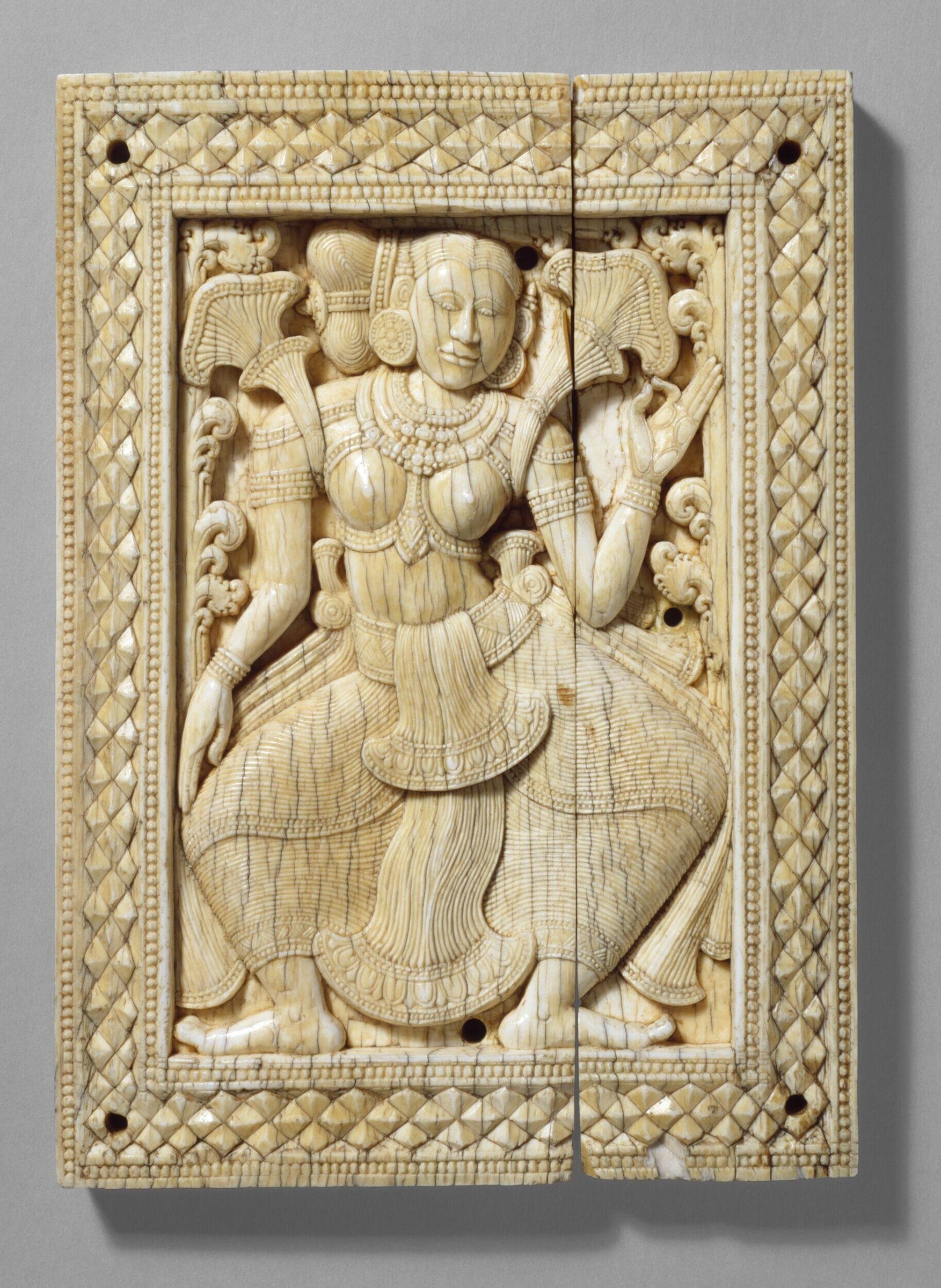
A carved ivory relief panel, split into two leaves hinged together, depicts a single female figure in opulent dress dominating the composition. She stands in a posed, frontal stance with her weight distributed across both feet, her body turned slightly to address the viewer directly. Her costume is extraordinarily detailed: a fitted bodice with geometric patterning, draped and layered skirts of tremendous volume arranged in precise, radiating pleats and folds that descend to her bare feet, multiple strands of pearl necklaces at her throat and across her chest, and an elaborate headdress with wing-like projections framing her face. Her arms are held high and outward in a graceful, open gesture. The figure is surrounded by scrollwork and foliate ornament, with two smaller attendant figures visible in the upper corners—one on each leaf—wearing similar but simpler dress. The entire composition is framed by a dense geometric border of quilted diamond patterns, suggesting wealth and refinement. The ivory has developed a warm, aged patina characteristic of centuries-old carved work.
The dancing
The primary figure presents an idealized female form with a small waist, broad hips, and an elongated neck—conventions of courtly feminine beauty. Her posture is erect and formal, neither weight-shifted nor dynamically moving; the arms rise from the shoulders in an open, welcoming pose rather than in any functional movement position. The two attendant figures flank the composition and appear static, serving as compositional balance rather than participants. This is a posture of display and presentation rather than active dance movement.
The dance depicted
The title 'Temple Dancer' suggests South Asian sacred or courtly dance tradition, likely referencing either Devadasi temple dancers or court entertainers from medieval India. However, the carving shows no evidence of active dance vocabulary—no weight transfer, no asymmetrical frame, no gesture indicative of classical Indian dance styles such as Bharatanatyam or Odissi. The figure is presented in formal court dress and posed for static display, which aligns more closely with courtly presentation or ceremonial portraiture than with documented temple dance practice. The pose and costume suggest this may be an imagined or theatrical interpretation rather than documentation of actual dance movement.
How it was made
This is a relief carving in ivory, a technique that requires subtracting material from a solid block to create dimensional forms. The two-panel format with hinge holes indicates it was a portable object, possibly a mirror back, game box, or devotional panel—common forms for elaborately carved Indian ivories from the 16th–18th centuries. Ivory carving demands extraordinary patience and technical precision; the fine linear details of the costume's patterning and the delicate foliate borders visible here would have required specialized tools and deep training. Such objects circulated as luxury trade goods and prestige items among European and Asian courts and collectors, reaching collections through colonial acquisition.
About this work
This ivory relief carving presents a richly dressed female figure in a formal, posed stance, titled as a temple dancer but rendered in the idiom of courtly portraiture rather than active dance documentation. The work exemplifies the decorative carving traditions of South Asia, likely created between the 16th and 18th centuries for a wealthy or royal patron. The figure's elaborate costume, including pleated skirts, pearl ornaments, and intricate headdress, speaks to courtly or sacred ritual contexts, though the static, frontal presentation prioritizes visual splendor and social status over movement vocabulary.
The work is significant not as documentation of authentic temple dance practice, but as evidence of how dance, dancers, and dancer-like figures were imagined and represented in luxury arts. It reflects the encounter between European artistic collecting traditions and Asian artistic production, and the romanticization or reinterpretation of dance forms through media and styles serving non-dance purposes.
How to look at it
Observe how the carver has prioritized costume and ornament over bodily movement: the drapery is meticulously articulated, the jewelry rendered in precise detail, the face given gentle idealization, yet the pose is entirely static and frontal. Notice the proportions—a corseted waist and accentuated hips that reflect courtly beauty ideals rather than the flexible, powerful lower body of an actual dancer. The scrollwork and attendant figures serve to frame and elevate the figure as an object of visual devotion or luxury consumption rather than as an agent of movement or narrative action.
The artist
Unknown. The work is characteristic of South Asian ivory carving traditions, likely produced in India (possibly Lucknow, Delhi, or Goa regions, which were centers of courtly carving). The technical skill and materials suggest a trained workshop specializing in luxury goods for elite patrons.
The period
South Asian courtly and temple dance traditions were vibrant during the medieval and early modern periods (12th–18th centuries), encompassing temple devadasi practice, court entertainment, and ritual dance associated with Hindu and Muslim courts. Simultaneously, European collecting of 'exotic' carved objects intensified during the colonial period. This carving reflects the intersection of these histories: Indian carving traditions meeting European appetite for precious and ornamental representations of the 'Orient.' The static, decorative treatment of the figure is aligned with European neoclassical and rococo aesthetics of the 18th century, even if the costume references South Asian dress.
Where it lives
The record indicates the work is held in the Victoria and Albert Museum collection. The museum holds one of the world's largest collections of Indian decorative arts, including many ivory carvings acquired during and after the British colonial period in India.
Dance in this work
Questions about this work
Did temple dancers really look like this?
Not necessarily in this static, posed way. Devadasi dancers were trained performers with sophisticated movement vocabularies and ritual roles. This carving represents an imagined, decorative version created for a different purpose—to display wealth and artistic skill through the ornamental rendering of an idealized female figure. The actual dancers' bodies, training, and performance contexts were likely quite different.
Is this carved from a single piece of ivory?
The work appears to consist of two carved panels hinged together, as indicated by the visible hinge holes. Each panel would have been carved separately and then joined, a common construction method for portable luxury objects.
How old is this?
The catalogue record does not provide a date. Based on the style of carving, the costume details, and the hinge construction, it likely dates to the 16th–18th century, produced in an Indian workshop, though this would require expert examination to confirm.
Why is it in a museum about dance if it's not really showing a dancer?
Because it tells us something important about how dance and dancers have been imagined and represented in visual culture—often through the lens of luxury, exoticism, and desire rather than through documentation of actual movement or practice. Understanding these representations is part of understanding the full history of dance.
More Swing artwork