2 works in this view — arrow keys or swipe to move between them.
Dance in Art
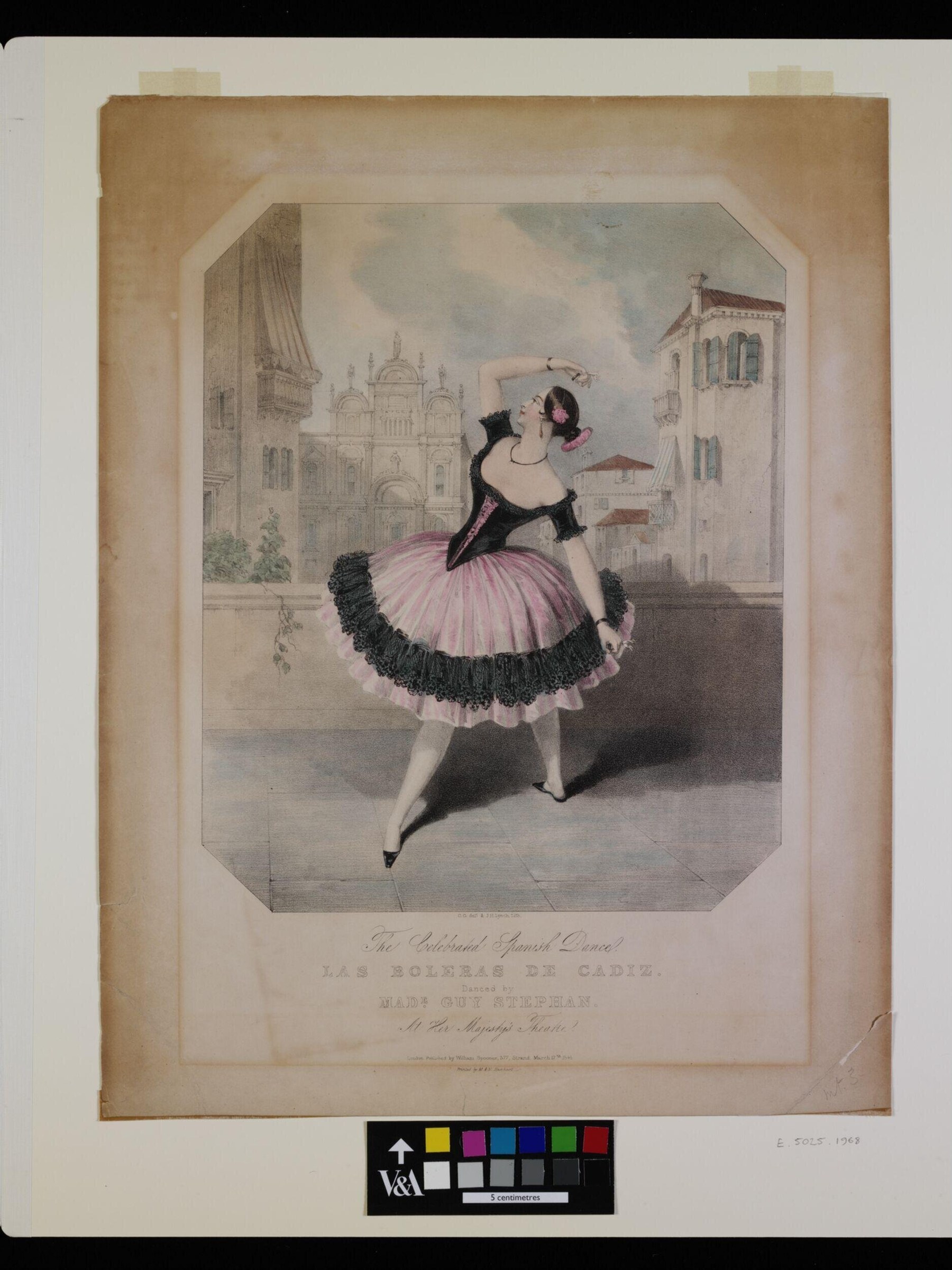
'The Celebrated Spanish Dance. / LAS BOLERAS DE CADIZ. / Danced by / MADE GUY STEPHAN. / At Her Majesty's Theatre.
Graf, C.
- Dance:
- Swing
- Era:
- Mid 1800s (Polka Era)
- Source:
- Victoria and Albert Museum
- Rights:
- Rights vary by item — check the source record before reusing this image. Source record ↗
- Recorded as:
- Check V&A creditLine
This work documents the 19th-century theatrical appropriation and aestheticization of Spanish regional dance, showing how the boleras were reimagined through the lens of Romantic ballet conventions for European consumption. For dance historians, it is evidence of both the circulation of Spanish dance on the London stage and the process by which living, social dances were converted into spectacular, virtuosic theatre pieces.
What you are looking at
A young female dancer in theatrical costume stands alone on a sunlit plaza before a grand cathedral with multiple domes and spires. She is caught mid-movement in a balletic pose, her body angled away from the viewer, left leg extended in an arabesque or similar elevation. The architectural setting—likely meant to evoke Cadiz or another Spanish city—recedes in soft focus behind her, with period buildings flanking the plaza. The print is hand-coloured, with delicate washes rendering the sky and stone in pale greys and ochres. Strong light falls from the upper left, casting gentle shadows and giving the scene a theatrical, stage-like quality despite the outdoor setting. The composition isolates the dancer as the sole active figure, emphasizing the spectacle of her body and costume.
The dancing
The dancer stands in a single, highly formalized pose rather than captured mid-stride. Her torso is upright and turned; her left leg extends behind her in a high, pointed line; her right leg appears to support her full weight en relevé or on demi-pointe. Her arms are positioned with studied grace—the raised arm holding a parasol, the other curved downward. The pose is elongated and balletic, emphasizing turnout and verticality. There is no partner, no interaction with an ensemble; the figure is presented as an isolated spectacle of trained body and virtuosity.
The dance depicted
The title names this as *Las Boleras de Cadiz*, a Spanish regional dance form, but the pose and framing suggest theatrical interpretation rather than authentic folk practice. The bolero and boleras are rooted in Spanish popular dance, but their representation in 19th-century European theatre—especially in London's West End venues—typically involved significant stylization. This print advertises the performance of 'Made Guy Stephan' (likely a stage name or professional pseudonym) at Her Majesty's Theatre, London. The hyper-refined balletic pose suggests the dance was presented as an exotic theatrical spectacle for a London audience, filtered through the aesthetic conventions of Romantic ballet rather than depicted as social or regional practice. The specific steps or rhythmic character of the boleras cannot be discerned from the pose alone.
How it was made
This is a hand-coloured lithograph or engraved print (the catalogue does not specify, but the technique appears to be lithography based on the tonal gradations and the character of the line). The base image has been printed and then carefully coloured by hand—evident in the delicate pink of the skirt, the deep black of the bodice and lace trim, and the subtle grey washes of the architecture. This technique allowed for relatively economical mass production and wide circulation among London theatre-goers as a souvenir or advertisement. The soft, romantic aesthetic of hand-tinting was typical of theatrical prints of the 1840s, conveying an air of refinement and desirability suited to a West End audience.
About this work
This is a theatrical print advertising a performance of Spanish regional dance at a London venue in 1844. The dancer is presented as a virtuoso soloist in a highly formalized, balletically inflected pose, holding a parasol and wearing an elaborate costume of pink silk trimmed with black lace. The image is not a documentary record of how the boleras were danced in Spain, but rather a commercial and artistic object advertising theatrical exoticism and feminine spectacle to London's middle-class audiences. It belongs in a history of dance because it shows how European theatres transformed non-European and regional dance forms into Romantic-era entertainment, and because it preserves a moment in the long history of Spanish dance on the English stage.
How to look at it
Observe the extreme refinement and elongation of the pose: the body is presented as a sculptural object rather than as a dancer in motion. The balletic verticality and the extended leg position signal to a London audience that this is a trained, theatrical body—not a folk dancer, but a virtuosa. The parasol, though named in the title as an element of the boleras tradition, is rendered here as an accessory of fashionable leisure, adding to the sense of exoticized spectacle. The architectural backdrop is decorative and historically vague; what matters is not accuracy but the suggestion of 'Spain' as a romantic elsewhere.
The artist
The artist is listed as 'Graf, C.' The print is dated 1844 and was likely produced as a commercial theatrical souvenir. The hand-colouring and soft romantic aesthetic are typical of London theatrical prints of the period; the artist may have been a theatre-print specialist or lithographer working in London's print trade.
The period
The 1840s were the height of the Romantic ballet era in Europe, when exotic and regional dances were fashionable subjects for theatrical performance and visual representation. Spanish themes—boleros, fandangos, and other regional dances—were particularly popular in London and Paris, appealing to contemporary taste for orientalism, regionalism, and the picturesque. The representation of female dancers in virtuosic solo poses became the dominant mode of theatrical advertising and souvenir production. At the same time, this period saw increasing theatrical professionalization and the emergence of the international star system, in which individual dancers like 'Made Guy Stephan' would tour across European capitals.
Where it lives
The work is held in the Victoria and Albert Museum collection. It was likely produced as a commercial print sold to theatre audiences during or after the performance at Her Majesty's Theatre, London. The museum's accession information suggests it is classified under theatrical prints and dance imagery.
Dance in this work
Questions about this work
What are the boleras, and is this an accurate representation?
The boleras are a Spanish regional dance form with roots in popular and folk traditions, typically performed in couples or groups. This print does not depict authentic boleras practice, but rather a highly theatricalized and balletically refined version adapted for London audiences. The soloist pose, the extreme elongation of the body, and the focus on virtuosic display are products of 1840s Romantic-era theatrical convention.
Who was Made Guy Stephan, and what else do we know about this performance?
The catalogue record provides only the performer's name and the venue—Her Majesty's Theatre, London. No other records of this specific performance have been identified. 'Made Guy Stephan' may be a stage name or a professional pseudonym; the name does not appear to be well documented in surviving theatre records.
Why is the dancer holding a parasol?
The parasol is both a costume element associated with Spanish regional dress and a fashionable accessory of 19th-century urban leisure. In this image, it serves to emphasize the dancer's status as a spectacle—a beautified object for viewing—while also anchoring the pose and adding compositional interest.
Why would this dance have been fashionable in London in 1844?
Spanish themes were hugely popular in Romantic-era Europe, feeding contemporary appetite for exoticism and regionalism. London theatres regularly presented Spanish dances, and they appeared in ballet and theatrical divertissements. The Spanish dancer became an archetype of the Romantic period, associated with passion, grace, and a picturesque 'otherness' appealing to European audiences.
More Swing artwork