49 works in this view — arrow keys or swipe to move between them.
Dance in Art
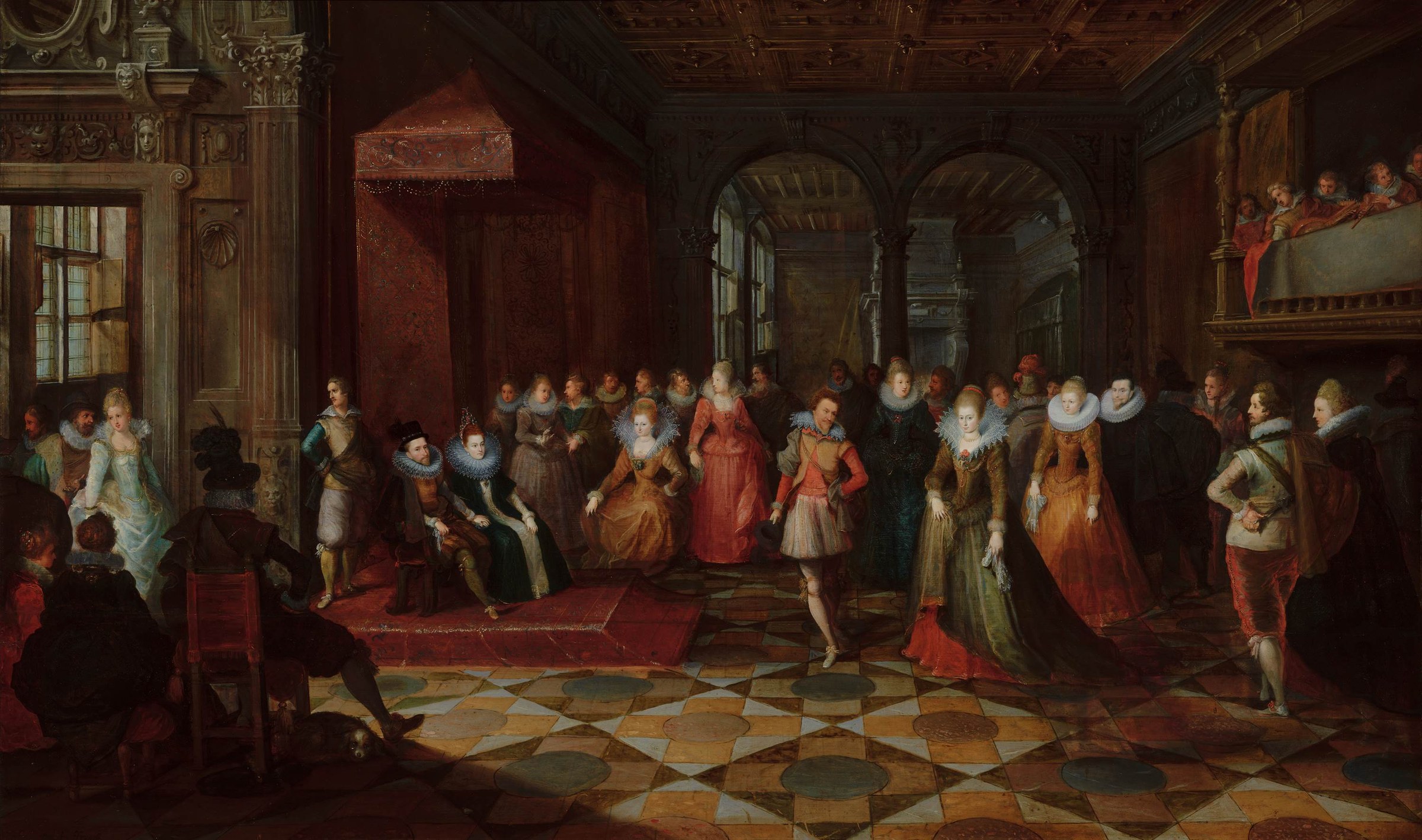
Ballroom Scene at a Court in Brussels label QS:Lnl,"Bal aan een Brussels hof"label QS:Len,"Ballroom Scene at a Court in Brussels"
Frans Francken the Younger / Paul Vredeman de Vries
- Source:
- Wikimedia Commons
- Rights:
- Public domain — free to use, share and adapt.
- Recorded as:
- public_domain
Court paintings of this kind are among the only surviving visual evidence of how court dances were actually performed—the posture, the pace, the dress, the spatial arrangement. Dance historians cannot rely on written notation alone; they need to see, and this painting shows what a pavane or almain looked like in practice. The geometric precision of the floor and the careful positioning of the dancers also demonstrates that early 17th-century court dance was already highly choreographed and spatially sophisticated, not improvised or casual.
What you are looking at
A formal court ball in a Renaissance or early Baroque palace, captured in the moment of greatest pageantry. The scene is dominated by a geometric floor of ochre, cream, and slate tiles arranged in a complex star pattern, which anchors and spatializes the composition. The architectural setting is grand: a coffered wooden ceiling spans the space, while classical columns with composite capitals frame two deep arches that recede into shadow, suggesting further chambers beyond. The walls are a deep oxblood red, hung with tapestries or cloth, and a high window on the left admits natural light. Approximately 40–50 figures fill the space—nobility and courtiers in extraordinary dress, arranged in a loose processional or dance formation along the floor's central axis. The palette is rich and somber: deep reds, blacks, and golds in the clothing and setting, with bright highlights of white linen at the necklines and cuffs. The lighting is subtle, with pools of warmer tone in the center and deeper shadow toward the rear, creating an effect of candlelit formality. The mood is one of stately ceremony, not festive exuberance; every figure is composed and aware of being observed.
The dancing
Most figures stand upright and still, arranged in rank along the floor or in small clusters. Several pairs in the central foreground appear to be in motion: at least two couples are visible in what looks like a closed or near-closed ballroom hold, with bodies upright, arms extended, and torsos aligned. The nearest couple to the center show a woman in a deep red gown with her body slightly turned, the man in dark clothing beside her. Their positioning suggests a gliding or processional step rather than any rapid footwork. Many of the watching figures—especially women—hold their arms at the side or slightly forward, palms often visible. The dress itself shapes the movement: the voluminous skirts of the women, weighted with fabric and stiffened by structure underneath, would permit only flowing, measured steps. No high kicks, no arm raising, no visible bounce or elevation in any of the bodies.
The dance depicted
This depicts a formal court dance of the early 17th century, most likely a pavane, almain, or slow courante—dances built on processional, gliding steps and the display of rank and dress rather than technical virtuosity. The dance is not a social free-for-all but a choreographed or at least formally structured affair: the arrangement of figures, the careful spacing, and the formality of dress all point to a court ballet or ceremonial dance. The presence of spectating nobility arranged as if in a receiving line, the architectural framing, and the description in the record naming the archduke and archduchess suggest this is a ball held under royal patronage, possibly one at which the named couple (Philips Willem and Éléonore) led a dance as a gesture of alliance or courtesy. The dance is about presence and propriety, not virtuosity.
How it was made
This is a panel painting, likely oil on wood or possibly oil on canvas, executed in the manner of Flemish court painting of the early 1600s. The technique is meticulous: the artist has layered transparent glazes to build depth, especially in the recessive architecture and in the shadow areas of the room. The geometric floor is painted with great care and precision, creating a rational, measured visual anchor for the chaotic arrangement of figures. The finish is smooth and the detail dense—every figure has its own costume recorded, every architectural molding rendered. This is not a sketch but a finished commission, likely produced for display in a court or noble collection. The style allowed for narrative complexity (many figures in one scene) while maintaining the optical realism that made it persuasive as a historical record.
About this work
This painting documents a formal court ball in early 17th-century Brussels, showing the aristocracy engaged in the choreographed dances that were central to court culture. It is a rare visual record of how these dances looked in practice—not how dancing masters drew them in manuals, but how they were actually performed in a palace setting, with real bodies in real clothes moving across a real floor. The work belongs to the tradition of court painting that treated dance as a subject of state ceremony: not entertainment, but proof of rank, alliance, and civilized order. The composition suggests that the artist (Frans Francken the Younger and/or Paul Vredeman de Vries, both active in the Southern Netherlands) was documenting a specific event of diplomatic or dynastic importance, and in doing so produced a portrait of a moment in the history of European dance.
How to look at it
Observe the floor: the geometric pattern is not decorative but functional—it helped dancers remember and execute the paths and positions of the choreography. Watch the central couples: their closed or near-closed positioning and upright carriage are diagnostic of pavane or almain technique. Notice the absolute stillness of the watching figures—this is not a spontaneous party but a formal ceremony in which most of the nobility are spectators or waiting their turn. The artist has frozen the moment of greatest formality, not in the middle of an energetic passage, but at a pause or processional moment when all the bodies are aligned and the architecture frames them like a stage. This is a portrait of order.
The artist
Frans Francken the Younger (1581–1642) was a leading painter of court and festive scenes in the Southern Netherlands, based in Antwerp. He specialized in densely populated interior scenes of pageantry, ceremony, and revelry, often commissioned by the Spanish court or Antwerp nobility. Paul Vredeman de Vries (1527–1607, though he lived into his eighties, this is likely his son or a later member of the family active in 1610) was an architect and painter, and the son of a celebrated court architect. Works attributed to both artists or their workshops often depict balls, banquets, and ceremonies. The style—the architectural precision, the massed figures, the rich color—is characteristic of Antwerp painting of this period.
The period
In the early 1600s, court dance in the Spanish Netherlands (modern Belgium) and at the Habsburg courts was at a peak of formal refinement. The pavane and almain were the dominant dances, and a mastery of them was essential to courtly status. The court of the Archdukes Albert and Isabella, who ruled the Spanish Netherlands from 1598, was a center of courtly life and artistic patronage. Court paintings documenting balls served dual purposes: they were records of historical events (especially when they depicted named individuals or marriages) and they were art objects that demonstrated the patron's sophistication and rank. The composition and style of this work—its architectural grandeur, its massed figures, its precision—reflect the influence of Italian Renaissance court painting, mediated through Antwerp.
Where it lives
The work is attributed to Frans Francken the Younger and Paul Vredeman de Vries on the basis of style and is held in a collection or reproduced from a source whose current holding is not recorded in the catalogue. It is known through Wikimedia Commons.
Dance in this work
Questions about this work
What dance are they doing?
Almost certainly a pavane or almain—stately, processional dances in which couples moved in a gliding step and the emphasis was on dress, rank, and formation rather than footwork. The upright posture, closed hold, and slow pace visible in the painting are all consistent with these dances. The painting does not show the kind of athletic or rapid movement that other dances of the period (like the galliard) would have required.
Who were Philips Willem and Éléonore?
Philips Willem of Orange-Nassau (1554–1618) was a noble of the House of Orange and a figure in the politics of the Spanish Netherlands. Éléonore de Bourbon (1587–1619) was a French princess. According to the painting's record, they are shown dancing at a ball held by the Archdukes Albert and Isabella, the Spanish Habsburg rulers of the Low Countries. The painting may commemorate a diplomatic or dynastic occasion.
Is this a real event or imagined?
The presence of named, identifiable figures (the Archdukes, the named couple) and the specificity of the architectural setting suggest this is a real event, or at least a painting commissioned to record or commemorate one. However, the artist may have taken liberties with the exact arrangement of figures and the precise decor. The painting is a historical document, but not a photographic one.
How do we know these are court dances and not something else?
The setting (a palace interior), the dress (expensive, formal, contemporary with c. 1610), the composed posture of the dancers, and the presence of spectating nobility all mark this as a formal court ball. The dances performed at court in this period were taught, choreographed, and learned from dance manuals. The technique visible in the painting—the closed hold, the upright carriage, the absence of vigorous footwork—matches the prescriptions of contemporary dance manuals.
More dance artwork





