49 works in this view — arrow keys or swipe to move between them.
Dance in Art
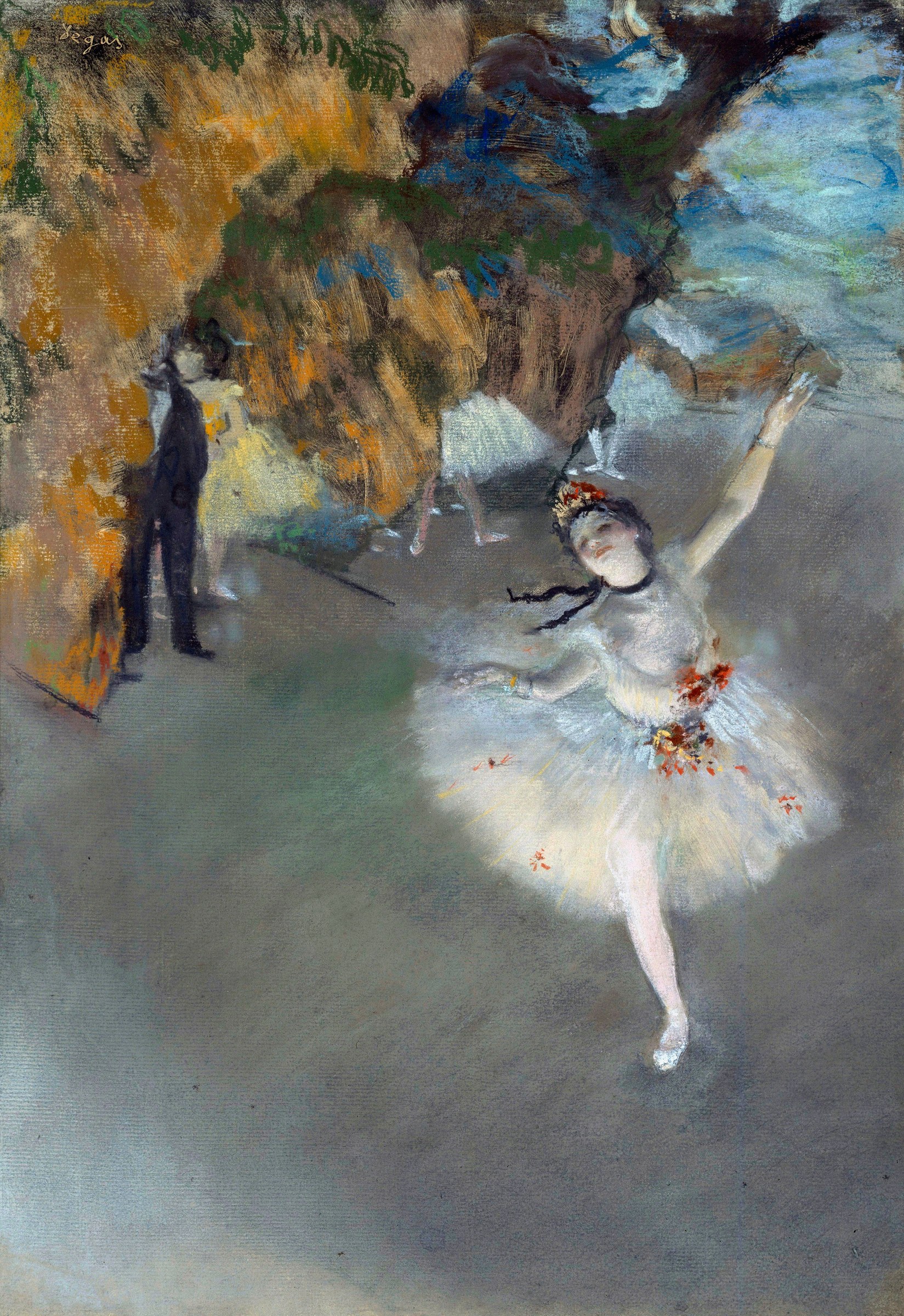
Ballet / The Star / Dancer on the Stage, 1876–1877. Dancer: Rosita Mauri.
Edgar Degas
- Source:
- Wikimedia Commons
- Rights:
- Public domain — free to use, share and adapt.
- Recorded as:
- public_domain
This image documents how one of the greatest painters of the era understood and represented the ballet body—the illusion of weightlessness, the technical precision, the theatrical spectacle. For dance historians, it is crucial evidence of how Romantic ballet technique and aesthetics were perceived and represented by contemporary visual artists. For art historians, it is a key example of how theatrical subjects entered the high art tradition in the later 19th century.
What you are looking at
A ballet dancer in a white tutu dominates the lower right of the composition, captured mid-performance in a pose of ethereal abandon. Her body is arched, one arm raised in a sweeping gesture, her head tilted back, her posture suggesting the peak of a movement—perhaps a développé or arabesque moment. She wears a white tutu with red or orange flowers adorning the bodice and scattered across the skirt. Her hair is styled up with what appears to be a floral crown or ornament. The stage floor beneath her is rendered in soft grays and greens. To the left, the scenery—painted rocks or cliff faces in ochre and golden tones with blue accents suggesting water or sky—recedes upward. In the background middle distance, two or three dark-clad figures (male, presumably musicians or other performers) stand near the painted backdrop. The lighting is soft and diffuse, with warm tones in the upper left contrasting with the cooler grays of the stage floor. The overall effect is one of theatrical illusion: the dancer seems to levitate above the stage, suspended in a moment of pure performance.
The dancing
The principal dancer's body is extended and weightless, with her torso arched backward, her raised arm sweeping upward in a classical port de bras. Her supporting leg is not clearly visible, but her extended leg and the tilt of her pelvis suggest the balletic vocabulary of Romantic-era technique. Her frame is characteristically balletic: elongated, turned out, ethereal. The background figures are sketched rather than rendered, their dark clothing and stillness marking them as ancillary to the dancer's radiance. The contrast between the precise articulation of the principal dancer and the loose handling of the supporting cast is deliberate—it enforces the hierarchy of the theatrical moment.
The dance depicted
This is unambiguously a Romantic ballet scene. The tutu, the ethereal pose, the theatrical lighting, and the stage setting all confirm this. The painting is identified in the catalogue record as depicting the role of Rosita Mauri, and the work is dated 1876–1877, placing it firmly within the Romantic ballet tradition as it was practiced in the Paris Opéra. The dancer's pose suggests a moment of apparent weightlessness or levitation characteristic of the Romantic ideal—the ballerina suspended above the stage, seemingly defying gravity. The flowers in her costume may reference a specific role (possibly from a ballet with a floral or garden theme), though the iconography is not immediately certain. The technical vocabulary visible—the extension, the port de bras, the ethereal quality of the pose—aligns with the Cecchetti and Vaganova-influenced classical training of the late 19th century.
How it was made
This is a work in pastel or mixed media on paper or canvas. The soft, luminous quality of the surface, the way color is blended and layered, and the visible brushwork all suggest pastel as the primary medium. Pastel allowed the artist to achieve the delicate chromatic transitions and the diffuse light effects that are central to the image's effect—the soft dissolving of forms in the background, the shimmer of the tutu, the luminosity of the dancer's skin against the darker stage. The technique is characteristically Impressionistic in its handling of light and atmosphere, even though the subject matter is decidedly academic and theatrical. This medium and approach would have made the work valued as a finished salon piece, suitable for exhibition and collection by the affluent patrons of the Paris Opéra.
About this work
This is a pastel study of a moment in a Romantic ballet performance, capturing the dancer Rosita Mauri suspended in an attitude of weightless grace. The work exemplifies the late 19th-century fascination with the ballet as a subject for visual art—a fascination that drew artists of the highest rank to the backstage and stage of the Paris Opéra. The painting is part of a long tradition of ballet imagery in European art, from Baroque court spectacles to modern dance photography; it also belongs to a more specific moment in French art history, when Impressionist and post-Impressionist painters were drawn to the theater as a subject of modern life. The work sits at the intersection of two aesthetic worlds: the academic ballet tradition on stage, and the avant-garde visual art tradition in the studio.
How to look at it
Look first at the dancer's pose: the arch of her back, the lift of her arm, the angle of her head. This is the apotheosis moment that Romantic ballet offered—the illusion of weightlessness and otherworldly grace. Note how the artist has rendered her with precision and luminosity, while the surrounding world (the painted scenery, the background figures) is treated more loosely and sketchily. This creates a visual hierarchy that mirrors the theatrical hierarchy: the principal dancer is the center of attention and the center of visual clarity. Also observe the color: the white tutu is not pure white but is modulated with grays, yellows, and touches of cool tone, giving it volume and substance even as it reads as ethereal. The flowers introduce a note of naturalism or narrative that the pure abstraction of the white tutu does not provide. Finally, note the vantage point: we are looking from the audience's perspective, from the orchestra or the lower boxes, which is where Degas would have sat when observing performances.
The artist
Edgar Degas (1834–1917) was obsessed with the ballet for nearly fifty years. He attended performances, sketched in the rehearsal rooms and wings of the Opéra, and produced hundreds of works on the subject—paintings, pastels, drawings, prints, and sculptures. His approach was not sentimental or reverential; rather, he brought an unflinching eye to the physicality of the dancers' bodies, the labor of training, and the theatrical machinery of performance. He knew the dancers personally, visited the studios, and had unprecedented access to the spaces of the ballet. His ballet works range from intimate sketches to large exhibition pieces, and they encompass both the idealized moments of performance and the unglamorous realities of rehearsal and physical strain. This work, a finished pastel, represents one of the moments in which Degas allowed the theatrical illusion to remain intact, showing the dancer as she appeared to the audience rather than as she appeared to his own skeptical eye.
The period
In the 1870s, the Romantic ballet had already passed its zenith (the Romantic era proper is dated to roughly 1830–1850), but Romantic aesthetics and technique persisted in the Paris Opéra throughout the century. The 1870s–80s were a period of transition toward the classical ballet that would be codified in the Russian imperial theaters under Petipa and Ivanov. The Paris Opéra in the 1870s was still a center of Romantic tradition, even as new works incorporated more elaborate spectacle and technical display. Visually, Degas was working during the height of Impressionism, though he was never a full member of the Impressionist circle. His interest in the ballet coincided with the Impressionists' broader interest in modern life and leisure as fit subjects for high art. The theatrical subject—the ballet, the opera, the cafe concert—was a way for avant-garde artists to claim contemporary experience as the proper subject of serious painting.
Where it lives
The work is recorded in the catalogue as being dated 1876–1877, with Rosita Mauri identified as the dancer. The medium is not recorded in the catalogue, but visual examination suggests pastel. The current holding collection and specific accession information are not provided in the source record; the image is sourced from Wikimedia Commons, suggesting it may be in a public collection, though this is not confirmed here.
Dance in this work
Questions about this work
Who was Rosita Mauri?
Rosita Mauri (1850–1923) was a Spanish-Italian prima ballerina of the late 19th century, renowned for her technique and her roles in Romantic and transitional-era ballets. She danced extensively in the Paris Opéra and other major European houses. She was known for her virtuosity and her ability to embody the Romantic ideal, and she was a favorite subject of Degas and other painters of the era.
What is the dance in this painting?
The painting does not depict a specific named dance or ballet, but rather a moment in a Romantic ballet performance. The pose and costume are characteristic of late 19th-century ballet technique and aesthetics. The white tutu, the ethereal pose, and the theatrical setting are the markers of this tradition. Without more information about the specific ballet being performed, we cannot identify it by name, but we can identify it as Romantic ballet of the 1870s.
Why did Degas paint the ballet so often?
Degas was fascinated by the ballet as a subject of modern life, as a space of labor and artifice, and as a site where the human body was trained and displayed for aesthetic effect. He had unprecedented access to the rehearsal rooms and wings of the Opéra, which allowed him to observe dancers in all states—training, waiting, performing. The ballet offered him a way to explore the body in movement, the machinery of theatrical illusion, and the intersection of artifice and reality that were central to his artistic practice.
Is this a finished work or a sketch?
This appears to be a finished pastel, suitable for exhibition and sale. However, Degas often blurred the line between study and finished work. Many of his ballet pastels exist in multiple versions or states, and some works he considered studies were exhibited and sold as finished pieces. The luminosity and precision of this work suggest it was intended as a finished exhibition piece rather than a private study.
More dance artwork





