49 works in this view — arrow keys or swipe to move between them.
Dance in Art
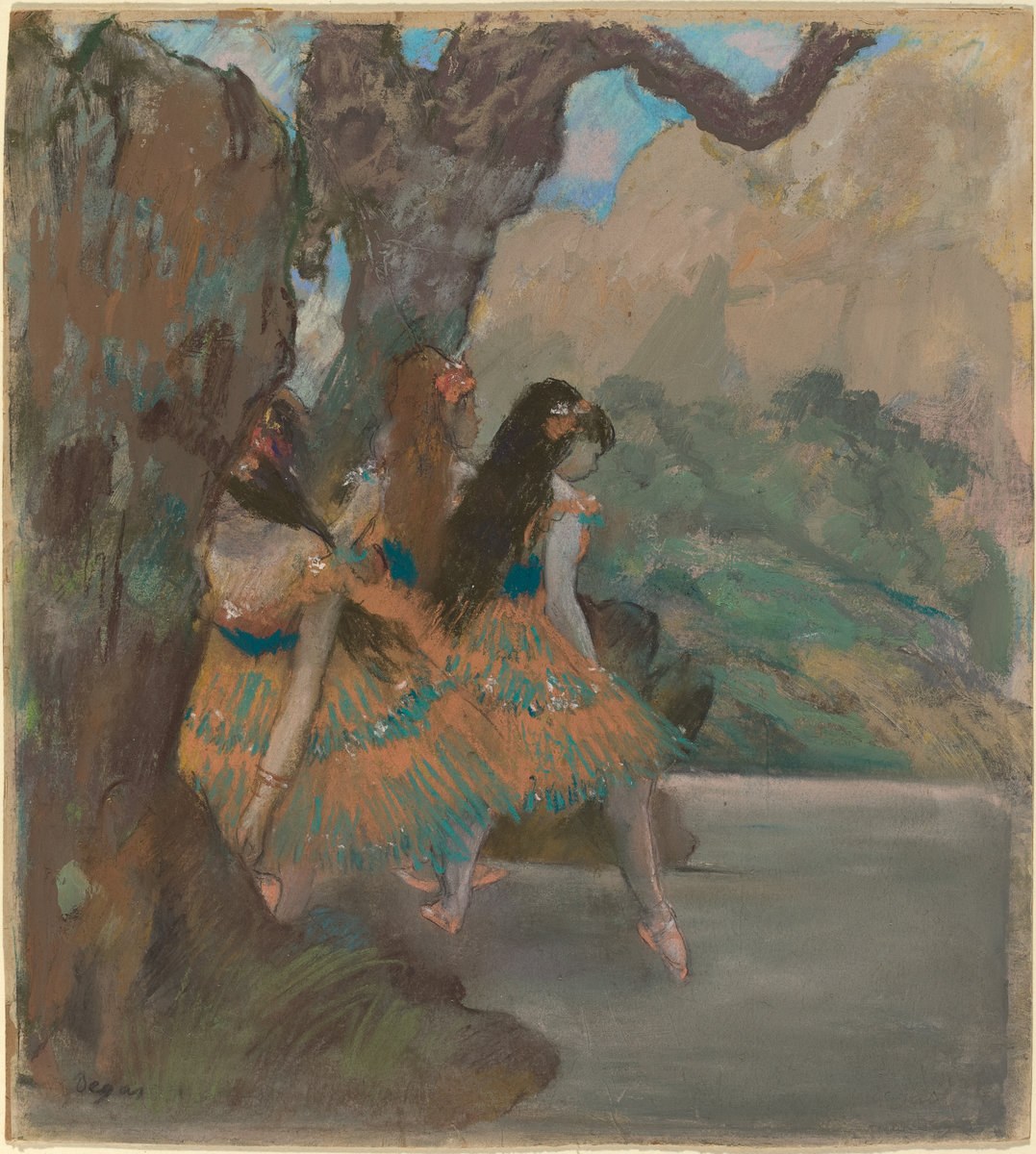
Degas - Ballet Dancers, c. 1877, 1970.17.27
Edgar Degas
- Source:
- Wikimedia Commons
- Rights:
- Reusable with conditions: credit the creator; share any adaptation under the same license. Source record ↗
- Recorded as:
- cc by-sa 4.0
This work documents a crucial moment in the history of how ballet was represented in art. Degas moved the subject of ballet away from grandiose stage scenes toward intimate, often unglamorous rehearsal moments, shifting the viewer's perspective from spectator to observer of the ballet world's daily reality. For dancers and historians, the image offers evidence of late-nineteenth-century ballet pedagogy, costuming, and the physical language of the Romantic era—how bodies were positioned, trained, and presented.
What you are looking at
Two ballet dancers in practice or rehearsal occupy the foreground of this pastel composition, positioned before a rocky overhang or cave-like natural setting. The dancer on the left wears a pale peach tutu with blue trim and orange-gold patterning, her dark hair pinned up; the dancer on the right, also in a similar tutu with peachy tones, turns away with her dark hair down her back. Both wear pointe shoes. Behind them, the landscape recedes into hazy atmospheric depth—pale ochres, greens, and blues suggesting either a backdrop or an outdoor setting that bleeds softly into the paper. The rocky formations above frame the scene with dramatic diagonal lines. The foreground shadow at the dancers' feet is rendered in grey-green. The overall effect is one of a moment caught in rehearsal or performance, lit from a warm, frontal light that picks out the tutus against the muted landscape.
The dancing
The left dancer stands in a prepared position, weight centered, arms raised in a soft port de bras. The right dancer is captured mid-turn or in an arabesque-like position, her body angled away from the viewer, weight shifted onto her supporting leg. Both dancers are on or very near pointe. The composition emphasizes the verticality and elongation of the ballet frame—straight spines, lifted chests, and controlled limbs. The spatial relationship suggests a rehearsal moment rather than a pas de deux; they are in proximity but not in direct partnered contact.
The dance depicted
This is a Romantic-era ballet scene, most likely depicting a moment from rehearsal or a solo variation performed in the mid-nineteenth-century theatrical idiom. The pale tutus, pointe shoes, and naturalistic landscape setting are consistent with Romantic ballet aesthetic around 1870–1880. The artists who documented ballet in this period were often capturing either stage performances or the studio practice that prepared them. The soft, diffused treatment of the background and the emphasis on the dancers' bodies and their ethereal positioning align with how Romantic ballet was conceptualized—weightless, otherworldly figures inhabiting a dream-like space.
How it was made
This is pastel and gouache over monotype, a technique that allowed Degas to build form and color in layers while retaining the fluidity of the monotype base. The monotype provides the underlying compositional structure and atmospheric depth, while pastel allows for precise rendering of the tutus' texture and the dancers' anatomical detail. This mixed-media approach was characteristic of Degas's method and allowed him to work quickly and revise, which was essential for capturing the fleeting moments of ballet practice. The technique produces a luminous, soft-edged quality that suits the subject matter.
About this work
This is a mid-nineteenth-century study of two ballet dancers in a studio or rehearsal space, rendered in pastel and gouache over monotype. Degas was the dominant painter of ballet life in the 1870s–1890s, and this work exemplifies his interest in the unglamorous, behind-the-scenes reality of ballet training and performance. The pale tutus and pointe shoes place it firmly within the Romantic ballet tradition, though the artist's analytical approach to the dancers' bodies—their posture, weight distribution, and spatial relationship—reveals a modern, almost scientific interest in human movement. The landscape setting is ambiguous; it may be a stage backdrop or may suggest an outdoor rehearsal, which adds to the dreamlike quality typical of Romantic ballet imagery.
How to look at it
Attend to the moment the artist chose to freeze: neither dancer is performing a grand, extended movement, but rather both are captured in a state of preparation or transition. The left dancer's raised arms and centered weight suggest a moment of gathering energy; the right dancer's turned body and shifted weight indicate a shift in direction. This is not the climax of an action, but the suspension between actions—a quality central to how Degas understood ballet. Notice also the soft, almost impressionistic handling of the landscape behind them; the rocks and sky are barely defined, allowing the dancers' bodies and tutus to be the primary focus. The color—warm peachy tones against cool grays and greens—creates a subtle vibration typical of pastel technique.
The artist
Edgar Degas (1834–1917) was a French Impressionist painter who became obsessed with ballet as a subject beginning in the 1870s. Unlike many of his contemporaries, Degas had access to the rehearsal studios and backstage areas of the Opéra in Paris, and he used this access to create hundreds of drawings, paintings, pastels, and prints depicting dancers in all contexts—performance, rehearsal, rest, and preparation. His approach was unsentimental and anatomically rigorous; he studied movement with scientific precision while capturing the grace and fragility of the form. Ballet was one of his primary subjects, and his representations have become iconic in the history of both dance and visual art.
The period
In the 1870s and 1880s, ballet in Paris was entering a transitional period. Romantic ballet, with its emphasis on ethereal, otherworldly female forms and naturalistic settings, was slowly giving way to more theatrical, formally structured productions. Degas's work captures this era at a moment when the aesthetics of Romantic ballet were still dominant—pale tutus, pointe work, sylph-like costuming—but his modern technique and unflinching gaze represented a new way of seeing dancers. Simultaneously, Impressionism was reshaping how artists approached light, color, and composition, and Degas applied these innovations to the ballet studio, treating it as a space of light and movement worthy of the same formal investigation as landscape or portraiture.
Where it lives
The work is recorded as part of the Ailsa Mellon Bruce Collection, a major gift to an American museum (likely the National Gallery of Art in Washington, D.C., based on the accession number format). The Bruce Collection is known for its strength in European Impressionist and Post-Impressionist works.
Dance in this work
Questions about this work
Is this a finished painting or a sketch?
This is a finished work in pastel and gouache over monotype—not a preliminary sketch. However, the technique and informal subject matter give it an immediacy that can feel sketch-like. Degas often worked in pastel precisely because it allowed him to capture movement and light with speed and freshness while still achieving finished, exhibition-quality results.
Are these two dancers performing together?
They appear to be in the same rehearsal space but not in direct partnered contact. The spatial arrangement and their independent poses suggest they may be working on separate variations or may be momentarily positioned near each other during a rehearsal session. This kind of overlapping, non-narrative arrangement was characteristic of Degas's composition.
What does the landscape setting mean?
The rocky, cavernous setting behind the dancers is most likely a painted stage backdrop rather than an actual outdoor location. Romantic ballet often used naturalistic scenery—grottoes, forests, moonlit gardens—and Degas frequently included these backdrops in his studio and stage scenes to indicate the theatrical context. The soft, undefined treatment of the backdrop emphasizes that it is a constructed environment.
How does this relate to Degas's other ballet works?
This is one of hundreds of works Degas created on ballet subjects. It exemplifies his mature style: pastel over monotype, two or more figures in a studio or stage setting, attention to the specific geometry of ballet positions, and a cool, observational approach to the subject. Like his other ballet works, it documents the physical reality of nineteenth-century dance training.
More dance artwork





