49 works in this view — arrow keys or swipe to move between them.
Dance in Art
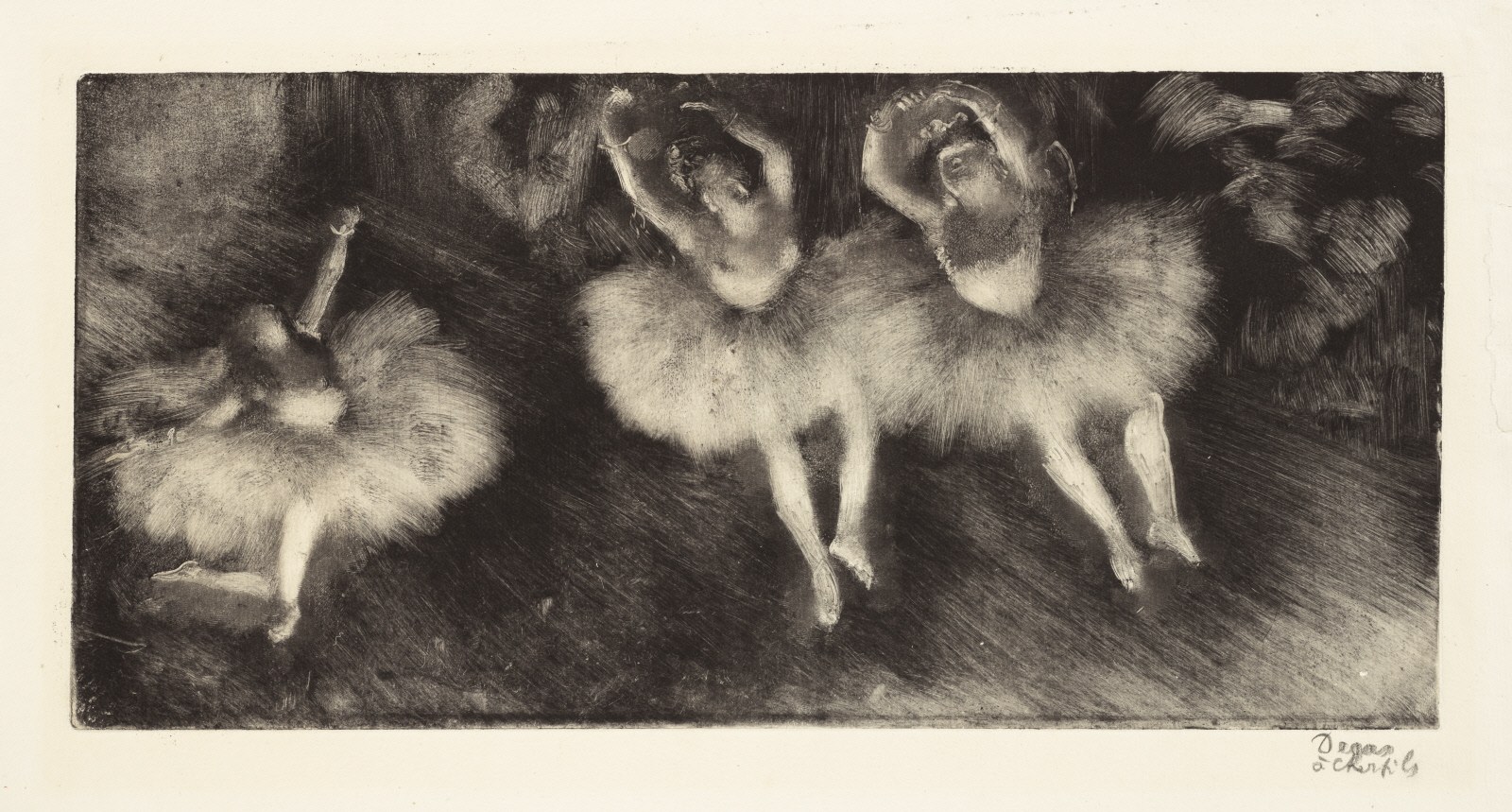
Degas - Three Ballet Dancers, 1955.1386
Edgar Degas
- Source:
- Wikimedia Commons
- Rights:
- Public domain — free to use, share and adapt.
- Recorded as:
- public_domain
This work shows a master printmaker's sustained interest in ballet across decades, but here focused on a moment of stillness and introspection rather than technical display. For dance historians, it documents the aesthetic priorities of Romantic ballet—verticality, symmetry, and emotional restraint—and shows how those values translated into visual form for an elite audience.
What you are looking at
Three female figures in classical dress occupy a dark, atmospheric stage or studio space rendered in dense cross-hatching. The leftmost figure stands in profile, one arm extended upward in an attitude of supplication or grace. The two central and right figures face forward with their heads tilted back and arms raised, their postures mirroring each other in a formal symmetry. All three wear tutus or skirts with visible volume and what appears to be bodices or corsetry. The background is a murky expanse of shadow and diagonal hatching that suggests depth without defining a specific setting. The composition reads as a moment of stillness rather than violent action—a tableau of repose or meditation within the dance.
The dancing
The three dancers occupy distinct spatial planes but are unified by verticality and upward-reaching arms. The two facing figures show an identical raised-arm geometry, suggesting either a choreographed unison or the artist's interest in formal repetition. Their necks are extended, heads back; this tilt is characteristic of Romantic ballet poses that emphasize line and vulnerability. The leftmost figure's single raised arm and profile stance suggest a different moment or variation. The tutus are rendered with sufficient weight and fold to indicate full skirts typical of mid-nineteenth-century ballet costume, not the gossamer tutus of later eras.
The dance depicted
This depicts Romantic ballet, almost certainly from the mid-nineteenth century based on costume and the artist's known practice. The poses—extended arms, tilted heads, verticality—are consistent with moments of repose or lyrical expression in works like *Giselle* or *La Sylphide*, where sylphs or spirits occupy a dreamlike register. The three-figure composition suggests either a corps de ballet moment or three soloists in parallel. The extreme restraint of action and the atmospheric rendering imply the artist was capturing not the virtuosity of movement but its emotional or metaphysical dimension—ballet as reverie rather than spectacle.
How it was made
This is an etching or drypoint on paper, executed in black ink with extensive cross-hatching to build tone and shadow. The technique is characteristic of printmaking rather than painting, which allowed for multiple impressions and wider circulation among collectors and artists. The hatching is particularly dense in the background, creating an immersive darkness that isolates the pale figures. The artist's control of the needle or burr is evident in the fine articulation of the dancers' anatomy and costume detail despite the overall atmospheric effect. This medium was favored for art-world circulation in the nineteenth century and suggests an audience of dealers, patrons, and fellow artists rather than the general public.
About this work
This is a Romantic-era ballet scene rendered in etching, capturing three female dancers in stillness and formal symmetry against a darkly shadowed background. The work demonstrates the artist's long engagement with ballet as a subject—not the mechanics of dance, but its emotional register and the formal beauty of the posed body. The etching technique, the choice of a moment of repose, and the careful construction of light and shadow all mark this as a work for connoisseurs, part of a tradition of printmaking that valued atmosphere and psychological suggestion over narrative clarity. It belongs in the gallery as evidence of how nineteenth-century visual artists understood ballet not as entertainment but as an occasion for exploring grace, formality, and the female body in space.
How to look at it
Attend first to the postures: the identical tilt of the two facing heads, the extension of the arms, and how this formal symmetry creates a sense of ritual or ceremony rather than narrative action. Notice how the artist has chosen a moment of absolute stillness—not a leap or turn, but a held pose. The atmospheric darkness is not background decoration but integral to the mood; it suggests a private or rehearsal space, or a dreamlike realm where these figures exist. The contrast between the pale, defined bodies and the shadowed void around them emphasizes their formal beauty and isolation.
The artist
Edgar Degas (1834–1917) was obsessed with ballet for nearly fifty years, producing paintings, pastels, drawings, and prints of dancers in studios, dressing rooms, and on stage. He studied movement obsessively, often from backstage vantage points, but was equally invested in the aesthetic and philosophical dimensions of dance—its geometry, its ephemeral beauty, its place in urban modernity. His prints are fewer than his paintings but equally refined; they represent moments when he sought to condense his observations into the austere language of line and tone. Late in his career, printmaking became a way to revisit earlier subjects with new technical sophistication.
The period
This work was created in the late nineteenth century, when Romantic ballet was already historicized—*Giselle* was forty years old by then. Degas was working in a period when ballet was shifting toward greater athleticism and spectacle under the influence of Russian Imperial aesthetics, yet he continued to find subjects in the Romantic repertory and in the quiet moments of rehearsal and rest that punctuated performance. Etching itself was experiencing a revival among fine artists in the 1870s–1890s, as printmakers sought to distinguish fine-art prints from commercial reproduction. His engagement with ballet was thus doubly archaic: a Romantic subject rendered in a refined, old-master technique.
Where it lives
The work is recorded in the Wikimedia Commons digital collection, which aggregates public-domain artworks from museums and institutional collections. The source does not specify the holding institution, but Degas's prints are widely held in major museums. The catalogue number 1955.1386 suggests a mid-twentieth-century accession.
Dance in this work
Questions about this work
Is this the same as Degas's famous ballet paintings?
No. This is an etching, a printmaking technique, whereas Degas's most famous ballet works are oil paintings and pastels. Prints allowed him to reach a different audience and to work in a different visual language—pure line and tone rather than color. The intimacy of the scene and the restraint of action are more typical of his later work, when he was increasingly interested in stillness and formal geometry.
Which ballet is this from?
It is difficult to say with certainty. The three-figure composition, the Romantic-era tutus, and the lyrical poses suggest a moment from a mid-nineteenth-century ballet like *Giselle*, *La Sylphide*, or *La Bayadère*, but the artist has abstracted away narrative detail. It may be a generalized image of Romantic ballet rather than an illustration of a specific scene.
Why are the dancers just standing still?
Degas was fascinated by the moments between movement—rehearsal, rest, the pause before action. This etching captures ballet as a formal, sculptural practice rather than as spectacle. The stillness emphasizes line, balance, and the geometry of the body, which were core to his artistic vision and to Romantic ballet aesthetics.
More dance artwork





