49 works in this view — arrow keys or swipe to move between them.
Dance in Art
Ballet Dancers on the Stage
Edgar Degas
- Source:
- Wikimedia Commons
- Rights:
- Public domain — free to use, share and adapt.
- Recorded as:
- public_domain
Degas was virtually alone among major visual artists of his era in treating ballet as a serious subject worthy of sustained investigation. His repeated, intimate images of dancers at work—not performing, but training, adjusting, resting—fundamentally shaped how audiences imagined the ballet and how dancers saw themselves. For dance historians, Degas provides an invaluable visual record of costume, studio practice, and body alignment in late 19th-century academic ballet.
What you are looking at
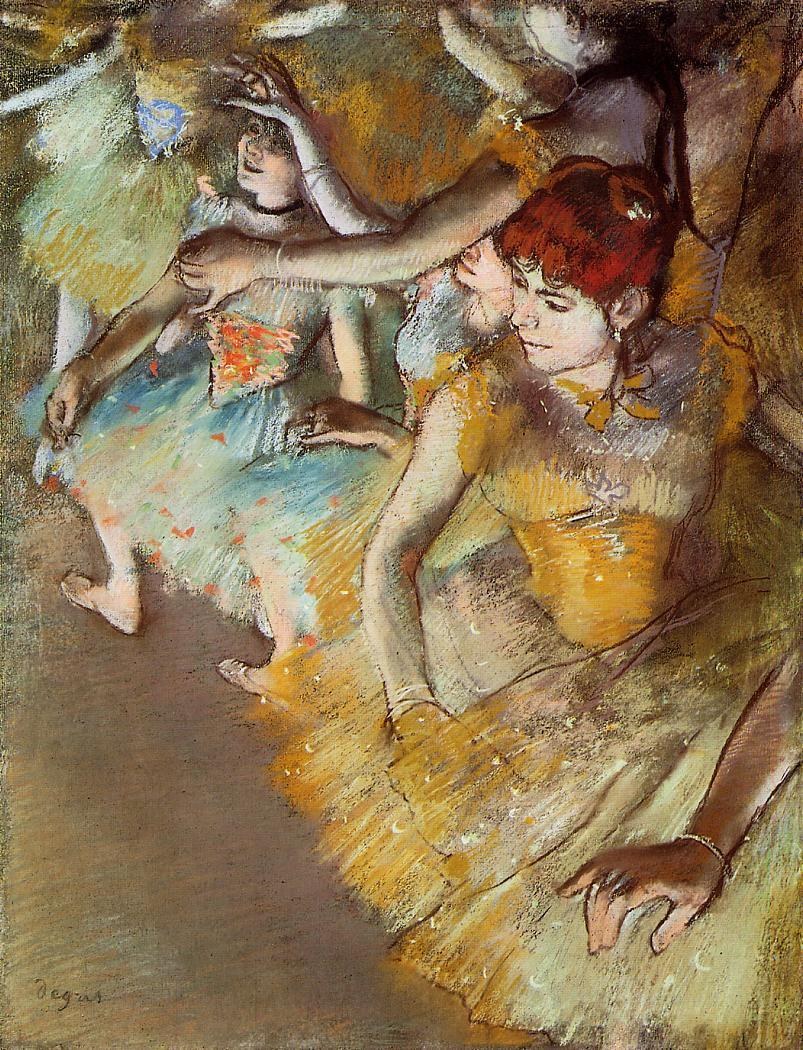
Three young female dancers in pastel tutus occupy a shadowy stage interior rendered in Degas's characteristic warm earth tones—ochre, tan, brown—with touches of pale blue and green. The figure at right, with reddish-blonde hair, sits or leans backward in a relaxed attitude, her yellow-green tutu splayed around her. At center-left, another dancer in a blue and coral tutu reaches upward with one arm in an extended arabesque or port de bras. A third figure at upper left, partially cropped by the composition, extends a leg upward with similar elegance. The floor beneath them is rendered in loose golden-brown strokes suggesting the stage floor or its lighting. The background dissolves into warm shadow punctuated by what may be scenery flats or drapery. The composition is decidedly asymmetrical and intimate—this is backstage or during a pause, not a formal performance moment.
The dancing
Three dancers in classical ballet positions: the central figure holds a clear port de bras with lifted arm and extended leg, suggesting an arabesque or écarté; her torso is upright and her weight controlled. The figure at right sits with one leg extended, the other bent—a relaxed but balletic posture. The cropped upper figure holds an extended leg lift. All three display the turned-out limbs and elongated line expected of trained ballet dancers. Their bodies show Degas's understanding of actual ballet technique: the lift in the torso, the placement of the limbs, the flow of movement rather than frozen pose.
The dance depicted
This depicts theatrical ballet in the academic tradition—almost certainly French ballet of the 1880s, given the style of tutu (the shorter tutu of the Romantic era giving way to fuller skirts), the stage setting, and the informal moment. The dancers are in class or rehearsal rather than performance; their poses suggest exercises (ports de bras, arabesques) rather than narrative action. Degas documented ballet obsessively from the 1870s onward, attending rehearsals at the Opéra and sketching dancers at work. This work shows his fascination with the unguarded moments of the profession: the strain, the waiting, the repetition of technique.
How it was made
The work is executed in pastel on paper, a medium Degas favored for its immediacy and luminosity—the soft, chalky pigment allows for rapid modeling of form and an almost atmospheric quality. Pastel suited his interest in light and color, especially the warm, artificial light of the stage. The technique is assured: he has built form through layering and blending, leaving areas of color visible beneath to create depth. Pastel was considered a sketch medium in the academic tradition, which meant works like this circulated among artists and collectors in Paris as semi-finished studies rather than grand exhibition pieces.
About this work
Edgar Degas created this pastel study of ballet dancers sometime around 1883, capturing three young dancers in a moment of rehearsal or rest on the stage of the Paris Opéra. The work exemplifies Degas's lifelong fascination with ballet as a subject: not the idealized spectacle of performance, but the lived practice of dancers—their bodies at work, their casual poses, the informal spaces where training happened. The composition is characteristically unconventional, with figures cropped and overlapped, and the viewpoint tilted to suggest immediacy and accident. In his hands, ballet became not a subject of romantic fantasy but a study in human form, light, and the physical discipline that underpinned the art.
How to look at it
Attend first to the postures: this is not a narrative moment but a study in classical positions and the body at rest. Notice how Degas has cropped the composition—figures are cut off at the edge, and the space tilts slightly, as if the viewer is moving through the space. The color is warm and intimate, nothing like the cool light of outdoor Impressionist painting. Look at the arabesques and ports de bras: the artist is showing knowledge of ballet vocabulary, but he is also interested in how these positions actually feel to the body—the weight, the strain, the momentary suspension. The unfinished quality of the work (some areas are more developed than others) is intentional, suggesting the fluidity of movement and the artist's rapid notation.
The artist
Edgar Degas (1834–1917) was a founder of Impressionism who focused obsessively on modern Paris: the racetrack, the café, the brothel, and above all the ballet. From the 1870s until the 1890s, he attended rehearsals at the Opéra, where he had connections and access. He made hundreds of drawings, pastels, and paintings of dancers—more than any other subject in his oeuvre. Unlike the Impressionists' focus on landscape and light, Degas was a draftsman first, interested in human movement and form. His treatment of ballet was unsentimental and anatomically acute, reflecting his academic training and his skepticism toward romantic ideals.
The period
In the 1880s, ballet in Paris was undergoing transition. The great age of Romantic ballet (1830–1870) had given way to a more eclectic period in which classical vocabulary coexisted with pantomime and spectacle. The Paris Opéra was the center of the art. Degas worked in this moment when ballet was being codified as a serious professional discipline with rigorous training. Artistically, his contemporaries in the avant-garde were moving toward abstraction and away from representation; Degas remained committed to the figure and to the close observation of actual life. His ballet works stand apart from mainstream Impressionism in their formality and their focus on the human body at work.
Where it lives
This work comes to us through Wikimedia Commons; the record notes no accession number, holding institution, or current location. It is a pastel on paper, a format typical of Degas's studio practice and private collection.
Dance in this work
Questions about this work
Is this a finished painting or a sketch?
In Degas's practice, the distinction is less clear than it might seem. He often worked in pastel as a fully realized medium rather than a preliminary step. While the work may not have been intended as an exhibition piece, it is a complete artistic statement—the loose handling and visible layering are deliberate choices that convey immediacy and movement.
Could Degas actually see ballet dancers in this much detail?
Yes. Degas had regular access to the Opéra rehearsal studios and was permitted to sketch from life. Dancers also posed for him in his studio. He combined observation with memory and drawing practice to create his works, much as any figure artist does.
Why did Degas paint ballet so often?
Degas saw ballet as a perfect subject for the study of human movement, form, and light. He was not interested in the narrative or the spectacle, but in the discipline of the body, the geometry of posture, and the play of artificial light on the stage. Ballet also offered him access to a world of working women—a social subject that fascinated him.
What ballet vocabulary is visible here?
The central figure holds an arabesque or écarté—a classical position in which one leg is extended backward or to the side. The port de bras (arm carriage) is lifted and open. These are fundamental positions taught in ballet classes to this day. The turned-out legs and elongated spine are hallmarks of classical training.
More dance artwork





