49 works in this view — arrow keys or swipe to move between them.
Dance in Art
Ballet Dancers by Degas (NG6705)
Edgar Degas
- Source:
- Wikimedia Commons
- Rights:
- Public domain — free to use, share and adapt.
- Recorded as:
- public_domain
Degas's series of ballet studio scenes changed how artists represented dance, replacing narrative and spectacle with observation of the actual body in motion and rest. This work is crucial evidence that by the late 19th century, dance was being understood and valued not only as entertainment but as a serious, physical, and deeply human practice worthy of sustained artistic attention.
What you are looking at
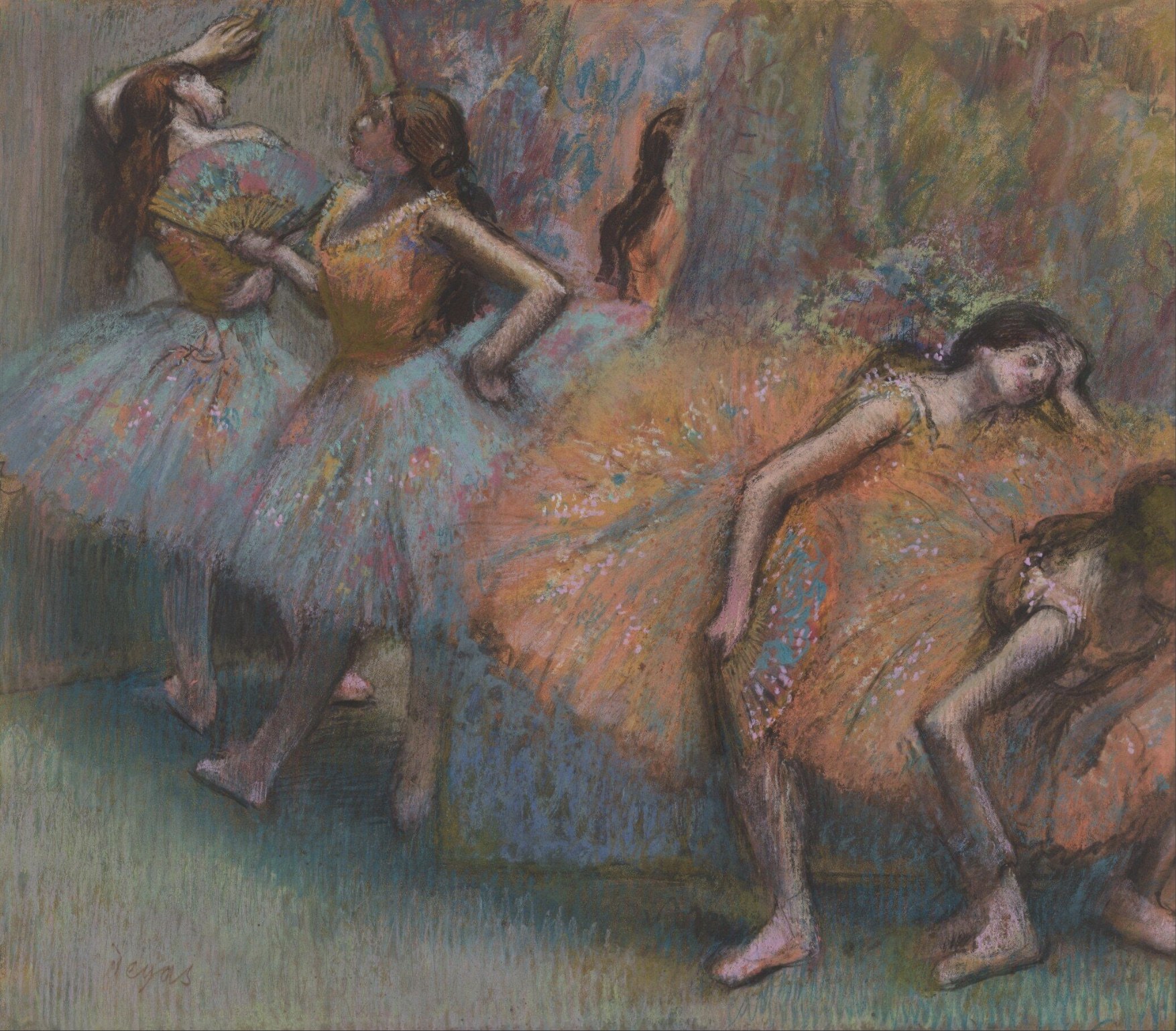
A rehearsal or practice studio scene in warm earth tones and muted blues, dominated by four female ballet dancers in various states of rest and preparation. On the left, one dancer in a pale tutu holds a fan and looks upward, her body twisted in an elegant contrapposto pose; beside her sits another dancer adjusting or examining her foot. In the center and right, two more dancers are bent forward in deep forward folds, their bodies forming elongated curves as they stretch or recover from exertion. The background is a warm, indistinct interior—perhaps a studio wall—rendered in soft, blended strokes of ochre, rust, and grey-blue. The lighting is diffuse and intimate, casting no sharp shadows, creating the effect of a candid glimpse into private practice rather than public performance. The overall composition is fluid and asymmetrical, with the dancers' bodies creating a rhythm of bent and extended forms across the canvas.
The dancing
Four dancers occupy the composition with varying degrees of activity and repose. The leftmost figure stands with weight distributed unevenly, one arm raised, suggesting momentary stillness or contemplation between movements. The others are in deeper states of physical release: two are folded forward at the waist in what appears to be a stretch or recovery position, their spines curved and heads dropped, weight pressing toward the floor. One seated figure reaches toward her own leg. None are in the formal, controlled port de bras or épaulement of performance; instead, the bodies are honest and informal, exploring the boundary between dance and exhaustion.
The dance depicted
This is ballet in the moment away from the stage—the rehearsal, the warm-up, the moment between choreography when bodies reset and breathe. The tulle skirts and the refined posture of even the most relaxed figures confirm the genre as classical ballet; the absence of pointe work visible does not contradict this, as much ballet training and many performance moments involve flat feet or soft shoes. The painting documents not the triumph of the formal dance but the labor and recovery that make it possible, a perspective that was relatively novel in visual art of the period.
How it was made
Pastel on paper, executed with Degas's characteristic technique of layered, blended strokes that blur the boundary between drawing and painting. The medium allowed rapid work and easy revision, suitable for capturing transient poses and the soft, diffuse quality of studio light. Pastel's inherent impermanence—the way pigment sits lightly on the surface—mirrors the ephemeral nature of the dancers themselves: they are here, caught, but already in the next moment. The warm palette is achieved through the interaction of multiple pastel hues rather than optical mixing, giving the work its intimate, suffused quality.
About this work
This is a ballet studio interior from the 1880s, painted by Edgar Degas during his long artistic engagement with dancers and dance practice. Rather than celebrating the spectacle of performance, it documents the quiet, often unglamorous work of dancers—stretching, adjusting, recovering, waiting. The four figures are individuated and observed with anatomical precision, yet the composition avoids narrative or drama. Instead, it creates a psychological space: we are invited into the privacy of the studio, where the body's real work is done away from applause. This painting belongs in a dance archive because it represents a fundamental shift in how artists understood and depicted dance—not as narrative spectacle but as labor, discipline, and the raw physical intelligence of trained bodies.
How to look at it
Observe the specificity of each body's posture: no two dancers are in the same position, and each posture carries information about fatigue, flexibility, and individual habit. Notice the artist's choice to paint the moments of rest rather than movement—this is strategic. By freezing the body in stretching and recovery, Degas reveals the anatomy and effort that performance conceals. Look also at the handling of the tulle: it is painted with loose, feathery strokes that suggest translucence and weight, and it clings to the bodies in ways that suggest real fabric and real sweat. The face of the standing figure on the left is rendered almost as an afterthought, her features soft and generalized; Degas is interested in the body, not personality.
The artist
Edgar Degas (1834–1917) spent the last four decades of his career obsessed with ballet and its dancers. He had privileged access to the Paris Opéra, where he could observe rehearsals and backstage life, and he created thousands of works exploring dancers in every context: performing, practicing, adjusting costume, resting. His interest was neither prurient nor sentimental; rather, he approached the dancer's body with the same anatomical precision and visual curiosity he brought to horses, laundresses, and bathers. By the 1880s, when this work was made, he had largely abandoned narrative painting and worked instead in series, returning to the same subjects and poses from multiple angles and in different media—oil, pastel, printmaking, sculpture—exploring what each medium could reveal.
The period
The 1880s were a moment of transition in ballet and in how it was understood. The Romantic era's ethereal, supernatural heroines were giving way to more naturalistic and increasingly sensual representations of the dancer's body. At the same time, the institutional structure of the Paris Opéra—with its hierarchical ballet school, its rehearsal structures, and its visible exploitation of dancers—was becoming a subject of artistic and social interest. Impressionist and post-Impressionist painters were increasingly interested in contemporary life and labor; Degas's ballet scenes fit this broader movement while maintaining his own fastidious technical discipline. The emergence of photography during this period may also have influenced the apparent casualness of these compositions: the snapshot quality, the cut-off figures, the asymmetrical framing all suggest the eye of a camera, though Degas's actual photographs (which he took) are separate from his painted work.
Where it lives
The painting is held by the National Gallery, London, and is catalogued as NG6705. It is one of thousands of Degas works in international collections, reflecting both his prolific output and the sustained demand for ballet imagery in the late 19th and 20th centuries.
Dance in this work
Questions about this work
Why are the dancers not moving?
Degas chose to depict the studio in moments of rest and preparation rather than active choreography. This was a deliberate artistic choice that allowed him to study the body's structure and the individuality of each dancer in a way that continuous movement would not permit. It also documents a reality of dance: most of the dancer's day is spent not dancing but training, stretching, and recovering.
Is this a finished work or a sketch?
This is a finished work in pastel, a medium Degas chose deliberately for works of this kind. While it may appear less 'finished' than an oil painting—the blending is softer, some areas are more resolved than others—this is characteristic of how Degas worked in pastel in his late career, and the composition is complete as conceived.
What can we learn about ballet technique from this painting?
The painting shows classical ballet training as it actually existed: the importance of flexibility work and stretching, the use of flat feet and a bent position (plié preparation) in the studio, and the physical toll of the work. The relaxed, even collapsed postures suggest the intensity of training and the relief of stopping. There is no idealization here; this is how bodies actually look when resting from physical exertion.
Why did Degas paint so many ballet scenes?
Degas had fascinated access to the Paris Opéra rehearsal studios and stage, and he used this access to explore a subject that interested him aesthetically, socially, and physically. The dancer's body in all its complexity—trained, expressive, vulnerable, often exploited—became his primary subject in the final decades of his career.
More dance artwork





