49 works in this view — arrow keys or swipe to move between them.
Dance in Art
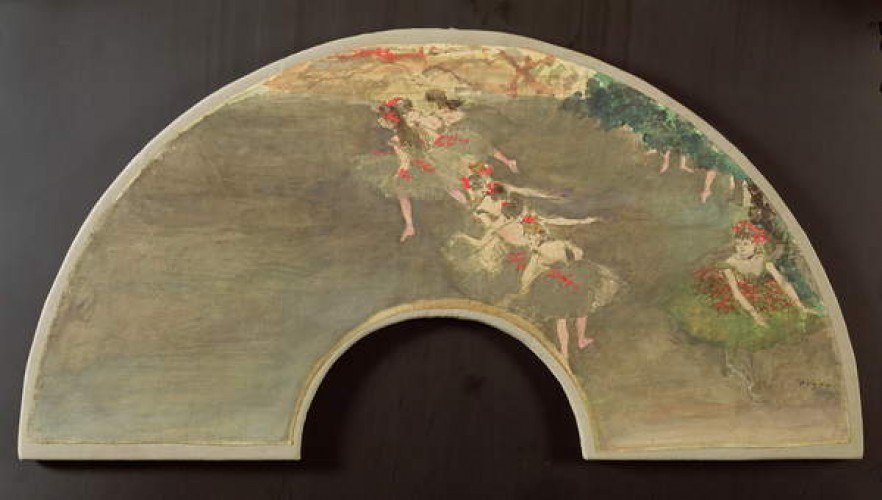
Degas - Ballet dancers design for a fan
Edgar Degas
- Source:
- Wikimedia Commons
- Rights:
- Reusable with conditions: credit the creator; share any adaptation under the same license. Source record ↗
- Recorded as:
- cc by-sa 4.0
This fan demonstrates that ballet was not confined to the stage or to academic art; it permeated luxury goods and domestic decoration. For historians of dance and design, it shows how choreography and spectacle were translated into portable, intimate art objects for a commercial market. For Degas scholars, it reveals his engagement with commercial and decorative practices before he became known primarily for his paintings of contemporary ballet rehearsals and performances.
What you are looking at
A semicircular fan leaf painted in muted greens and earth tones shows a ballet scene of delicate, ethereal quality. Four female dancers in pale, flowing tutus are scattered across a luminous stage space, their bodies arranged in attitudes suggesting flight or weightlessness. The nearest dancer on the left reaches upward with extended arm; others are caught mid-leap or in poses of classical repose. The background suggests a wooded or garden setting rendered in soft greens and warm ochres, with foliage suggested at the right edge. The overall tonality is hazy and atmospheric, with the dancers' pale figures seeming to emerge from or dissolve into the misty ground. This is a work designed for intimate viewing—a luxury object held in the hand.
The dancing
The dancers are rendered in the delicate, elongated proportions of Romantic ballet, with small heads, long limbs, and an emphasis on verticality and weightlessness. The nearest figure stands with weight seemingly lifted, one arm reaching skyward in a classical port de bras. Others are positioned in arabesque-like attitudes or suspended jumps, their bodies angled to suggest continuous motion rather than stable poses. The tutus are short and full, consistent with mid-nineteenth-century ballet costume. The spacing and overlapping of figures creates a sense of depth across the shallow fan format.
The dance depicted
This is unquestionably a Romantic ballet scene, almost certainly from the mid-nineteenth century when this genre was at its height. The soft, ethereal quality of the poses and the woodland setting are hallmarks of Romantic ballet's preoccupation with sylphs, spirits, and supernatural beings. The dancers' extreme verticality and the emphasis on effortless elevation reflect the vocabulary of pointe work and the visual language of Romantic aesthetics. Without an inscription or other identifying detail, the specific ballet cannot be determined, but the style and costume align with works like *La Sylphide* (1832) or *Giselle* (1841), which dominated the era. The image captures not a narrative moment but a mood—the dream-like, otherworldly quality that defined the style.
How it was made
This is a fan leaf, a painted decorative object for hand use. The support appears to be paper or vellum mounted on a semicircular backing. The technique is gouache or watercolor, applied with considerable refinement to create subtle modeling and atmospheric effect. The pale palette—soft greens, ochres, flesh tones, and near-whites—is characteristic of fan painting and suited to the intimate scale and delicate subject. Fan painting was a luxury craft practiced by trained artists and distributed among the affluent; this object represents both the commercial art market and the domestic leisure world of its time.
About this work
This is a fan design by Degas depicting four Romantic ballet dancers in a misty, woodland setting. Fans were fashionable accessories for women of means, and hand-painted fans with theatrical subjects—especially ballet—were prized luxury goods in the nineteenth century. The work shows Degas' mature understanding of ballet movement and atmosphere, rendered in the soft, jewel-like technique appropriate to the object's intimate scale. It sits at the intersection of commercial art, theatrical culture, and domestic refinement.
The work is significant as evidence of how thoroughly ballet had penetrated the visual and material culture of Parisian society by the mid-nineteenth century. That Degas would design a fan with a ballet subject reflects the widespread taste for the form among educated women. The Romantic aesthetic visible here—the weightlessness, the supernatural mood, the garden or forest setting—was the dominant visual language of ballet in Degas' youth, even as he would later paint the ballet world of his own time with greater realism and psychological complexity.
How to look at it
Observe the placement of the dancers across the fan's curved space: none is centered or dominant, creating a sense of floating or dreaming rather than performance. Notice the near-absence of a defined ground line or stage edge—the dancers seem to emerge from and dissolve into atmosphere. Look closely at the handling of the pale tones in the tutus and flesh: the artist has used the fan's pale ground as highlight, building shadow and modulation around it rather than working light over dark. The woodland setting is suggested rather than detailed, reinforcing the ethereal, non-naturalistic mood. This is a work asking to be held close and turned gently in the light.
The artist
Edgar Degas (1834–1917) was born into a wealthy Parisian banking family and trained as a painter at the École des Beaux-Arts. Throughout his career, he was deeply engaged with the world of Parisian dance, particularly the Opéra Ballet, and created thousands of works on ballet subjects—paintings, pastels, prints, and sketches. He was also a skilled and versatile technician who worked in multiple mediums including printmaking and decorative arts. Fan design was an established commercial practice among artists, and Degas' willingness to take on such commissions reflects both economic necessity and artistic practice; many avant-garde artists of the period produced work for the luxury and decorative trades. His ballet work ranges from grand narrative compositions to intimate studies of dancers at rest, rehearsal, or in performance.
The period
This work belongs to the height of Romantic ballet (1830s–1850s), when the genre was dominated by supernatural narratives featuring sylphs, spirits, and ethereal female dancers in white tutus. Marie Taglioni in *La Sylphide* and Carlotta Grisi in *Giselle* defined the era's aesthetic of weightlessness and otherworldliness. By Degas' maturity, however, the ballet world was shifting toward greater realism, character dances, and eventually Impressionist-inflected treatments of the Opéra's daily practices. The mid-nineteenth-century commercial art market for fans and other decorative objects was robust and sophisticated; hand-painted fans with theatrical subjects were luxury items purchased by women of the bourgeoisie and aristocracy. The soft, hazy Romantic aesthetic visible in this work would have been instantly recognizable as fashionable taste.
Where it lives
The work is recorded as a fan design attributed to Degas with a date of 1850, held (according to the source) in a public collection and documented on Wikimedia Commons. As a decorative object, it belongs to the class of luxury fans that were both wearable art and collectable objects.
Dance in this work
Questions about this work
Is this a painting or a design? What was it actually used for?
It is a functional fan—a hand-held object designed to be held and looked at by its owner, likely a woman. Fans of this kind, especially those with theatrical or aesthetic subjects, were luxury accessories that signaled taste and cultural engagement. They were carried in social settings and could be displayed or given as gifts. The object is both practical and decorative, and owning a hand-painted fan by or attributed to a known artist was a marker of refinement.
How do you know this is Romantic ballet and not some other kind of dance?
The costume, pose, and aesthetic are unmistakable. The short white or pale tutu, the emphasis on verticality and weightlessness, the ethereal mood, and the woodland or supernatural setting are visual signatures of Romantic ballet. The dancers are clearly en pointe or in aerial attitudes, which places them firmly in the Western theatrical ballet tradition. The soft, luminous technique and the emphasis on mood over narrative specificity are also hallmarks of how Romantic ballet was represented in art.
Can you tell which ballet this is from? Or is it a generic scene?
Without an inscription or other identifying mark, it is impossible to say whether this depicts a specific moment from a known ballet or whether Degas created a generic Romantic ballet scene that evokes the mood and aesthetic of the genre without illustrating a particular narrative. The image shows the style and world of Romantic ballet, not a particular story.
Why would Degas design a fan?
Fan design was a respected and profitable branch of commercial art in the nineteenth century. Even artists of high reputation took on decorative commissions for income and exposure. For Degas, who was financially dependent on sales, such work was entirely consistent with his practice. Fans also allowed artists to explore their subjects—in this case, ballet—at an intimate scale and with technical refinement suited to a luxury object.
More dance artwork





