49 works in this view — arrow keys or swipe to move between them.
Dance in Art
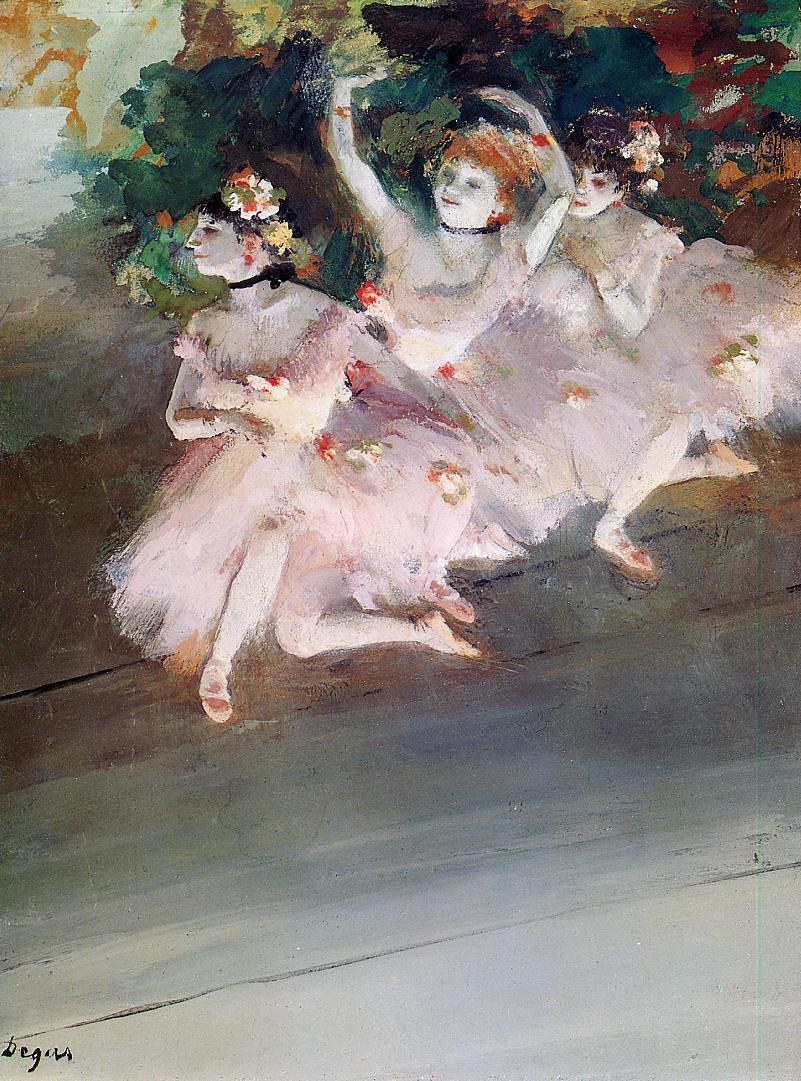
Degas - Three Ballet Dancers, 1879
Edgar Degas
- Source:
- Wikimedia Commons
- Rights:
- Public domain — free to use, share and adapt.
- Recorded as:
- public_domain
This painting exemplifies Degas's revolutionary approach to ballet representation: rather than depicting the grand spectacle of the stage or the moment of peak virtuosity, he chose intimate, unguarded repose. For dancers and historians, the work matters because it shows how a major artist understood the ballet body not as a vehicle for narrative drama but as a subject of aesthetic and psychological interest in itself—influencing how ballet would be seen in visual culture.
What you are looking at
Three young women in pink tutus and ballet pointe shoes sit or recline on a gray stage floor, their bodies arranged in a loose triangular composition. They wear floral garlands in their hair and the tutus are decorated with flowers—sprays of white and red blossoms scattered across the fabric. Behind them, a dense thicket of dark green and reddish foliage creates a compressed, almost claustrophobic backdrop. The lighting is soft and diffuse, with cool gray tones dominating the stage area and warm ochres and greens in the scenery above. The three dancers' poses are relaxed and informal: one looks down pensively, another gazes upward with arm raised, and the third turns slightly away. The overall mood is one of repose rather than action—dancers between moments rather than in the execution of steps.
The dancing
The three figures display the soft, rounded arm positions and turned-out legs characteristic of classical ballet training, even in repose. None are en pointe in the traditional sense; rather they sit or recline with legs extended and turned outward in first or fifth position. Their upper bodies are gently curved, with one dancer's arm raised in a graceful port de bras. The poses suggest a moment of stillness—perhaps a pause in rehearsal or a tableau vivant—rather than active movement. All three wear the standardized costume of the Romantic ballet era: fitted bodices, tutus (here mid-length rather than floor-length), and pointe shoes.
The dance depicted
This is unmistakably Romantic ballet, likely depicting a scene from a mid-nineteenth-century ballet or possibly a study for one. The floral garlands, the pastoral or sylvan setting, and the dreamy, introspective quality align precisely with the aesthetic of Romantic ballet (c. 1830–1870), in which female dancers, often portrayed as sylphs, spirits, or maidens in enchanted settings, were the focus. The three-figure composition may reference a corps de ballet moment, or possibly a scene of supernatural beings at rest. The artist has captured not the virtuosity of technical execution but the romantic ideal of the dancing body—ethereal, youthful, and introspective.
How it was made
This is a pastel or mixed-media work on paper, executed with loose, gestural strokes that prioritize luminosity and atmosphere over precise detail. The medium allows soft blending of tones, visible especially in the flesh tones and the diffuse transitions between stage and scenery. The sketch-like quality of the background—the freely handled foliage—contrasts with the more carefully rendered figures, suggesting this may be a study or finished work intended for exhibition rather than a formal composition. The technique is economical: Degas has established form through color and gestural mark-making rather than line, a method suited to capturing the fleeting, posed moment of dancers in repose.
About this work
This work depicts three Romantic-era ballet dancers at rest on a stage, their soft pink tutus and floral wreaths creating a poetic image deeply aligned with mid-nineteenth-century ballet aesthetics. The composition emphasizes repose and introspection rather than technical virtuosity, capturing a moment of quietude that was not itself a standard part of ballet narrative but reflects the artist's interest in the dancers' lives offstage or between scenes. The work sits within Degas's broader project of documenting ballet—a subject he returned to throughout his career—and represents his particular sympathy with the Romantic ballet tradition, even as he was creating these works in the late nineteenth century.
How to look at it
Notice first the artist's choice to show the dancers not in motion but in stillness—a radical departure from earlier ballet imagery, which almost always depicted the moment of greatest virtuosity. The soft, warm light and the careful rendering of the tutus and skin tones draw attention to the material reality of the performers' bodies. Look at the positioning of the heads and gazes: each figure seems inward, contemplative, almost melancholic. Finally, observe the relationship between the dancers and the stage floor: Degas has compressed the pictorial space so that the background scenery looms large and close, intensifying the sense of confinement and enclosure. This was a deliberate choice, not an accident of perspective—it creates a mood very different from the open, expansive compositions of earlier ballet paintings.
The artist
Edgar Degas (1834–1917) was obsessed with ballet from the 1860s onward, producing hundreds of paintings, pastels, prints, and drawings on the subject. Unlike his Impressionist colleagues, Degas rarely exhibited outdoors; instead, he pursued the human figure in interior settings—particularly the rehearsal studios, dressing rooms, and stages of the Paris Opera. His approach was neither celebratory nor satirical but unflinchingly observational. He combined careful draftsmanship with experimental media (pastels allowed him to work with speed and luminosity) and unconventional compositions (high viewpoints, cropped figures, asymmetrical framing), many derived from his study of Japanese prints and photography. Ballet gave him a subject that was modern, urban, and endlessly variable in pose and gesture.
The period
The 1870s–1880s, when this work was likely created, represented a transition in ballet and in how it was represented. The great age of Romantic ballet had passed; the ballerinas of Degas's youth had retired or were aging. Yet the Romantic aesthetic—the emphasis on ethereal, ethereal femininity and pastoral or supernatural settings—remained the dominant visual and cultural language of ballet, even as the technical demands on dancers were increasing. Simultaneously, Realist and Impressionist painters were breaking with academic tradition, and Degas's choice to treat ballet dancers with serious artistic attention, rather than as mere decoration or spectacle, was itself a modernist gesture. The work also reflects Parisian theatrical life of the period: the Opera was a center of urban culture, and dancers were culturally visible figures.
Where it lives
The work is documented in Wikimedia Commons. The catalogue record indicates it is from 1879, though the medium is not recorded; visual analysis suggests pastel or mixed media on paper.
Dance in this work
Questions about this work
Why are the dancers sitting down? Is this a finished ballet scene?
This is almost certainly not a scene from an actual ballet narrative. Rather, Degas has chosen to depict dancers in a moment of rest—possibly between rehearsals, or in the moments before or after a performance. He was interested in the dancers' bodies and inner lives beyond the formal choreography, which was a new and important contribution to how ballet was understood in art.
What do the flowers mean?
The floral garlands and scattered blossoms are partly ornamental—part of the aesthetic of Romantic ballet, which loved sylphs, fairies, and maidens in enchanted settings. But they also convey a sense of theater itself: these are stage props and costume elements, part of the machinery of ballet spectacle. Degas shows us both the aesthetic ideal and the material reality of theatrical production.
Is this a study, or a finished work?
This appears to be a finished work. Although the background is sketchily handled compared to the figures, this is a deliberate artistic choice—Degas used loose, gestural technique to suggest atmosphere and movement even in static compositions. The work was clearly exhibited or intended for exhibition, not merely a preparatory study.
What happened to classical ballet heroines? These look very different from Swan Lake.
This work dates to 1879, before Swan Lake (1895). It depicts the aesthetic of Romantic ballet from the earlier period (1830–1870), when the female dancer as ethereal spirit was the dominant type. By the time Degas painted this, that era was already passing, and he seems to have been documenting a tradition he valued—the grace and introspection of Romantic ballet—even as newer styles were emerging.
More dance artwork





