49 works in this view — arrow keys or swipe to move between them.
Dance in Art
Ballet Dancers
Edgar Degas
- Source:
- Wikimedia Commons
- Rights:
- Public domain — free to use, share and adapt.
- Recorded as:
- cc0
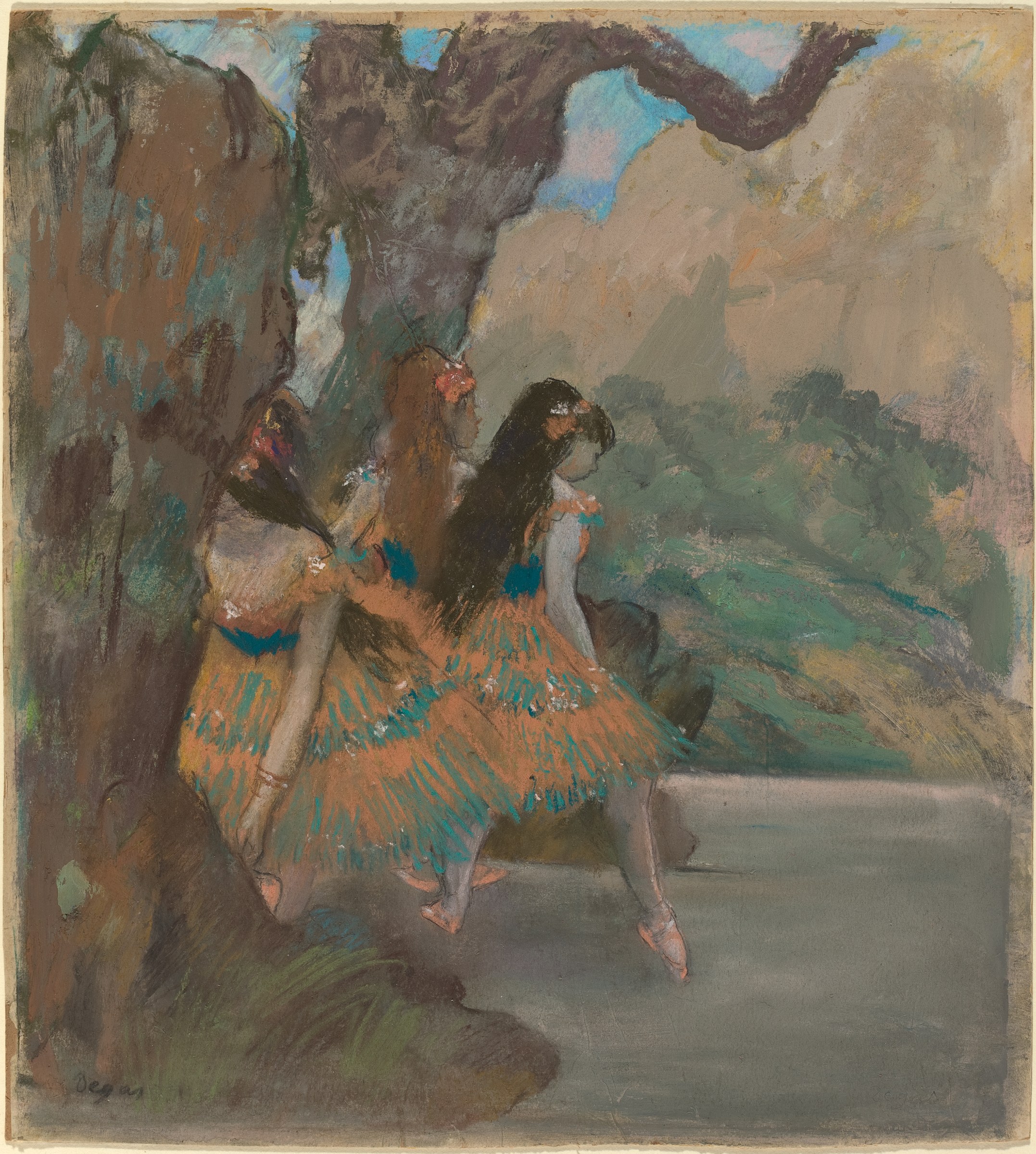
This work preserves how Romantic ballet was staged and how it was seen—not as isolated technical display but as narrative drama in which the dancer's body moved through an imagined space. For historians of dance, it is evidence of the relationship between costume design, set design, and choreography in the nineteenth-century theater. For artists, it documents how pastels could capture theatrical atmosphere and movement on a small, intimate scale.
What you are looking at
Two ballet dancers occupy a rocky, cavernous stage set rendered in muted earth tones and slate blues. The setting suggests a grotto or mountainous landscape, with dark rocky outcroppings framing the figures from above and a pale, misty background suggesting distance or sky. The dancers wear tutus in warm orange and peachy tones, their legs bare and extended in balletic positions. The figure on the right, in profile, leans back with her body in an arabesque-like attitude, while the figure on the left reaches toward the rocky wall, her posture suggesting either pursuit or arrival. The lighting is diffuse and atmospheric, creating an otherworldly quality—the kind of Romantic-era stage design that emphasized fantasy, natural settings, and the ethereal qualities of the female dancer. The composition is vertical and compressed, with the dancers small against the monumental rocks, emphasizing the drama of the narrative moment.
The dancing
Both dancers are en pointe or at the balls of their feet, their legs extended in classical positions—one arabesque, one attitude devant. Their upper bodies show the lifted, elongated frame characteristic of nineteenth-century ballet technique: heads held high, arms extended with control. The dancer on the right appears caught mid-leap or sustained turn, her body arched. The dancer on the left extends one arm toward the rocky setting, suggesting interaction with the environment. Their tutus and slippers are rendered with attention to the weight and volume of the skirts. There is no closed-hold partnership; rather, the dancers occupy separate moments within the same dramatic scene, a compositional choice typical of Romantic narrative ballet.
The dance depicted
This is Romantic ballet, almost certainly from the mid-nineteenth-century repertory. The setting, tutus, pointe work, and the narrative quality of the pose—a moment of encounter or drama within an imagined landscape—are signature elements of works like *Giselle* or *La Sylphide*. The grotto setting and the solitary or paired female dancers suggest a scene from the supernatural or tragic acts of a full-length ballet. The artist has captured not a moment of technical display but a dramatically charged instant within a story, which is the fundamental intent of Romantic ballet. Without inscription or further context, the specific ballet cannot be certain, but the stylistic and iconographic markers are unmistakable.
How it was made
This is pastel or mixed media on paper, executed with blended and layered strokes to create atmosphere and three-dimensionality. The technique allows for soft modeling of light and shadow, particularly visible in the rendering of the rocky forms and the diffuse stage lighting. Pastel's capacity for luminous layering suits the ethereal, dreamlike quality that the artist sought. The medium was favored for theatrical subjects in the nineteenth century because it permitted rapid, gestural work while maintaining detail in costume and the human figure. The slight matte quality and the visible texture of paper suggest this is a study or finished work on a modest scale, likely created for exhibition or as a collector's piece rather than as a large-scale mural.
About this work
This pastel documents the Romantic ballet aesthetic at its height, capturing a moment from a narrative work set in a supernatural or exotic landscape. The work is one of many such theatrical studies produced in the mid-nineteenth century, when ballet had shifted from the dance of the court to the dance of illusion and storytelling. The two dancers en pointe in a rocky grotto represent a dramatic crux: a meeting, a haunting, an arrival in another realm. The artist has rendered both the technical vocabulary of ballet—the extended legs, the lifted spine, the pointe work—and the theatrical machinery of Romanticism: the setting, the costume, the play of light. This is neither documentary nor abstraction, but rather theatrical imagination made visible.
How to look at it
Look first at the setting and how it frames the dancers. The rocky forms are not merely backdrop; they are active elements of the composition, creating a sense of claustrophobia and drama. Notice how small the dancers are in relation to the space—this is not the wide-open stage of neoclassical ballet but the enclosed, intimate space of Romantic fantasy. Then attend to the pose and the moment: the artist has chosen an instant of reaching, of extension, not a static tableau. The arabesque and attitude are at their fullest extension; the dancer on the left gestures toward the stone. This is a moment of action within narrative, not a demonstration of technique. Finally, observe the atmospheric treatment: the soft, blended pastels, the muted colors, the way light falls without harsh definition. This was how the nineteenth-century stage lit dancers in such scenes—dimly, mysteriously, with an emphasis on silhouette and gesture over fine detail.
The artist
Edgar Degas (1834–1917) was obsessed with ballet for nearly five decades, producing hundreds of pastels, paintings, drawings, and prints of dancers in rehearsal, performance, and repose. He had privileged access to the Opéra and the rehearsal studios of Paris, and his work ranged from quasi-documentary studies to highly finished exhibition pieces. Degas was not a ballet enthusiast in the romantic sense; he was interested in the body in motion, in the architecture of the limb, in fatigue and discipline. Yet his theatrical works, such as this one, show his command of stage composition, lighting, and the conventions of nineteenth-century ballet spectacle. He drew from life and from memory, often combining sketches made in the studio into finished compositions. This work belongs to his mid-career period, when he had fully absorbed the language of Romantic ballet and was beginning to reinvent it through his own formal and technical innovations.
The period
By 1877, when this work is dated, Romantic ballet had already entered its historical phase. The great works of the 1830s and 1840s—*La Sylphide*, *Giselle*—were in revival, and new works were still being created in the tradition, but the dance world was beginning to fragment. Classical ballet was becoming codified; the Russian Imperial Ballet was rising to prominence. In France, the Opéra remained the center of ballet life, and Paris was still the arbiter of taste. At the same time, Impressionism was transforming visual art, and artists like Degas were working at the intersection of academic tradition and modernist experimentation. His ballet works sit at this crossroads: they are deeply rooted in Romantic iconography and stagecraft, but they are animated by a modernist eye—an interest in unusual angles, cropped compositions, and the unvarnished truth of bodies at work. The grotto scene was a staple of nineteenth-century ballet; it appeared in *Giselle* and countless other works.
Where it lives
The work is recorded as held by Wikimedia Commons, which typically hosts images of works in public collections or the public domain. The specific holding collection and accession number are not recorded in the catalogue provided.
Dance in this work
Questions about this work
Which ballet is this from?
The catalogue record gives only the title 'Ballet Dancers' and does not specify a source ballet. The grotto setting and aesthetic suggest a work from the Romantic ballet repertory—possibly *Giselle* or *La Sylphide*—but without an inscription or signature visible in the image, certainty is not possible. The style and staging are consistent with mid-nineteenth-century French theatrical ballet.
Why are the dancers so small in the composition?
The monumental rocky setting emphasizes the supernatural or dreamlike quality of the scene, a hallmark of Romantic stage design. The small scale of the human figures against vast natural forms creates a sense of wonder and otherworldliness—the dancer is not the master of space but a creature within it. This compositional choice reflects both theatrical convention and Degas's modernist interest in unusual spatial relationships.
What medium is this work?
The work appears to be pastel or mixed media on paper, based on the soft blending, the luminous layering of color, and the visible paper texture. Pastel was a favored medium for theatrical studies in the nineteenth century because it allowed for rapid, gestural execution and created the atmospheric effects essential to capturing stage lighting and illusion.
How does Degas's ballet work fit into his broader practice?
Ballet was Degas's primary subject for nearly fifty years. Unlike other artists who approached ballet as a spectacle to be admired from a distance, Degas had unprecedented access to rehearsal studios and the backstage world. His works range from quasi-documentary studies of rehearsal and fatigue to highly finished theatrical compositions like this one. He used the ballet subject to explore his formal and technical interests: movement, light, the architecture of the human body, and unusual compositional structures.
More dance artwork





