49 works in this view — arrow keys or swipe to move between them.
Dance in Art
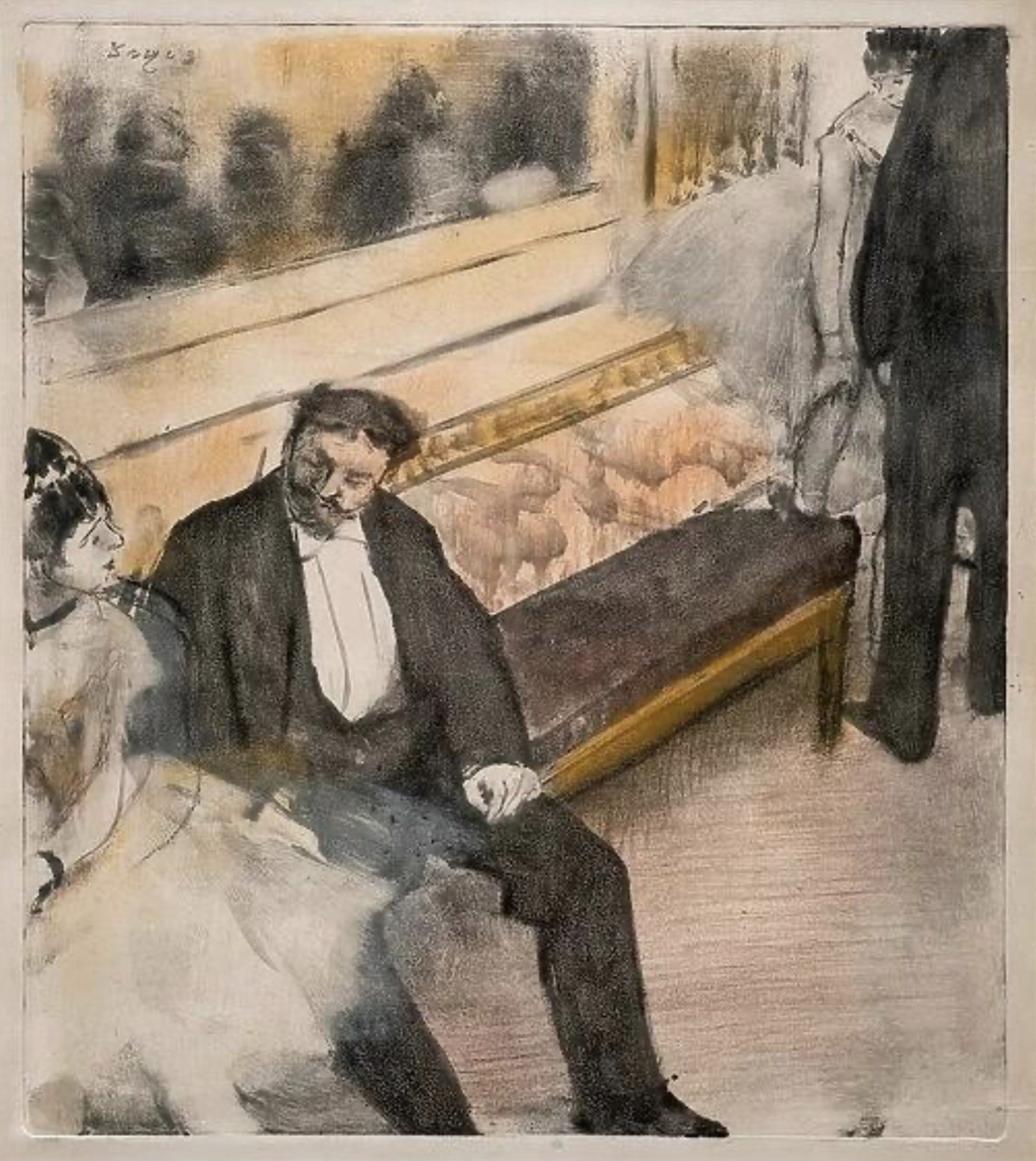
Edgar Degas-Two dancers and two men
Edgar Degas (1834 - 1917)
- Source:
- Wikimedia Commons
- Rights:
- Public domain — free to use, share and adapt.
- Recorded as:
- public_domain
This work is essential to understanding how 19th-century artists moved beyond ballet as spectacle to examine the professional and social lives of dancers. Degas's studio scenes established a new category of dance imagery that persists in contemporary art, and this pastel exemplifies his technique for capturing psychological and physical intimacy in confined spaces. For dancers and historians, the image documents not only the practice and dress of Romantic-era ballet but also the power dynamics, rest, and mundane reality that shaped dancers' lived experience.
What you are looking at
A ballet studio or rehearsal space during an informal moment, rendered in pastel with soft atmospheric effects. Two dancers dominate the composition: a woman in a pale tutu and pointe shoes sits or reclines on a wooden bench in the center-left, her body relaxed and turned away from the viewer, while a male dancer in dark formal dress—tailcoat and white shirt—bends forward attentively beside her. Two additional male figures appear in the background: one seated on the bench behind the woman, another standing at the far right edge. The setting is rendered in warm ochres and pale creams with darker accents; a wooden railing runs horizontally across the middle distance, and what may be a mirror or window occupies the upper portion. The light is diffuse and cool, characteristic of indoor studio work. The overall mood is one of pause or transition—not a performance moment but the quieter, often overlooked reality of rehearsal and rest.
The dancing
The seated female dancer's body is turned inward, her posture loose and ungainly, neither performing nor formally composed; her tutu and pointe shoes identify her as a ballet dancer, but she is captured in a state of rest or conversation rather than movement. The male dancer beside her leans forward with evident interest or solicitude, his frame upright in his tailcoat, creating a clear dynamic of attention between the two figures. The other figures in the background are shadowy and less defined, their purpose ambiguous—they may be instructors, other dancers, or observers. The spacing and relative scale suggest a shallow depth; the wooden bench grounds the composition and anchors the sense of a real, inhabited space.
The dance depicted
This is ballet, rendered at a moment when dance is not happening. The woman's tutu and pointe shoes are unmistakable markers of 19th-century theatrical ballet, likely Romantic-era practice based on the style of dress and the softness of the rendering. The image documents the social and professional space of the ballet studio—a genre of dance imagery that became increasingly important in the late 19th century as artists moved beyond the stage spectacle to capture the mundane, intimate, and often ungraceful reality of rehearsal and training. The presence of the attentive male figure and the woman's relaxed posture suggest a moment of instruction, rest, or flirtation; such scenes align with the growing interest in the lives of dancers off-stage.
How it was made
This work is executed in pastel, a medium that allows for soft blending, atmospheric effects, and rapid capture of fleeting moments. The pastel technique is visible in the way form dissolves into color, especially in the backgrounds and drapery; the paper shows through in places, creating a luminous quality that oil paint could not easily achieve. Pastel favored sketchy, unfinished-looking subjects and allowed artists to work quickly and directly, making it ideal for studio scenes and informal moments. The technique also enabled a particular kind of psychological intimacy—the softness and immediacy of pastel draws the viewer close and creates a sense of directness that suggests the artist was present and observing.
About this work
This is a late 19th-century pastel by Edgar Degas depicting an informal moment in a ballet studio. Rather than painting the spectacle of performance, Degas captures the texture of professional dance life: two dancers and two male figures in a moment of pause, rest, or conversation. The woman's pointe shoes and tutu ground the work in Romantic-era ballet practice, while the informal, off-stage setting marks this as part of Degas's larger interest in dancers as working professionals in their own spaces, not as mythological beings for public consumption.
The work belongs to a tradition of late 19th-century artistic interest in the dancer's world—rehearsal, fatigue, instruction, and the everyday realities that stage lighting obscured. Degas was the primary architect of this genre, producing hundreds of drawings, pastels, and paintings of dancers in studios, at the barre, and in moments of rest. Such images fundamentally changed how artists thought about dance as a subject and how audiences understood the labor and lived experience behind the theatrical illusion.
How to look at it
Attend to the posture of the seated dancer: her body is heavy, turned inward, without the lifted spine or extended line that ballet technique demands. This is a dancer at rest, captured with unflinching realism. Notice also the quality of attention the male figure directs toward her—leaning, focused, present—and consider what relationship that gesture implies. The soft, diffuse light and the way the pastel medium blurs and softens the background create a sense of intimacy and immediacy, as if the viewer has stumbled upon this moment without the dancers' knowledge. Degas's framing emphasizes the shallow depth and flatness of the studio wall, making the figures feel very close and very real.
The artist
Edgar Degas (1834–1917) was a French Impressionist painter and printmaker who became obsessed with dancers, especially those of the Opéra Garnier in Paris, from the 1870s onward. He produced over a thousand works depicting dancers in rehearsal, performance, and rest—more dance imagery than any artist before or since. Degas was unusual in his interest in the dancers' bodies at rest, in ungainly positions, and in the social and economic structures of professional dance. He had close access to the Opéra and its studio spaces, and he used that proximity to build an archive of movement, gesture, and posture. His approach was analytical and psychological rather than romantic; he was interested in how bodies actually moved and rested, not in the fantasy of the stage.
The period
This pastel dates to 1880, a moment when Impressionism was consolidating itself as a movement and when the representation of everyday life, labor, and private spaces had become central artistic concerns. In dance, the 1880s were a period of transition: the Romantic ballet tradition was giving way to more technical, spectacle-driven work (the era of Petipa and the Imperial Russian Ballet), but Paris remained a major center for ballet training and performance. The late 19th-century interest in dancers' lives was partly enabled by easier access to studios and backstage spaces, and partly by a broader artistic shift toward documenting modern life in its unglamorous reality. Degas was part of a movement of artists—alongside photographers and writers—who found the studio and the rehearsal more interesting than the stage.
Where it lives
The work is recorded as coming from Wikimedia Commons, indicating it is likely in the public domain or in a collection with open access. The catalogue record provides minimal information; the medium is not formally recorded but is identifiable as pastel from visual examination.
Dance in this work
Questions about this work
Why would Degas paint dancers at rest instead of in performance?
Degas was interested in truth and reality rather than spectacle or fantasy. He believed that a dancer's body revealed itself most fully in ungainly, private moments—at rest, in rehearsal, stretching, or conversing. This approach challenged the Romantic ideal of the ethereal, gravity-defying ballerina and replaced it with a vision of dance as labor performed by real, mortal bodies.
What is the relationship between the two main figures?
The image does not make this explicit. The male figure may be an instructor, a fellow dancer, a choreographer, or an admirer. His attentive posture and the woman's relaxed state suggest either a professional relationship or a moment of flirtation. Degas often left such relationships ambiguous, inviting viewers to read the body language and emotional tone themselves.
Why did Degas choose pastel for so many of his dance works?
Pastel allowed Degas to work quickly and directly, capturing fleeting moments and subtle gestures with immediacy. The medium's soft, luminous quality was ideally suited to the play of light in studios and theaters, and it enabled him to build up color and form in layers without the formality or finish of oil painting. Pastel also felt more spontaneous and sketch-like, which suited his interest in unguarded moments.
More dance artwork





