49 works in this view — arrow keys or swipe to move between them.
Dance in Art
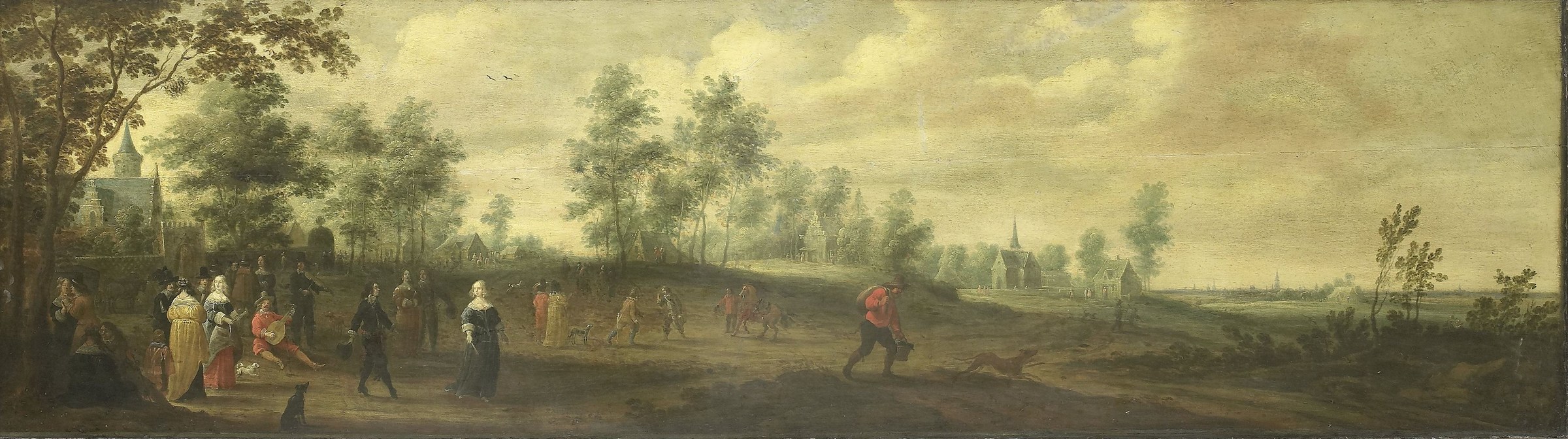
Landscape with a Dancing Couple
Pieter Meulener
- Source:
- Wikimedia Commons
- Rights:
- Public domain — free to use, share and adapt.
- Recorded as:
- public_domain
This work is valuable evidence for understanding how dance functioned in aristocratic society: not as entertainment consumed passively, but as a ritual of courtship and social display that bound community together. The painting also preserves visual knowledge of costume, posture, and spatial arrangement that historians cannot recover from written sources alone. For dancers and choreographers, it offers a window into the formality and restraint expected of courtly bodies in the early Baroque period.
What you are looking at
A landscape painting depicting leisure and courtship in what appears to be a European parkland or country estate. The composition is dominated by a vast open meadow with scattered tall trees and distant architecture—a church spire and other buildings visible across the middle distance. In the foreground left, a group of elegantly dressed figures in rich jewel tones and pale silks gather in animated conversation; their precise social hierarchy and groupings suggest a formal outing. The right side of the meadow shows a dancing couple in bright red garments, isolated but prominent against the gentle hillside. The light is clear and generous, falling from the upper left and creating soft shadows. The entire scene conveys prosperity, leisure, and the social mixing of dance and conversation that characterised aristocratic entertainment of the mid-seventeenth century.
The dancing
The dancing couple on the right stands in an open position with the man facing the woman across a small gap. Both figures are upright and composed rather than dramatically animated; their posture suggests a formal, measured movement rather than exuberant display. The man's arm reaches toward the woman in a gesture of partnership typical of courtly dance. The woman's skirt is voluminous and bilows slightly, indicating movement or the turn of her body. Across the meadow, the gathered onlookers stand in clusters of three to five, watching and conversing, with no apparent participation in the dance itself.
The dance depicted
This appears to depict a Renaissance or early Baroque courtly dance, most likely a pavane, galliard, or branle—the kind of social dance that would have been performed at aristocratic gatherings in sixteenth- and seventeenth-century Northern Europe. The formal posture, open position, and the presence of attentive spectators all support a courtly tradition rather than folk or peasant dance. The isolation of the couple and the formality of their bearing suggest this is a 'display' dance, performed for the amusement of assembled company rather than a participatory revel. The painting presents dance as an essential element of polite courtship and social distinction.
How it was made
This is an oil painting on canvas, executed in the landscape tradition of the Northern European school. The atmospheric perspective—the softening of detail and colour in the distant landscape—creates a convincing sense of depth and space. The careful rendering of dress, the delicate attention to light on fabrics, and the composition of multiple small figures across a broad landscape all suggest this is a panel painting intended for a wealthy collector's cabinet. The work demonstrates the kind of technical virtuosity and naturalistic observation associated with seventeenth-century Flemish art.
About this work
This painting documents a moment in the history of courtly dance when dance was inseparable from landscape, leisure, and the display of aristocratic sophistication. The work sits within a broader European tradition of depicting dance in landscape settings—a tradition that flourished in the sixteenth and seventeenth centuries among Flemish and Northern European painters. By placing the dancing couple in a vast parkland attended by fashionably dressed spectators, the artist presents dance as a public, ceremonial act central to the life of the social elite. The painting is not a record of a specific event but rather an idealised vision of how the cultivated classes spent their leisure and conducted courtship.
How to look at it
Notice first the isolation of the dancing couple—they are set apart from the gathered spectators, suggesting this is a formal, witnessed performance rather than participatory revelry. The woman's billowing skirt and the man's extended arm convey a moment of turning or courtly salutation; the artist has chosen a composed, formal instant rather than vigorous action. Attend to the dress: the couple's bright red garments stand out against the softer greens and greys of the landscape and the pale silks of the watchers, marking them as the focus of attention. Finally, observe the vast empty space surrounding them—it speaks to the importance of dance as a ceremonial act in a landscape designed for pleasure and social distinction.
The artist
Pieter Meulener (c. 1602–1654) was a Flemish painter active in Antwerp, known for landscapes populated with small figures engaged in leisure, courtship, and social gathering. He worked in the tradition established by painters like David Teniers the Younger and Jan Brueghel, combining Flemish landscape tradition with scenes of aristocratic and middle-class social life. His paintings often depict parklands, gardens, and open countryside as spaces of pleasure and courtship, populated by fashionably dressed figures. Meulener's work documents the visual culture of the mid-seventeenth-century Flemish elite.
The period
By the 1640s, when this work was painted, the pavane and galliard had given way to the minuet as the dominant courtly dance forms, though older dances remained part of aristocratic repertory. In Flanders and the Spanish Netherlands, the culture of courtly entertainment remained deeply invested in the visual and social display of dance, even as political upheaval reshaped the region. Painting itself was becoming a medium for documenting and celebrating aristocratic leisure; collectors valued detailed scenes of parklands and gardens as records of ideal social life. Meulener's work reflects this appetite for paintings that combine landscape grandeur with the intimate observation of social ritual.
Where it lives
The work is known from Wikimedia Commons, the primary source listed in the catalogue record. No collection or current holding location is recorded.
Dance in this work
Questions about this work
What dance is being performed?
The painting almost certainly depicts a pavane, galliard, branle, or similar courtly dance of the Renaissance or early Baroque period. The formal posture, open position, and the presence of attentive spectators all point to one of these social dances. The exact form cannot be determined from the image alone, but the style is unmistakably courtly and aristocratic rather than folk or peasant.
Why are there so many people standing around?
In aristocratic courtly dance, performance and spectatorship were closely linked. Dance was a display of social status, education, and courtship potential, and it was expected that the assembled company would watch. The gathering shown here is typical of how courtly dances were conducted—they were formal, witnessed events, not casual participation.
Who was Pieter Meulener?
Meulener (c. 1602–1654) was a Flemish painter based in Antwerp who specialised in landscapes populated with elegantly dressed figures engaged in leisure, courtship, and social gathering. He was part of a tradition of Flemish painters, including Teniers and Jan Brueghel, who documented the social life and visual culture of the seventeenth-century elite.
Why paint a dance in a landscape?
Aristocratic entertainment in the seventeenth century was intimately connected to the designed landscape—gardens, parks, and estates were spaces where leisure and courtship unfolded. By setting dance in a vast parkland, Meulener presents it as part of an ideal world of cultivated pleasure and social distinction that collectors and patrons valued highly.
More dance artwork





