49 works in this view — arrow keys or swipe to move between them.
Dance in Art
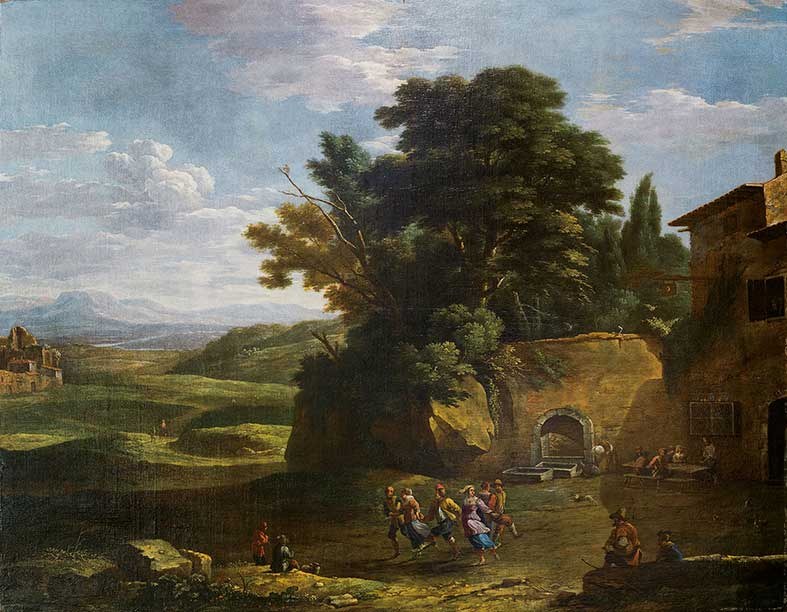
Landscape with Roman saltarello
Gaspar de Witte
- Source:
- Wikimedia Commons
- Rights:
- Public domain — free to use, share and adapt.
- Recorded as:
- public_domain
This is one of the few surviving visual records of how a saltarello was actually danced—the formation, the spirit, the social context. For a dance historian or dancer interested in reconstruction, it offers evidence of body posture, arm gestures, and the kind of landscape or festive setting in which such dances occurred. For art historians, it exemplifies how the 17th-century landscape painter could absorb narrative and social content while maintaining the primacy of natural light and space.
What you are looking at
A sunlit landscape opens onto a sprawling Italian countryside, with distant mountains under a pale sky. In the immediate foreground, at the base of a ruined stone tower on the right, a group of figures—perhaps a dozen—are caught mid-dance on the ground. The dancers wear warm earth tones and muted reds; the men are in breeches and stockings, the women in long skirts. To the left, figures wade or stand in a shallow stream. The composition is theatrical: the massive, gnarled tree at center-left frames the dancers and anchors the scene, its dark foliage luminous against the sky. The architecture—a half-ruined fortification—and the arcadian landscape create a stage set for the action. The moment is one of energetic movement: bodies are in motion, some with arms raised or extended, suggesting rapid footwork and the kinetic exuberance of a courtly or popular dance.
The dancing
The dancers occupy a loose, open formation rather than a closed hold. Bodies are upright and animated, with visible arm gestures—some raised, some extended outward in a manner consistent with Renaissance or early Baroque social dance. The figures appear to be moving in individual or small-group patterns rather than in couples locked in embrace. The overall impression is of a sprightly, energetic social occasion rather than a formal ballet; the poses suggest the kind of quick footwork and lively arm movements characteristic of saltarello or similar folk-derived courtly dances of the period.
The dance depicted
The title identifies this as a 'Landscape with Roman saltarello,' and the image supports that attribution. The saltarello was a vigorous, jumping Italian dance popular in Renaissance and early Baroque courts and among common people alike, typically danced in groups or lines rather than as couples. The figures here display the loose formation, raised spirits, and animated arm work that would be consistent with a saltarello—a dance known for its energetic hopping, turning, and the infectious joy it conveyed. The setting in an Italianate landscape and the period dress align the work with the dance's time and place of origin.
How it was made
This appears to be an oil painting on canvas, worked with the careful light and atmospheric effects characteristic of 17th-century landscape painting. The artist has used aerial perspective to recede the landscape and create depth; the foreground figures are rendered in warmer tones and sharper definition, while the distant hills fade into cool blues and grays. The technique allows for a seamless integration of the dance into landscape—the figures are small but distinct, the moment naturalized into the countryside rather than staged. This approach suggests a work intended for a patron of some sophistication, one who could appreciate both landscape virtuosity and the cultural value of recording a particular dance tradition.
About this work
This is a carefully composed landscape painting that captures a moment of popular or courtly dance—specifically a saltarello—in an Italianate setting. The work sits at the intersection of two early modern genres: the landscape painting, which was gaining prestige and market value in the 17th century, and the dance scene or festa, which recorded social pleasures and cultural practices. By embedding the dance into landscape, the artist elevates the saltarello from street or courtyard to the realm of high art. The work is a document of how Renaissance and Baroque elites viewed popular dance: as picturesque, joyful, and worthy of preservation in paint.
How to look at it
Note the position of the tree: it frames the dancers and draws the eye to the action while anchoring the composition spatially. Look at the arm gestures of the individual figures—raised, extended, varied—and the absence of the closed couples' hold that would later define Baroque courtly dance. The artist has chosen a moment of high energy but not peak confusion; the group is recognizable as a coordinated dance, not a random gathering. The lighting picks out the dancers against the shadowed base of the tower, making them legible despite their small scale in the composition.
The artist
Gaspar de Witte (also Caspar de Witte, c. 1619–c. 1681) was a Flemish painter active in Rome and later in the Spanish Netherlands. He was known for Italianate landscapes populated with small figures engaged in daily life, hunting, or festive activity. His work bridges Flemish landscape tradition and Italian baroque realism, combining the detailed naturalism of Northern painters with the golden light and classical ruins favored in Rome. He was part of a circle of Northern artists who exported the Italian landscape tradition north, and his scenes of rural or courtly life were sought by collectors across Europe.
The period
The saltarello was at the height of its cultural currency in the 16th and 17th centuries, when it appeared in dance manuals, court records, and artistic depictions. By the time de Witte painted this work in the mid-17th century, the saltarello had already begun to be associated with Italian folk tradition and nostalgic rusticity—exactly the note this painting strikes. Landscape painting itself was undergoing a profound elevation in status; collectors and critics were increasingly viewing landscape as a vehicle for expressing mood, history, and cultural values. De Witte's generation of painters was making Italian landscape—with its ruins, its peasants, its festivals—into a subject worthy of serious artistic attention.
Where it lives
The work is recorded on Wikimedia Commons; no holding collection or accession number is given in the available record. It is presented as an oil painting, though the exact support and dimensions are not documented here.
Dance in this work
Questions about this work
What is a saltarello?
The saltarello is a lively Italian dance dating to at least the 15th century, known for quick footwork and an energetic, often improvised character. It was danced socially and at court, sometimes as a follow-up to more stately dances like the pavan. The name comes from the Italian 'saltare' (to jump), reflecting its bouncy, springing quality. It remained popular across Europe and was associated with Italian folk tradition well into the modern era.
How do we know this is a saltarello and not another dance?
The title explicitly identifies it as a 'Roman saltarello,' and the artist or a contemporaneous owner would have named it as such. The visual evidence—the loose grouping, the energetic arm gestures, the open formation, and the Italian landscape setting—is consistent with what we know of how saltarellos were danced and depicted. However, without a signature or dated inscription on the painting itself, we rely on the title as recorded.
Who danced saltarellos?
Saltarellos were danced across social classes. Court nobility danced them at festivals and in chambers, often as part of an evening of mixed dances. Common people danced them at street fairs, weddings, and seasonal festivals. The presence of both in painted landscapes like this one reflects the dance's broad appeal and its status as a marker of Italian cultural identity.
Why paint a landscape with a tiny dance in the corner?
For collectors in the 17th century, a landscape enlivened by small figures—whether dancers, hunters, or peasants—was more valuable and interesting than an empty scene. The figures gave narrative and human interest; the landscape gave prestige and technical skill. By including a recognizable dance, the artist also documented a cultural practice and associated his patron with refined taste and knowledge of continental fashions.
More dance artwork





