49 works in this view — arrow keys or swipe to move between them.
Dance in Art
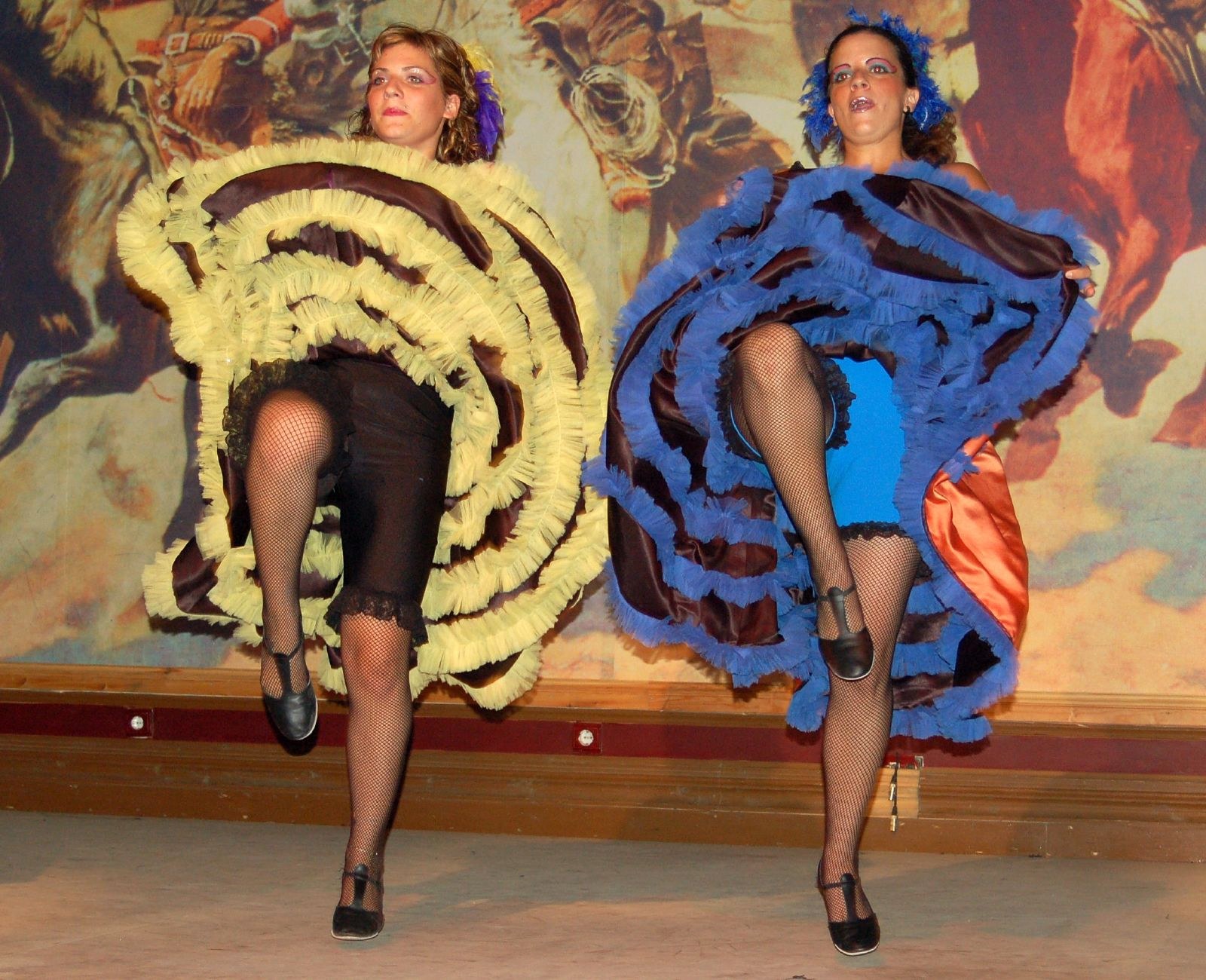
Can can dancers at Mini Hollywood
Emilio del Prado
- Source:
- Wikimedia Commons
- Rights:
- Reusable with conditions: credit the creator; share any adaptation under the same license. Source record ↗
- Recorded as:
- cc by-sa 2.0
Can-can is frequently misunderstood as crude or uncontrolled; this photograph shows it as a disciplined, precisely executed style with genuine technical demands. The image also documents the geography of can-can's survival: it remained an active tourist attraction in European entertainment venues well into the contemporary period, demonstrating how 19th-century dance styles persisted in specialized contexts.
What you are looking at
Two female dancers perform high-kicking can-can kicks on a wooden stage, their legs raised powerfully in the characteristic split-leg extension of the style. The dancer on the left wears a pale yellow costume with a ruffled, layered skirt that fans explosively outward from the impact of her movement; she has purple ribbon in her hair. Her partner on the right wears a bright electric blue version of the same design, with matching blue hair ribbons. Both dancers wear fishnet stockings and black heeled shoes. Behind them stretches a painted theatrical backdrop in warm ochres and reds, depicting what appears to be classical or mythological figures in a romanticized landscape style—the kind of permanent scenery typical of small entertainment venues. The lighting is direct and even, casting sharp shadows that emphasize the sculptural quality of their raised legs and the explosive volume of their skirts.
The dancing
Both dancers are captured mid-kick with legs extended high and wide, bodies leaning slightly backward for counterbalance, a signature pose of can-can performance. The raised legs are nearly horizontal, executed with the control and precision that distinguishes can-can from crude high-kicking. Their upper bodies remain relatively upright despite the extreme leg position, with arms positioned for balance. The framing shows two dancers of similar height and build, moving in unison or near-unison, suggesting a paired or ensemble formation typical of can-can numbers.
The dance depicted
This is can-can, the high-kicking social dance that originated in Paris in the 1840s and became a signature style of Montmartre cabarets and music halls. The costume, the theatrical setting, the paired formation, and above all the explosive high kicks with spread legs are all diagnostic of the style as it was performed throughout the 20th century. The can-can was danced by ensembles of women in theatrical venues, though it also existed as a participatory social dance. The image shows the theatrical, staged version typical of cabaret and tourist entertainment. The control evident in the leg height and alignment suggests trained dancers rather than amateurs.
How it was made
This is a photograph, likely digital color given the saturation and evenness of exposure, capturing a live performance moment. The photographer has chosen a full-body framing that emphasizes the geometry and volume of the skirts and the height of the kicks. The theatrical backdrop and stage flooring are fully visible, providing context for the venue. The color photography allows the designer's clear differentiation between costumes—the yellow and blue choices are visually striking and help the viewer distinguish the two performers.
About this work
Photograph of two can-can dancers performing high-kick choreography on a small theatrical stage. The work documents the mid-20th-century practice of can-can as live entertainment in tourist and cabaret settings, particularly the Spanish venue 'Mini Hollywood.' The image shows the dance as a technically accomplished, visually spectacular performance art rather than as social dance, with emphasis on costume volume, leg extension, and synchronized partnering. Can-can persisted in theatrical contexts long after its decline as a participatory social form, and this photograph records that survival in what appears to be a small entertainment venue rather than a major theater.
How to look at it
Watch for the control in the leg extension—the kicks are not wild flailing but geometrically precise, with both legs fully extended and separated. Notice how the skirt design amplifies the visual effect of the movement, with layering that creates a starburst pattern. The photographer has frozen the moment of maximum leg extension, which is the climactic point of the can-can's visual statement. The matched costumes and synchronized pose suggest this is a staged, formally choreographed performance moment rather than a candid glimpse of social dancing.
The artist
Emilio del Prado is a Spanish photographer. Without further biographical information in the record, the work can be situated as professional documentary/performance photography of Spanish tourist and entertainment venues in the early 21st century.
The period
By 2007, can-can was no longer a living social dance or mainstream cabaret form in Europe, but it persisted as a heritage attraction and novelty performance in tourist venues and smaller theaters. Mini Hollywood was a Western-themed tourist attraction in Almería, Spain. The can-can of this period was consciously styled and presented as a historical or exotic entertainment rather than as contemporary dance. Costume design had evolved significantly from 19th-century sources, but the fundamental high-kick vocabulary remained unchanged.
Where it lives
The image is held in Wikimedia Commons, a publicly accessible digital archive. It was created by photographer Emilio del Prado and appears to document a live performance at Mini Hollywood, a tourist entertainment venue.
Dance in this work
Questions about this work
Is this real can-can or a recreation?
This is a real, live performance of can-can as it was performed in tourist and entertainment venues in the early 21st century. Can-can itself is a historical dance from the 1840s onward, but it continued to be performed in theatrical contexts. The photograph shows the living tradition of can-can as stage entertainment, not a historical recreation or museum performance—it is contemporary performance of a historical dance style.
Where did can-can come from, and why is it associated with Paris?
Can-can originated in Paris around 1840 and became the signature dance of Montmartre cabarets such as the Moulin Rouge, where it was performed by ensembles of women in theatrical settings. It spread throughout Europe as both a social dance and a cabaret attraction. By the 20th century it was primarily a theatrical and tourist entertainment rather than a form of participatory social dance.
What does Mini Hollywood have to do with can-can?
Mini Hollywood was a Western-themed tourist village and entertainment venue in Almería, in southern Spain. Like many small European tourist attractions, it offered variety entertainment including can-can performances. The venue allowed tourists to experience a theatrical version of a famous dance style in an exotic setting.
More dance artwork





