49 works in this view — arrow keys or swipe to move between them.
Dance in Art
BodleianDouce364Fol8rRomanRoseMirthGladnessLeadDance
Unknown artist
- Source:
- Wikimedia Commons
- Rights:
- Public domain — free to use, share and adapt.
- Recorded as:
- public_domain
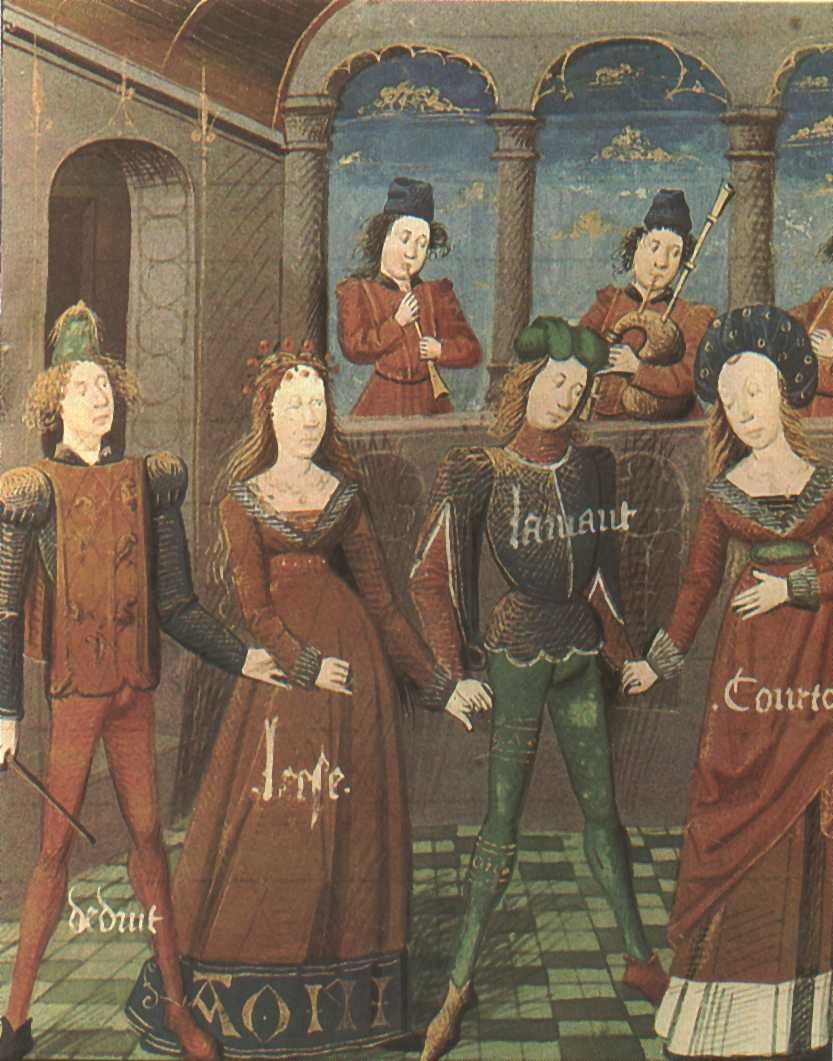
This work is among the most detailed surviving visual records of 15th-century European court dance, capturing not only the posture and formation of dancers but also the allegorical framework within which courtly dance was understood. For dance historians, it is primary evidence for the formal arrangement, musical accompaniment, and social meaning of aristocratic dance before the Renaissance transformation of dancing practice. For art historians, it exemplifies how the luxury manuscript tradition documented and transmitted courtly culture.
What you are looking at
A formal indoor dance scene set within a vaulted Gothic chamber with blue-grey decorative lunettes above round arches. At least eight figures in richly dressed medieval court costume occupy the space. In the foreground, five figures are arranged in a line or loose formation: three women in deep red and burgundy gowns with long sleeves and fitted bodices, and two men in contrasting dress (one in red, one in green with decorative elements). In the upper register, above the arches, two additional male figures appear in a gallery or performing space, one playing what appears to be a wind instrument (possibly a pipe or recorder) and the other holding a long staff or baton. The checkered floor in black and white suggests perspective and formality. Inscriptions on the figures' garments identify them: the women appear to be labeled with names including 'Lydie' and others partially legible, while the male figure in green is marked with text that appears to say 'Courtoisie' or similar. The lighting is warm and golden, typical of manuscript illumination, with careful attention to the texture of fabrics and the geometry of the architectural space.
The dancing
The figures in the foreground stand in an open, processional arrangement rather than a closed partnered hold. The women carry their bodies upright with arms at or slightly away from their sides, hands visible and delicate. The men occupy positions of prominence—one centrally placed, one to the right. The musicians above are separated from the dancers and positioned as accompanists rather than participants. The overall posture is formal and somewhat static, with weight distributed evenly rather than caught in dynamic movement. No visible footwork or active turning is depicted; instead, the group appears poised in a moment of presentation or pause.
The dance depicted
This is a courtly dance of the late medieval or early Renaissance period, likely from a manuscript of the Roman de la Rose, a 13th-century French allegorical poem that was widely illustrated in the 15th century. The scene depicts the personified abstractions—Mirth ('Lydie' or similar), Gladness, and Courtesy—leading or participating in a formal court dance. The presence of musicians above and the hierarchical arrangement of costumed figures suggests a ceremonial or allegorical dance rather than a social one. The style appears consistent with early 15th-century European court dancing as depicted in manuscripts, characterized by processional movement, upright carriage, and the integration of music and personified virtue into a narrative of courtly life.
How it was made
This is a manuscript illumination—a hand-painted miniature on vellum, as is typical of luxury manuscripts like those produced for aristocratic patrons in France and Flanders during the 15th century. The technique employs tempera or ink pigments with gold leaf accents, visible in the decorative details of clothing and architectural elements. The fine detail and rich colors, along with the careful composition within a defined rectangular frame, are characteristic of this precious medium. Manuscript illuminations of this kind were made for a small, educated, elite audience and would have been consulted repeatedly, making them important witnesses to courtly practices and allegorical traditions.
About this work
This miniature from a 15th-century manuscript of the Roman de la Rose depicts an allegorical courtly dance led by personified figures of Mirth, Gladness, and Courtesy. The work is a rare visual record of how medieval aristocracy understood and visualized the formal dances of their own courts, rendered through the lens of medieval allegory. The scene combines dance, music, architectural splendor, and personified virtue into a single moment of courtly ceremony, reflecting both literary and social values of the period.
The image belongs in a dance gallery because it documents an actual performance tradition—the formal court dances of the late medieval nobility—through a contemporary source. It shows us how artists of the period understood and depicted the relationship between dancers, musicians, and the abstract concepts that governed courtly behavior. The careful attention to gesture, costume, and spatial arrangement provides evidence for how these dances were organized and what they meant.
How to look at it
Observe the upright, formal carriage of all the figures and the lack of dynamic movement or active turning—these dancers are poised rather than in motion, a convention of manuscript illumination that prioritized clarity and symmetry over captured action. Notice the separation of musicians (above, in the gallery) from dancers (below, on the floor), indicating a hierarchical organization of courtly performance. The inscriptions identifying each figure as an allegorical concept rather than a named person invite the viewer to read the dance as a visual enactment of courtly virtue. Finally, attend to the architectural framing: the arches and perspective lines organize the dancers into a formal composition that mirrors the order of courtly society itself.
The period
This manuscript dates to the 15th century, a period of intense manuscript production in France and Flanders, when the Roman de la Rose was among the most copied and illustrated texts in Europe. The early 15th century saw the development of increasingly sophisticated courtly dancing, particularly in Burgundian and French courts, where formal group dances and processional choreography were central to aristocratic display. The allegorical tradition of the Roman de la Rose—personifying virtues, vices, and emotional states—was a dominant mode of courtly literature and was often visually elaborated in manuscripts. Dance in this period was understood as a moral and aesthetic practice intimately connected to courtesy, virtue, and social order, which is precisely what this scene conveys through its careful arrangement of personified figures.
Where it lives
This miniature is from Oxford, Bodleian Library, MS Douce 364, folio 83. The manuscript is part of the Douce Collection, a major assemblage of medieval and Renaissance manuscripts, manuscripts formed by Francis Douce (1757–1834) and bequeathed to the Bodleian Library. It is part of a surviving tradition of luxury manuscripts of the Roman de la Rose produced for wealthy patrons.
Dance in this work
Questions about this work
Who are the named figures in this dance?
The inscriptions identify personified abstractions from the Roman de la Rose: Mirth and Gladness lead the dance, and Courtesy is also present. These are not named individuals but allegorical figures representing courtly virtues. In the medieval literary and visual tradition, abstract concepts were depicted as beautiful, well-dressed figures participating in courtly activity.
Did medieval court dancers actually dance like this?
The formal, upright posture and processional arrangement shown here are consistent with 15th-century court dance, particularly the basse danse and other group dances of the period. However, manuscript illuminations prioritize clarity and symbolic arrangement over dynamic capture, so this represents idealized courtly dance rather than a snapshot of motion. The separation of musicians from dancers and the emphasis on formation are historically accurate.
What is the Roman de la Rose and why was it illustrated so often?
The Roman de la Rose is a 13th-century French allegorical poem about courtship, virtue, and the pursuit of beauty. It was one of the most widely copied and illustrated texts of the medieval period because it addressed audiences invested in courtly culture, aristocratic display, and the refinement of behavior. Over 200 manuscript copies survive, many richly illustrated with scenes like this one.
What is the significance of the musicians in the gallery above?
The placement of musicians in a separate, elevated space reflects the hierarchical organization of courtly performance. Musicians provided essential accompaniment to dance but were not themselves dancers or participants in the social event. This arrangement—live music in an elevated position—was a standard feature of courtly ceremony and festivities.
More dance artwork





