49 works in this view — arrow keys or swipe to move between them.
Dance in Art
Musik- und Tanzgesellschaft
Frans Francken the Younger
- Source:
- Wikimedia Commons
- Rights:
- Public domain — free to use, share and adapt.
- Recorded as:
- public_domain
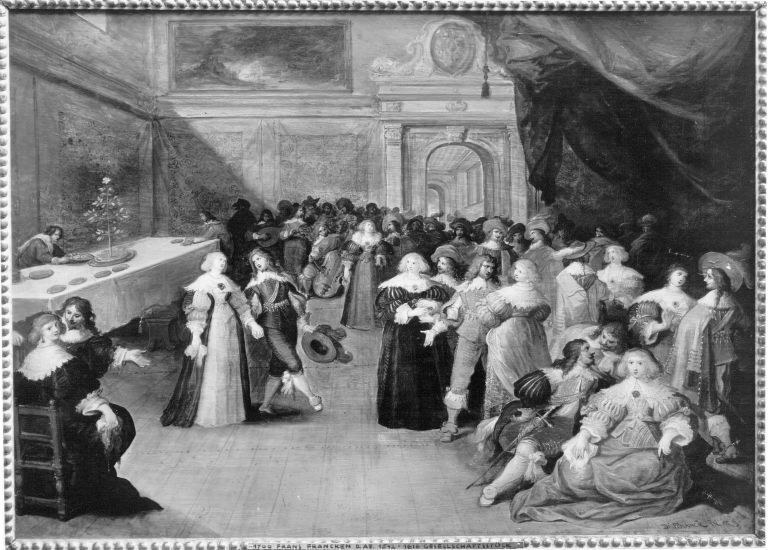
This image documents the formal function of court dance in Flemish society: dance as organized social ceremony, not spontaneous expression. It shows how the presence of music, structured audience, and formal dress transformed the meaning of movement. For anyone studying the social history of dance, or how Renaissance courts managed spectacle and hierarchy through bodily practice, this work is essential visual evidence.
What you are looking at
A crowded interior gathering fills a palatial Renaissance hall lit by high windows and a distant archway. The scene depicts a music and dance society—a formal social assembly of the Flemish elite. In the center-left, two couples occupy the dance floor in measured formation; the dancers nearest us wear rich fabrics—the women in pale silk gowns with full skirts and the men in dark doublets and hose. Around them clusters a densely packed audience: standing figures in blacks and grays observe from the margins, while seated women in pale silks and headdresses occupy the foreground right, some with children. A lute player sits at left; musicians gather elsewhere. The lighting is even and architectural, emphasizing the formal social order: the dancers isolated and framed, the onlookers arranged by rank and gender. The moment captures not the frenzy of movement but the controlled ceremony of display—the purpose of the gathering is to be seen, to participate in courtly ritual.
The dancing
The active dancers move in paired formation, arms at ease and bodies upright, suggesting a stately processional or figura rather than rapid footwork. Their posture is formal and frontal; weight appears centered and controlled. The nearest dancers face toward the architectural center of the hall, their line suggesting either a branle or a pavane—a sideways or forward progression without violent arm movement or elevation. The stationary figures (easily forty or more) arrange themselves deliberately: some gesture in conversation, others turn to observe, children cling to their mothers. This is not a working partnership of dancers and musicians but a hierarchical spectacle where most are witnesses.
The dance depicted
The dance appears to be a stately Renaissance court form, most likely a pavane, branle, or similar processional figure danced in pairs or small groups. The upright posture, measured spacing, and formal dress match early 16th-century Flemish court practice. The gathering itself—the *Musik- und Tanzgesellschaft* (music and dance society)—suggests an organized social club rather than improvised festivity, a context consistent with the structured, visible behavior of the dancers. The dance serves as the focal point of a formal social assembly, but the artist emphasizes the social and observational aspects equally with the movement itself. The specific style cannot be determined from gesture alone, but the context and deportment strongly indicate a historic-renaissance dance tradition.
How it was made
This is an engraving (or possibly a fine pen drawing; the record does not specify). The technique allows for precise linear detail and a high degree of finish: every figure is individually characterized, the architecture is rendered in perspective, and the tonal gradations create a sense of depth despite the shallow picture plane. The technique required multiple preparatory drawings and careful burin work or pen-work, implying a work made for circulation as a print and intended for a educated audience—collectors, court officials, other artists. The clarity of detail suggests this may be a document of actual practice or at least a faithful rendering of type.
About this work
This is a Flemish engraving of a formal Renaissance social gathering centered on a courtly dance. It depicts a *Musik- und Tanzgesellschaft*—a music and dance society—the kind of organized ceremonial assembly that structured elite leisure in 16th-century Flanders. The work documents not only the dance itself but the social function of dance: its role as a public display of status, refinement, and order. By filling the composition with witnesses—mothers, children, attendants, musicians—the artist makes clear that to dance was to perform for a structured audience and that to attend was to confirm one's place in a social hierarchy.
The work belongs in a gallery about dance because it captures a moment when dance was not entertainment or personal expression but civic ritual. It shows how the body moved in a specific place and time, yes—but it shows equally how dance produced and performed social structure. For historians of dance, music, and early modern society, this image is a precious record of actual or representational practice.
How to look at it
Focus first on the two pairs at the center: their posture, the distance between them, the direction they face, and the absence of rapid or elevated movement. These details tell you the *kind* of dance. Then look outward: the arranged audience, the musicians placed strategically, the children being held, the adults turned toward the dancers. The artist is showing you a social structure, not just a moment of motion. Notice which figures are lit and which are in shadow; the dancers are brightest, confirming their role as spectacle. Finally, attend to the architectural framing—the archway, the regular floorboards, the high windows—which emphasizes that this is a formal space with rules, not a garden or tavern.
The artist
Frans Francken the Younger (1581–1642) was a prolific Flemish painter and printmaker, the son of Frans Francken the Elder. The Franckens were a dynasty of court and guild painters based in Antwerp, known for detailed narrative scenes, religious subjects, and court life. Frans the Younger was particularly skilled at densely populated interiors and genre scenes that reveal the customs, dress, and social hierarchies of Flemish society. His works circulated widely as engravings and were collected by educated elites across northern Europe. He had a gift for rendering individual figures within crowded compositions and for capturing the texture of social life—ritual, ceremony, rank, and gesture—with anthropological precision.
The period
In early 17th-century Flanders, organized dance societies—*Gesellschaften* or sodalities—were fashionable among the urban elite. These were semi-formal clubs that met to dance, listen to music, and perform sociability according to rules of decorum. The dance forms themselves—pavanes, branles, and galliards—had been codified in the 16th century by dancing masters like Arbeau and Caroso and were disseminated through printed instructional books. By the time Francken painted this scene (c. 1630), these Renaissance forms were well established but beginning to cede ground to French baroque styles. The engraving served as a record of Flemish courtly life and as a guide to proper social behavior—how to dress, whom to watch, when to dance, and how to order oneself within a hierarchy. Such prints were collected by merchants, nobles, and civic officials.
Where it lives
The work is held at Wikimedia Commons, indicating it is in the public domain or has been digitized for open access. It is listed as an engraving (medium not formally recorded in the catalogue). The title *Musik- und Tanzgesellschaft* (Music and Dance Society) appears in the catalogue record and may be inscribed on the plate or added later; the work documents a specific social form characteristic of early 17th-century Flemish urban culture.
Dance in this work
Questions about this work
What dance are these people doing?
The specific form cannot be named with certainty from the image alone, but the posture, spacing, and dress suggest a Renaissance court dance—most likely a pavane, branle, or similar stately processional figure. The dancers move in measured pairs with upright carriage and minimal arm movement, consistent with early 16th-century dancing-master notation. The formal setting and the presence of musicians suggest a choreographed or rule-governed form rather than improvisation.
Why are there so many people just standing around?
This is a formal social gathering where participation in dance and observation of dance were equally important rituals. The majority of attendees were witnesses—their role was to see and be seen, to confirm their status by attendance, and to judge the quality and decorum of the dancers. This reflects the social function of court dance in early modern Flanders: to display hierarchy and refine behavior.
How do we know this is Flemish?
The artist is Frans Francken the Younger, an Antwerp painter and printmaker. The setting, dress, and social form depicted are consistent with Flemish urban elite culture of the 1630s. The title *Musik- und Tanzgesellschaft* (using the German term for such societies) and the specific organization of the scene reflect Flemish courtly practice and the circulation of such images in northern European printmaking.
Was this a real event or an imagined ideal?
Almost certainly a type rather than a portrait of a specific event. Francken's composition shows a typical *Musik- und Tanzgesellschaft*—an organized social club. The precision of the detail and the clear social hierarchies suggest the artist drew from observation and from actual practice, but the composition is a constructed example of the form, intended to instruct or document proper behavior.
More dance artwork





