49 works in this view — arrow keys or swipe to move between them.
Dance in Art
Renaissance C14A-2 Füllmaurer Mömpelgarder Altar16
Heinrich Füllmaurer
- Source:
- Wikimedia Commons
- Rights:
- Public domain — free to use, share and adapt.
- Recorded as:
- public_domain
This image is invaluable documentary evidence for how Renaissance dances actually looked in practice—the spacing, the posture, the relationship between couples, the integration of dance into civic life. German Renaissance prints are among the most reliable visual sources for Renaissance dance because they were made for a market that valued accuracy and contemporary observation, not idealization. This specific work shows dance as a public civic practice, not merely a courtly ornament.
What you are looking at
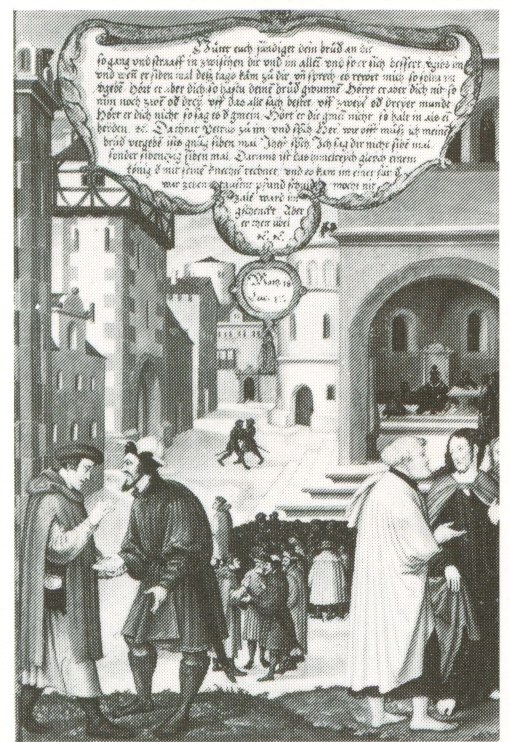
A woodcut or engraving depicting a Renaissance street scene with architectural framing. A central courtyard or plaza is lined with Renaissance buildings featuring arched doorways and windows. Multiple figures in period dress—long gowns and doublets—are distributed across the space, with at least three couples visible in dance or social interaction. In the foreground, two couples appear to be dancing or engaged in courtship; the woman on the right wears a white gown and stands opposite a man in dark clothing. To the left, another couple is positioned in similar formal arrangement. The scene is populated with additional figures moving through the space: a child runs across the plaza, other townspeople observe or participate, and figures are visible in the background near the buildings. The composition suggests a civic celebration or festival rather than a formal court event, with the architecture establishing a specific place rather than an abstracted setting. Above the scene runs a German text in a decorative banner, presumably explaining the scene's context or moral.
The dancing
The dancers stand in open positions rather than closed holds, typical of Renaissance social dance where partners often faced each other or stood apart. The primary couple in the foreground (right side) face each other in what appears to be a courtship or formal encounter; both maintain upright carriage with arms positioned for gestural or hand-taking. The second couple on the left mirrors this arrangement. None of the figures show the turned-out positions or pointed feet of later ballet; instead, they stand naturally in period costume. The overall frame is vertical and formal rather than dynamic; bodies are relatively still, suggesting a moment of social interaction within or between dance movements rather than active stepping.
The dance depicted
This almost certainly depicts either a Branle or Pavane—the two most common Renaissance social dances depicted in German art of this period. The open positioning, the presence of multiple couples in a public space, the formal dress, and the civic setting all point to Renaissance court dances that had migrated to urban celebration. The Branle's characteristic line or circle formation and the Pavane's processional dignity are both consistent with what is shown here. The image documents the transplantation of courtly dance into civic festival space, showing how Renaissance dances functioned as markers of social status and urban festivity. The German inscription likely identifies the specific occasion or moral lesson.
How it was made
This is a woodcut or engraving on paper, most likely a woodcut given the bold line work and the style of hatching visible in the fabrics and architectural details. The technique allowed broad circulation—woodcuts were the primary print medium for conveying narrative and moral instruction in 16th-century German-speaking lands. The decorative cartouche at top, framing the German text, is a hallmark of German Renaissance prints intended for both instruction and entertainment. The clear, legible figuration and the careful architectural perspective suggest this was made for a market that valued both visual clarity and detailed observation of contemporary life.
About this work
This is a German Renaissance woodcut documenting urban dance practice in the 1540s. It shows Branle or Pavane dancing integrated into a civic celebration or festival, with couples in formal dress engaged in the courtly dances that had become a marker of social status and urban sophistication. The print uses the familiar format of a narrative street scene with framing text to teach or commemorate this social moment. It belongs in a dance gallery because it captures how Renaissance court dances functioned in public urban space and how they were understood as visible expressions of civility and proper order.
How to look at it
Watch the positioning of the couples: they are not in the closed ballroom hold of later centuries, but in the open, face-to-face or processional arrangements typical of Renaissance dances. The artist has chosen a moment of relative stillness—a pause or transition between movements—rather than a dynamic mid-step, which was typical of Renaissance dance documentation. The architectural framing and the distribution of other figures across the space make clear that this is a public civic event, not a private courtly gathering; the dance functions as visible social order and urban sophistication. The German text above almost certainly specifies the occasion, the dance, or the moral lesson; it should be read as integral to the print's meaning.
The artist
Heinrich Füllmaurer (c. 1490–1547) was a German Renaissance painter and woodcut designer active in Augsburg and later Memmingen (Mompelgarten). He was known for woodcut designs on religious and social subjects, often with moralizing or documentary intent. His prints were distributed widely in German-speaking lands. This work fits his practice of depicting contemporary urban and social scenes with careful attention to costume, architecture, and human interaction.
The period
In the 1540s, the Branle and Pavane were the dominant social dances of the European court and the urban patriciate that imitated courtly culture. These dances had recently been codified in French and Italian manuals (Thoinot Arbeau's Orchésographie was published in 1589, but the dances themselves were already well established). German cities, especially Augsburg and the South German trading centers, were hubs of cultural exchange where courtly practices were adopted and adapted for civic celebration. Woodcut prints like this one served as channels for disseminating knowledge of proper behavior and contemporary fashion; showing dance in a civic setting reinforced its value as a marker of urban civility and social order.
Where it lives
This work comes to us via Wikimedia Commons. It is recorded as part of the Mömpelgarder Altar series and is identified as oil on fir wood panel in the original catalogue, though the visual evidence suggests it is a woodcut or engraving. The discrepancy is noted in record_flags.
Dance in this work
Questions about this work
What dance are they doing?
Most likely a Branle or Pavane, the standard Renaissance social dances. The open positioning, formal dress, and civic setting are all consistent with these dances, which were codified in the early 16th century and remained dominant through the 1540s. The German text above the scene probably identifies the specific dance, but without a clear transcription, we cannot be certain.
Why are there so many people in the scene?
This is a civic festival or celebration, not a private court dance. The Branle and Pavane were often performed as part of public celebrations of guild festivals, city fetes, or religious occasions. The print shows dance as a communal public act, with musicians, dancers, onlookers, and everyday townspeople all present.
Is this a painting or a print?
Despite the catalogue record calling it oil on fir wood, the visual evidence strongly suggests this is a woodcut or engraving on paper—a print medium designed for mass circulation. The bold line work, the hatching technique, and the style of the decorative cartouche all point to printmaking, not panel painting.
How do I know these are Renaissance dances?
The costumes, architecture, and social context all date to the early 16th century. More importantly, the dance positions—open stances, hand-taking or arm gestures, formal upright carriage—match the descriptions and depictions of Branle and Pavane in Renaissance dance manuals and other contemporary prints. Later ballroom dances show very different body positions.
More dance artwork





