49 works in this view — arrow keys or swipe to move between them.
Dance in Art
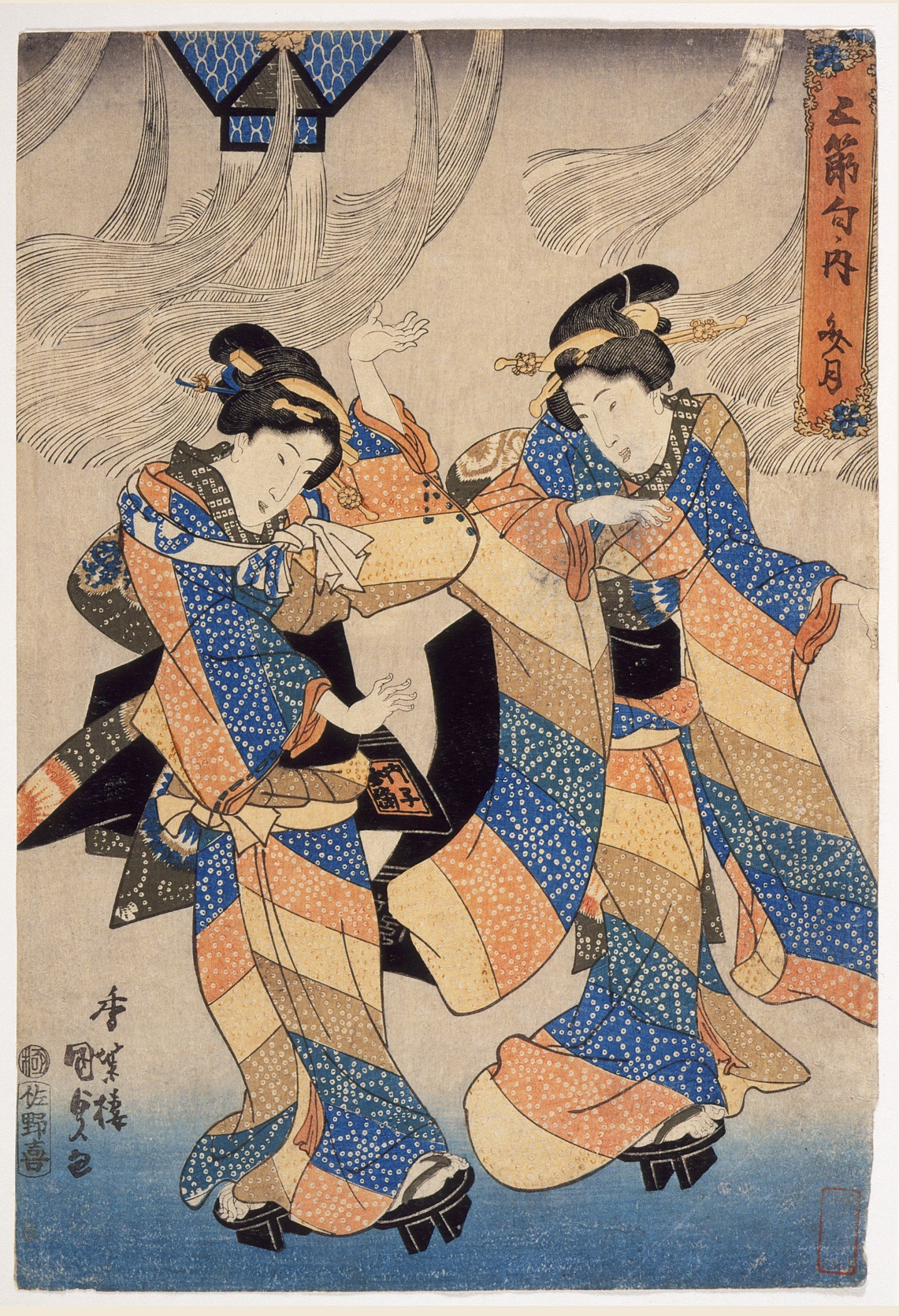
Tanabata Festival Dance
Utagawa Kunisada
- Source:
- Wikimedia Commons
- Rights:
- Public domain — free to use, share and adapt.
- Recorded as:
- public_domain
Female dance in early modern Japan is poorly documented in Western dance history, which tends to center male performance and martial forms; this print offers a visual record of how women danced together in formal, celebratory contexts and how that practice was valued enough to be reproduced and circulated as fine art. The image reveals the aesthetic principles of the period—restraint, coordination, elegance, and the integration of dress as performance—and invites questions about the relationship between seasonal ritual, gender, and artistic practice in urban Japan.
What you are looking at
Two young women in richly patterned layered robes dance together indoors, their figures nearly touching as they perform in synchronized, mirrored movement. Both wear deep blue robes with contrasting orange and cream geometric patterns, their hair arranged in the elaborate topknot style of early 19th-century Japan. The woman on the right leans slightly forward with her right arm extended, while her partner mirrors the gesture with gentle asymmetry; their bodies show the easy familiarity of practiced dancers moving in concert. The background is rendered in pale ink with flowing horizontal lines suggesting either silk curtains or the interior architecture of a formal space, while a blue canopy or noren hangs above them. The composition captures a moment of elegant, restrained motion—not the explosive energy of martial or acrobatic performance, but the refined coordination of courtly or festive celebration.
The dancing
Both dancers occupy a close, parallel spatial relationship with synchronized arm positions and forward-leaning torsos that suggest trained coordination. The woman on the right extends her right arm with a slight flourish, while her partner's left arm echoes the line; both maintain upright spines despite the forward inclination. Their weight appears distributed evenly, their feet placed carefully within voluminous robes that conceal footwork, and their gaze directed downward in the demure convention of formal female performance. The pairing and mirror-image quality suggest this is couple or duo choreography rather than individual display.
The dance depicted
This depicts the Tanabata festival dance (as the title indicates), a seasonal celebration in Japan traditionally performed by young women and girls. The Tanabata festival, observed in summer, commemorates the meeting of two star-crossed deities and was marked by elaborate pageantry, music, and synchronized dancing among the urban merchant and samurai classes. The image shows the refined, slow-moving aesthetic of female court or celebratory dance (likely related to odori or other formalized social dance), characterized by fluid arm movements, modest posture, and the emphasis on coordinated beauty rather than technical virtuosity. The dancers appear to be moving through a formal figure or processional element rather than a vigorous or gymnastic sequence.
How it was made
This is a color woodblock print (ukiyo-e), a medium that dominated Japanese visual culture in the Edo and early Meiji periods. The technique allowed for precise registration of multiple color layers—here the deep indigo, warm orange, pale cream, and black outlines—and enabled mass reproduction for urban audiences. Woodblock printing required planning and coordination between carvers and printers, making it a collaborative medium; the flattened perspective, bold outlines, and decorative surface pattern are all characteristic of the form. This print's inclusion in a series of seasonal festivals suggests it was part of a commercial publication aimed at educated urban consumers interested in theater, fashion, and cultural celebration.
About this work
This early 19th-century Japanese woodblock print documents the Tanabata festival dance, a seasonal form of celebration performed by women in merchant-class and samurai households. The image captures two dancers in synchronized motion, their elaborate robes and formal posture conveying both social status and trained refinement. As a ukiyo-e print, it circulated widely in urban Japan and offers rare documentary evidence of how women's dance was understood, performed, and valued in Edo-period society. The print belongs to a series on seasonal festivals, suggesting that dance was integral to how Japanese culture marked the ceremonial calendar and celebrated the turning of the year.
How to look at it
Observe the careful symmetry and mirroring of gesture between the two figures—this is not coincidental movement but deliberate choreographic design meant to display harmony and training. Notice how the artist has rendered the density and weight of the layered robes, which constrain and shape the dancers' movement; this is not free-form dance but performance within formal dress codes that carry social meaning. Pay attention to the faces and eyes, which are downcast in a demure convention that signals respect and formality rather than extroversion. Finally, look at how the artist has placed the dancers within a shallow, decorated interior space that frames them as precious objects on display, a compositional choice that reveals how female dance was valued and viewed in this period.
The artist
Utagawa Kunisada (1786–1865) was one of the most prolific and commercially successful ukiyo-e artists of the late Edo and early Meiji periods, known for theater prints, portraits of actors and beauties (bijin-ga), and historical and literary scenes. He founded his own workshop and trained numerous students; his prints were widely distributed and influenced the visual culture of his time. Kunisada excelled at rendering costume, pattern, and the social life of the urban merchant and entertainer classes, making him an ideal artist for a series on seasonal celebrations and festivals.
The period
In early 19th-century Japan, the Edo period was in its final decades—a time of urban cultural flourishing, strict social hierarchy, and a thriving commercial print market. Seasonal festivals were important markers of the ceremonial calendar, and dance was a central component of festival celebration, particularly among the merchant and samurai classes. The ukiyo-e genre was at its commercial peak, with artists like Kunisada producing elaborate series on every aspect of contemporary social life. At the same time, female performance and dance were becoming increasingly visible in urban culture, though formal documentation was rare; prints like this one offer insight into how women's dance was understood and aestheticized.
Where it lives
The print is held by the Los Angeles County Museum of Art (LACMA) and is documented as part of their Japanese Art collection. It is identified as the left print of a triptych, suggesting it was originally part of a larger composed work; the title cartouche on the upper right edge bears Japanese characters identifying it as part of the "Five Seasonal Festivals" series. The source for this record is Wikimedia Commons, which provides access to the digitized image.
Dance in this work
Questions about this work
What is the Tanabata Festival and why did it matter enough to depict in art?
Tanabata is a summer festival in Japan that celebrates the mythological meeting of two separated deities (Orihime and Hikoboshi), represented as stars. It was a significant ceremonial occasion in the urban calendar, marked by special dress, decoration, and performance. The fact that Kunisada dedicated a print series to seasonal festivals reflects how important these celebrations were to social identity and cultural memory in early 19th-century Japan.
How do we know these are dancers and not just women in formal dress?
The postures, synchronized arm gestures, and close coordinated positioning indicate trained movement and deliberate choreography rather than static display. The forward-leaning torsos and mirrored arm extensions show purposeful gesture; combined with the festival context identified in the title, this reading is supported. However, the restraint and fluidity of the movement would have appeared quite different from European or American theatrical dance of the same period.
Why are the dancers' feet not visible?
The voluminous, layered robes typical of formal Japanese dress completely conceal the feet and lower legs. This concealment was both a sign of status and modesty, and it reflected the aesthetic of female formal performance, where the upper body, arms, and face carried the primary expressive weight. It also meant that footwork and stepping patterns were less important to the visual composition of the dance than they might be in European ballet of the same era.
How was this print made and what does that tell us about who saw it?
This is a color woodblock print (ukiyo-e), a mass-produced medium that required skilled carvers and printers working from an artist's design. It would have been sold to educated urban consumers—merchants, minor samurai, and wealthy townspeople—who collected prints as affordable art. The circulation of such prints meant that images of festival celebration, theater, and beauty reached a broad urban audience, helping to create shared visual culture around seasonal festivals and female performance.
More dance artwork





