49 works in this view — arrow keys or swipe to move between them.
Dance in Art
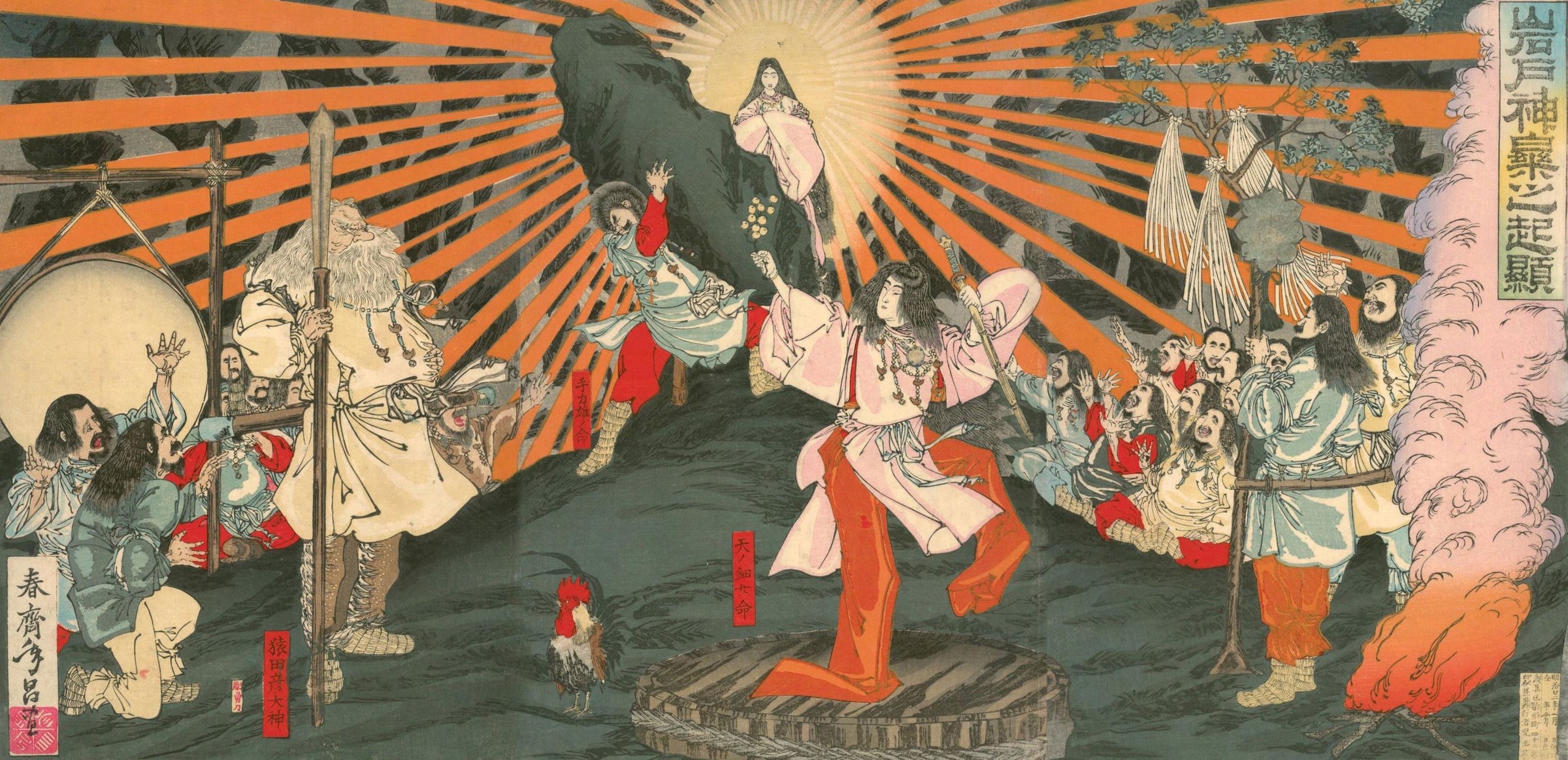
Origin of the Cave Door Dance (Amaterasu) by Shunsai Toshimasa 1889 cut repaired
Shunsai Toshimasa
- Source:
- Wikimedia Commons
- Rights:
- Public domain — free to use, share and adapt.
- Recorded as:
- public_domain
This print documents a critical moment in dance history: the mythological codification of dance's power to move both divine and human realms. For historians of Japanese performance, it reveals how the Iwato Kagura was visualized and understood in the late nineteenth century, when Japan was simultaneously modernizing and reasserting indigenous cultural traditions. The work shows that sacred dance was not confined to ritual or theater but was celebrated as a subject worthy of fine artistic treatment and wide distribution.
What you are looking at
This is a three-part woodblock triptych depicting the moment from Japanese mythology when the sun goddess Amaterasu emerges from the cave, restoring light to the world. The composition is organized around a dramatic radial perspective: brilliant orange and yellow rays emanate from a central point, creating an almost overwhelming sense of divine illumination. At the upper center, Amaterasu appears in white robes surrounded by a golden halo, gazing downward toward the assembled gods below. The foreground is crowded with figures in elaborate court dress—robes of red, green, and white with intricate patterns—some kneeling in reverence, others gesturing in celebration. To the left, a figure in a large white mask or headdress (possibly representing a demon or protective deity) stands beside attendants holding ritual implements. The stage-like setting suggests a sacred space or mountain sanctuary, with dark rocky formations framing the composition. At the very center of the lower register, a single female figure in a striking red robe with flowing white sleeves performs the fertility dance—her body angled dynamically, one arm raised, her posture suggesting vigorous, celebratory movement. Animals including roosters and dogs populate the scene, adding to the sense of universal rejoicing. The dense, crowded composition and the play of light create a scene of cosmic significance rendered in the detailed, decorative style of Meiji-era woodblock prints.
The dancing
The central dancer—Ame no Uzume—occupies a commanding position in the lower center, her body in a dynamic, open stance with one arm elevated and the other extended, suggesting energetic, uninhibited movement. Her red robe contrasts sharply with the white underdrapery, emphasizing the body's articulation and freedom. Around her, other figures are arranged in poses of watching, kneeling, or ceremonial gesture rather than dancing; their postures are formal and reverent, creating a clear distinction between the soloist and the assembled court. The density of figures and their varied positions—some full-length, some compressed into the background—suggests a processional or ritualistic gathering rather than a coordinated ensemble dance.
The dance depicted
This depicts the Iwato Kagura (岩戸神楽), the mythological origin dance performed by Ame no Uzume to lure Amaterasu from the cave. The dance is central to Japanese sacred tradition and appears in multiple historical and artistic contexts, including Shinto ritual, Noh theater, and ukiyo-e prints. The image captures not the formalized theatrical Noh version but rather a narrative representation of the mythological event: a moment of ecstatic, fertility-oriented performance designed to provoke divine curiosity and laughter. The dancer's open, expansive posture and the surrounding atmosphere of celebration distinguish this from the more restrained, codified movements of later theatrical traditions. The work documents a foundational moment in Japanese performance culture—the idea that dance itself has cosmological power.
How it was made
This is a woodblock print (likely a triptych comprising three separate blocks), a medium that allowed for mass production and wide circulation in Meiji Japan. The technique is evident in the bold outlines, flat color fields, and the sophisticated use of overprinting to create the layered orange rays that dominate the composition. The precision of registration (the alignment of multiple blocks) and the handling of metallic pigments (gold and silver) suggest a high-quality production. The 1889 date and the record's notation of "cut repaired" indicate this is a later impression or a repaired block; woodblocks were often reworked to extend their commercial life.
About this work
This is a Meiji-era woodblock triptych by Shunsai Toshimasa (Spring Studio) depicting the mythological origin of Iwato Kagura, one of Japan's most sacred dances. The work combines visual spectacle—dramatic radial light, crowded composition, brilliant color—with serious religious content: the moment when divine dance restores cosmic order. It belongs to a rich tradition of ukiyo-e prints that depicted Shinto and Buddhist sacred narratives alongside popular theater and court life, and it demonstrates how printmakers used the formal resources of woodblock technique to render both the narrative and the transcendent quality of sacred performance. The image is not a record of how the dance was actually performed in 1889, but rather a visionary interpretation of a foundational mythological moment, translated into the idiom of late Meiji visual culture.
How to look at it
Attend first to the radical spatial composition: the print creates a single vanishing point in the divine light at the top center, drawing the viewer's eye upward toward Amaterasu and downward toward the dancing figure. This double movement mirrors the mythological action—Amaterasu's emergence and Uzume's upward gaze and gesture. Notice how the artist uses the dancer's red robe and open posture as the visual anchor of the lower composition, keeping her distinct and legible despite the crowded surround. The choice to show the moment of performance rather than the moment of emergence reflects a printmaker's understanding that dance, not divinity alone, is the subject: the work privileges human movement as the cause of cosmic change.
The artist
Shunsai Toshimasa (春斎年昌) was active as a woodblock designer during the Meiji period, a time of rapid transformation in Japanese print culture. The name suggests association with the 'Spring Studio' (Shunsai), a productive atelier. The artist worked in the ukiyo-e tradition but in the later nineteenth century, when the medium was navigating the challenge of Western artistic influence and new technologies like chromolithography. Works of this scale and ambition—a three-part triptych with sophisticated color work—required significant commercial backing and suggest the artist had access to skilled carvers and printers.
The period
The work dates to 1889, during the Meiji Restoration (1868–1912), a period of intense cultural negotiation in Japan. While Japan was eagerly adopting Western technologies and artistic styles, there was simultaneous interest in documenting and elevating 'traditional' Japanese culture as a source of national identity. The Iwato Kagura, as a foundational Shinto myth, represented authentic Japaneseness. At the same time, woodblock printing itself was under pressure from Western-style lithography and modern media; artists and publishers used ambitious historical and mythological subjects to assert the continued relevance and prestige of the medium. This print thus sits at the intersection of modernization and cultural preservation.
Where it lives
This work is known from Wikimedia Commons and was held in a collection with the accession references KI 10404-1, KI 10404-2, and KI 10404-3 (the three sheets of the triptych). The record notes that the print was 'cut repaired,' indicating this is a later impression from a woodblock that had been damaged and restored—a common practice that extended the commercial life of valuable blocks. The publisher Kodama Matashichi (児玉又七) was an active producer of woodblock prints in the Meiji period.
Dance in this work
Questions about this work
What is the Iwato Kagura and why does it matter in Japanese dance history?
The Iwato Kagura is the mythological origin story of Japanese sacred dance, documented in the Kojiki (712 CE). According to the myth, the sun goddess Amaterasu hid in a cave in anger, and the goddess Ame no Uzume performed a wildly ecstatic dance to lure her out, restoring light to the world. The story establishes dance as a cosmological force—a practice capable of moving gods and reshaping reality. This foundational narrative shaped Japanese approaches to dance as spiritual and social practice for centuries.
How does this print differ from how the Iwato Kagura was performed in actual Shinto ritual or Noh theater?
This print is not a documentary image of ritual or theatrical practice, but a narrative and visionary interpretation of the mythological moment. Actual Shinto kagura performances tend to be more austere and formalized; Noh versions (such as the play *Ame no Uzume*) use highly codified gesture and a restrained aesthetic. The print emphasizes ecstatic, celebratory movement and spectacular visual display—conventions more suited to woodblock art and popular entertainment than to the subtlety of either ritual or Noh.
Why was this subject chosen for a three-part woodblock triptych in 1889?
In the Meiji period, Japan was both modernizing rapidly and reasserting indigenous cultural identity. Publishing large-scale, high-quality prints depicting sacred Shinto mythology served multiple purposes: they demonstrated the prestige and sophistication of Japanese visual culture, asserted the value of traditional subjects in a modernizing nation, and sustained the market for woodblock printing against competition from Western lithography and photography. The Iwato Kagura, as a foundational Japanese myth, was particularly suited to this project of cultural assertion.
More dance artwork





