49 works in this view — arrow keys or swipe to move between them.
Dance in Art
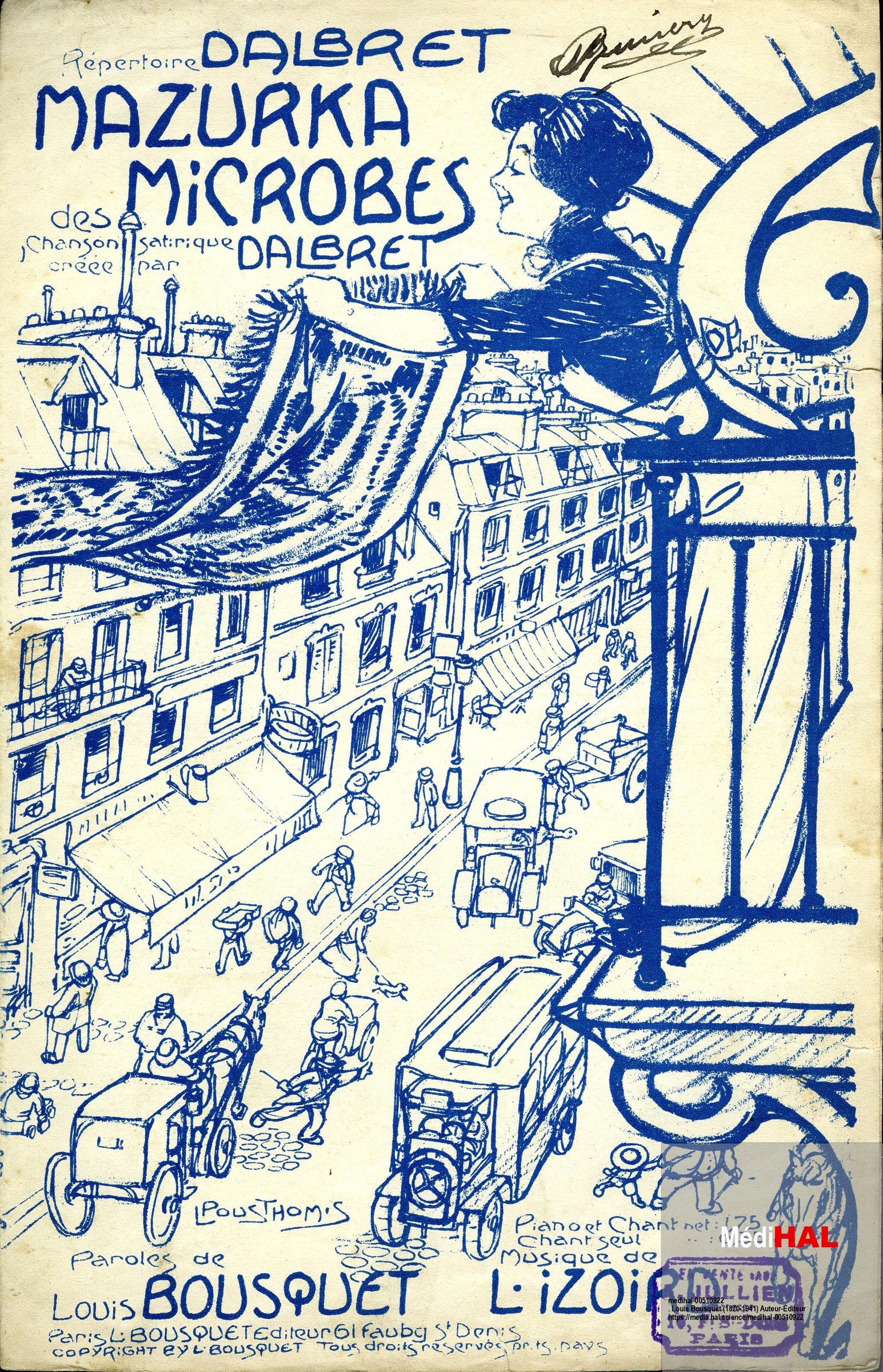
Mazurka des microbes - chanson satirique créée par Dalbret -Paul Dalbret- -illustration Léon Pousthomis) (MédiHAL 510922)
Éliane Daphy / Institut Interdisciplinaire d'Anthropologie du Contemporain / National Center for Scientific Research
- Source:
- Wikimedia Commons
- Rights:
- Public domain — free to use, share and adapt.
- Recorded as:
- public_domain
Sheet-music covers were the most widely circulated dance images of the early 20th century, shaping how ordinary people imagined social dancing. This work shows how the mazurka—a specific, codified European dance—was transformed into a symbol of lightness, foreignness, and comic excess in the hands of Parisian commercial designers, and how dance imagery could carry meanings far beyond the steps themselves.
What you are looking at
This is the cover design for a satirical song published in 1912, rendered in blue ink on cream paper. A woman in profile floats or dances above a Parisian street scene, her body angled sharply upward as if caught mid-leap or suspended in air. She wears a feathered cape or cloak that sweeps dramatically behind her, and her dark hair is styled in an Edwardian updo. Below her stretches a busy urban street lined with Haussmann-style apartment buildings; pedestrians, motorcars, and horse-drawn vehicles crowd the pavement in a lively but orderly composition that recedes toward the horizon. The artist has used flowing, decorative Art Nouveau lines to frame the composition—particularly a bold swirling motif on the right edge—and the contrast between the elegant, suspended figure above and the bustling street life below creates a whimsical tension.
The dancing
The central figure is a single woman, shown in strict profile with her body tilted sharply backward or upward, legs extended or lifted asymmetrically. Her arms appear to be raised, with one swept back into the folds of her cape. The pose suggests weightlessness rather than grounded movement—she does not appear to be executing a codified dance step but rather floating or being lifted. Her frame is elongated and stylized in the Art Nouveau manner, not naturalistic. No partner is visible, and her relationship to the street scene below is vertical rather than spatial—she hovers above it rather than inhabiting it.
The dance depicted
The title *Mazurka des Microbes* (Mazurka of the Microbes) promises a mazurka, a Polish social dance in triple meter associated with grace and elevating movement. The image captures an exaggerated, fantastical version of that characteristic lightness: the woman's upward tilt and the sweep of her cape suggest the buoyant, rising energy of the mazurka as it was understood in early 20th-century Paris, where Polish dances held romantic and exotic appeal. However, the satirical context—the title references microbes (germs or bacteria), and this was created as a cover for a comedic song—means the dance depicted is stylized and ironic rather than naturalistic. The work visualizes not the dance itself but the *idea* of the dance as it circulated in popular culture.
How it was made
This is a lithographic or ink illustration, likely a color lithograph or chromolithograph (suggested by the controlled blue tone, the sharp registration, and the commercial finish). The technique allowed the artist to combine flowing Art Nouveau lines with detailed architectural rendering and to achieve broad distribution—sheet music covers were mass-produced and circulated widely, reaching singers, musicians, and the general public. The clean linework and decorative framing were characteristic of Belle Époque commercial design, and the medium's affordability made such covers a major vehicle for visual culture and dance imagery in the early 1900s.
About this work
This is a 1912 sheet-music cover for a satirical song composed by L. Izoird with lyrics by Louis Bousquet and illustrated by Pousthomis, commissioned by the Éditions Bousquet publishing house in Paris. It depicts a woman suspended in an exaggerated, weightless version of the mazurka, a Polish social dance that had entered French urban culture as a symbol of elegance and foreign glamour. The contrast between the ethereal, floating dancer and the prosaic, crowded street below—full of modern motorcars and apartment buildings—creates a playful tension between fantasy and everyday life. The work is a commercial object, a vector for both music and visual design, and it captures how dance imagery in this period served as a vehicle for satire, nostalgia, and the absorption of European folk traditions into metropolitan popular culture.
How to look at it
Notice the sharp angle of the dancer's body and the way her cape billows behind her: these are not the stable, grounded movements of a real ballroom dance, but a visualization of the *idea* of weightlessness and grace. The tiny figures in the street below, rendered with careful but diminished detail, emphasize the vertically of the composition and the dreamlike quality of the floating figure. The decorative swirl on the right and the architectural precision of the buildings create a frame that emphasizes how far removed this fantastical dance is from everyday urban life. The artist has rendered not a moment of actual dancing but a symbol—the mazurka as Parisian imagination conceived it.
The artist
Léon Pousthomis (also listed as L. Pousthomis) was a commercial illustrator and designer working in Paris during the Belle Époque and early 20th century. He specialized in Art Nouveau-style cover designs for sheet music and entertainment publications, where his distinctive use of flowing lines, profile poses, and decorative framing made his work instantly recognizable. His practice was typical of the illustrator-designers who shaped the visual language of French popular culture in this period, translating literary and musical content into commercially successful visual form.
The period
The mazurka experienced a second wave of popularity in European dance culture during the late 19th and early 20th centuries, after its initial arrival in the 1830s. It was associated with Romantic-era ballet (appearing in works like *Swan Lake*) and with fashionable salon dancing, but it also became a subject of parody and comic treatment in popular entertainment. The 1912 date places this work in the final years before World War I, when Paris was the unchallenged center of European popular culture and sheet-music design had become a major art form in its own right. The *fin de siècle* and Belle Époque fascination with non-European or historically distant dance forms—filtered through the lens of urban modernity—is fully on display here.
Where it lives
This work is held in MédiHAL, a digital collection of mediaeval and historical documents. It is catalogued as a sheet-music cover from the Éditions Bousquet publishing house in Paris, part of the commercial music culture of the Belle Époque. The presence of a publisher's mark and the standardized format confirm its role as a mass-produced cultural object.
Dance in this work
Questions about this work
What is the mazurka?
The mazurka is a Polish social dance in triple meter, known for its graceful, buoyant character and for the elevation and lightness of its movement. It entered European ballroom culture in the 1830s and remained fashionable through the 19th and early 20th centuries. It also appeared in Romantic-era ballet and became a symbol of exotic, European elegance in urban popular culture.
Why is it called 'Mazurka of the Microbes'?
This is a satirical work: the title is a joke. The song was intended as comic entertainment, and the pairing of the elegant, aristocratic mazurka with the lowly microbe (a recently discovered and culturally feared entity) created absurdist humor. We cannot fully interpret the satire without hearing the song itself, but the visual image suggests the contrast between fantasy and modernity.
Was this a real dance that people performed?
The mazurka was a real and popular social dance, danced in ballrooms and at fashionable events. This image, however, does not depict a naturalistic version of it. Instead, it visualizes a stylized, fantastical, and comic interpretation—the exaggerated lightness and the floating pose are part of the work's satirical tone.
Why was sheet-music cover design important?
Sheet-music covers were the primary means by which images of dance circulated in the early 20th century. They reached far beyond elite art audiences, appearing in middle-class homes, music halls, and street vendors. Illustrators like Pousthomis shaped how the general public imagined dance, making sheet-music design a major vehicle for both artistic innovation and popular culture.
More dance artwork





