49 works in this view — arrow keys or swipe to move between them.
Dance in Art
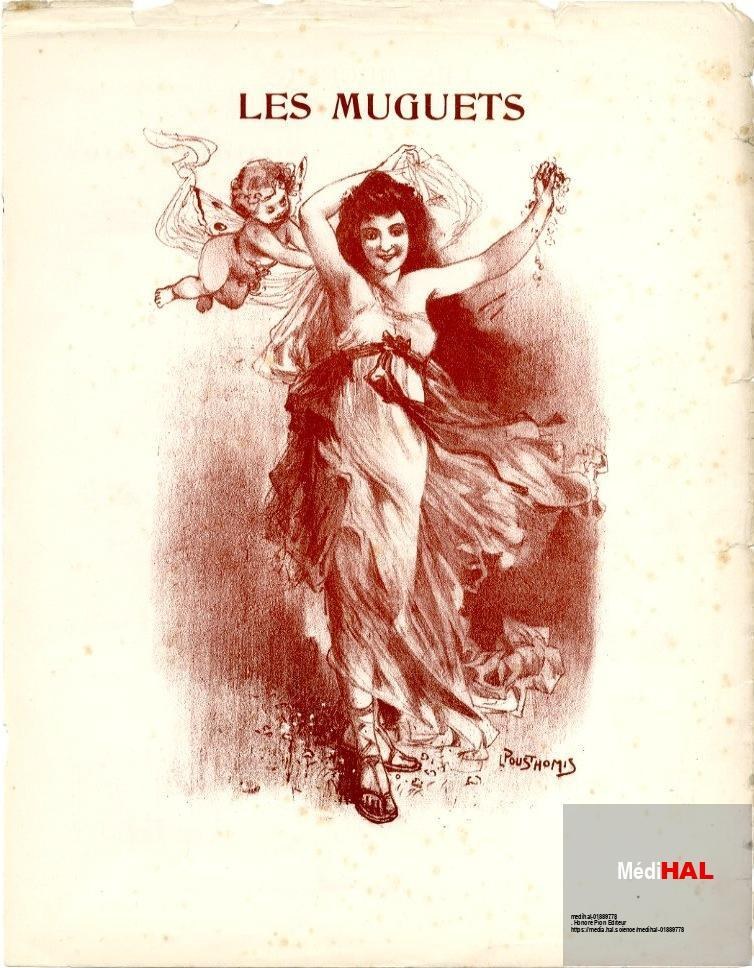
Les muguets - mazurka pour piano -couverture partition grand format- -illustration L Pousthomis (Léon Pousthomis 1881-1916)- (MédiHAL 1889778)
Éliane Daphy / Institut Interdisciplinaire d'Anthropologie du Contemporain / National Center for Scientific Research
- Source:
- Wikimedia Commons
- Rights:
- Public domain — free to use, share and adapt.
- Recorded as:
- public_domain
The work documents how the mazurka circulated as a salon dance in early 20th-century Paris, marketed to amateur dancers and musicians through illustrated sheet music covers. It also shows how a trained commercial illustrator understood and rendered a specific dance vocabulary—the spiral, the lift, the lyrical arm line—suggesting that dancers and artists shared a common visual language for this repertoire.
What you are looking at
This is a cover illustration for a piano score of *Les muguets*, a mazurka by composers A. Delattre and B. Devaux, published in Paris around 1909. A young woman in a flowing white and rose-colored dress dominates the composition, her body arched in a dynamic, spiraling pose that suggests the rotational energy of the mazurka. Her dark hair is swept back, and her right arm extends upward in an elegant gesture while her left arm curves across her body. A cherub or putto floats above her left shoulder, also rendered in sepia tones that warm the cream-colored paper. The woman's pose is buoyant and weightless—her feet barely touch the ground, which is suggested only by the faintest outline at the bottom of the frame. The entire composition spirals upward, emphasizing movement and musicality rather than a fixed moment. The illustration is signed by L. Pousthomis (Léon Pousthomis, 1881–1916) in the lower right.
The dancing
The primary figure is a soloist in a flowing theatrical dress, with the body in a three-quarter turn and a characteristic mazurka lift—the torso rises and turns while the lower body anchors the movement. Her arms are in a lyrical port de bras rather than a closed ballroom hold; the raised right arm and curved left suggest the ornamental, individualistic arm vocabulary of late 19th-century theatrical dance. The accompanying cherub is decorative rather than functional, reinforcing the work's romantic and ethereal tone. There is no partner visible, making this a solo or display piece rather than a couple dance.
The dance depicted
The work depicts a mazurka, a Polish national dance in triple meter that became a favorite of the Romantic ballet and the European dance salon in the 19th century. The title *Les muguets* (lily of the valley, a French spring flower) suggests a light, lyrical variant suited to a female soloist. The image captures the characteristic mazurka spiral—a turning, rising motion—rather than the sharp footwork and characteristic accent on the second or third beat that defines the dance. The pose is theatrical rather than vernacular, indicating this is a concert or ballet mazurka for a trained dancer, likely a soprano or ballerina performing in a Paris salon or theater.
How it was made
This is a color lithograph, identifiable by the crayon-like handling of the sepia and rose tones, the soft gradation of shadow, and the way the image sits on cream-colored paper typical of early 20th-century score covers. Lithography allowed for rapid, economical reproduction of cover art for sheet music, making it an ideal medium for marketing music to amateur pianists and dancers in the home. The technique's ability to render soft transitions and delicate line work suits the romantic subject matter and gives the image a warmth and immediacy that would have made it appealing on a music merchant's shelf.
About this work
This is the cover illustration of a piano score for *Les muguets*, a mazurka published in Paris circa 1909, illustrated by the French artist Léon Pousthomis. The work is a lithographed image of a woman in an elegant spiraling pose that captures the essence of the mazurka—a dance of Romantic ballet and the European salon. The image sits at the intersection of music publishing, theatrical dance, and graphic design at a moment when the mazurka was enjoying renewed popularity in Paris. It testifies to the close relationship between dance imagery and commercial sheet music in the Belle Époque: the cover sold the music to amateurs, and the image itself had to communicate the style and sentiment of the piece through a single figure.
How to look at it
Attend to the upward spiral of the body and the way the artist has frozen the dancer at the moment of greatest lift and turn—the mazurka at its most ethereal. Notice that the figure is not in a stable, grounded position but rather suspended in motion, which conveys the dance's characteristic rising action. The cherub and the loose, calligraphic shadows around the figure suggest lightness and buoyancy rather than weight or effort. The image tells you that by 1909, the mazurka was imagined as a light, romantic, almost weightless dance for women, very different from the earthy, stamping vernacular original.
The artist
Léon Pousthomis (1881–1916) was a French illustrator active in the Belle Époque, known for decorative and theatrical subjects. He worked in lithography and contributed illustrations to sheet music, periodicals, and theatrical programs during the height of Parisian café and salon culture. His style combines Art Nouveau influences—the flowing line, the decorative cherub, the ethereal female figure—with an accurate observation of dance movement and costume.
The period
The mazurka underwent a revival in Parisian dance culture during the 1890s and early 1900s, transitioning from a vernacular Polish dance to a staple of ballet and salon repertoire. By 1909, the mazurka was firmly established as a romantic, lyrical form, often performed by women soloists in ballrooms, theaters, and concert halls. Simultaneously, the commercial market for sheet music was booming: middle-class households purchased piano reductions of ballets and popular dances. Cover art had become an important marketing tool, and the most fashionable illustrators of the period (including Pousthomis) specialized in theatrical and dance subjects that appealed to the amateur performing public.
Where it lives
This is a cover illustration for a large-format piano score published by Honoré Pion et Cie., music publishers at 42 boulevard Bonne Nouvelle in Paris. The work is catalogued in the BNF (Bibliothèque Nationale de France) and is reproduced here from Wikimedia Commons. It is a commercial object, one of thousands of decorated score covers produced for the Parisian market in the early 20th century.
Dance in this work
Questions about this work
Is this a real painting or a print?
This is a color lithograph, a print made from a stone or metal plate. Lithography was the standard technique for illustrated sheet music covers in this period because it allowed artists to work in color quickly and economically. Each copy was printed, not hand-painted, so many copies were made and distributed through music shops.
Was the mazurka actually danced this way?
This is a theatrical or salon version of the mazurka, idealized for the stage and the ballroom rather than a faithful representation of how the dance was performed in Poland or among peasants. The spiraling pose, the ethereal lightness, and the decorative cherub all mark this as a Romantic-era interpretation, meant to appeal to audiences who saw the dance as exotic, poetic, and refined.
Who was Léon Pousthomis?
Pousthomis (1881–1916) was a French illustrator of the Belle Époque, active in Paris during the 1900s and early 1910s. He specialized in theatrical and dance subjects for sheet music covers, periodicals, and posters. He worked in lithography and his style blends Art Nouveau decorative elements with theatrical observation.
What is a mazurka?
A mazurka is a Polish national dance in triple meter, usually with a characteristic accent on the second or third beat. It became fashionable in European ballrooms and concert halls in the 19th century, and was adopted into ballet and salon dance. Famous composers like Chopin wrote mazurkas for piano, and dancers performed mazurkas as solo pieces in concerts and theatrical performances.
More dance artwork





