49 works in this view — arrow keys or swipe to move between them.
Dance in Art
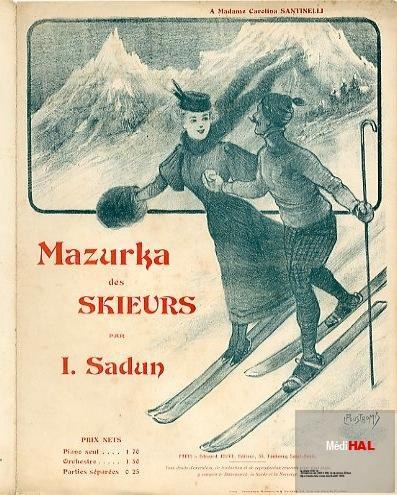
Mazurka des skieurs par I Sadun -couverture de la partition grand format- -illustration couleurs Léon Pousthomis- (MédiHAL 1176718)
Éliane Daphy / Institut Interdisciplinaire d'Anthropologie du Contemporain / National Center for Scientific Research
- Source:
- Wikimedia Commons
- Rights:
- Public domain — free to use, share and adapt.
- Recorded as:
- public_domain
This work documents the mazurka's reach into early 20th-century European popular culture at a moment when both ballroom dance and winter tourism were becoming mass leisure activities. It shows how traditional dance forms were reframed and repackaged to appeal to modern consumers—a practice that remains central to how dance genres survive and evolve.
What you are looking at
This is the cover of a musical score for a mazurka composed by I. Sadun, illustrated in color by Léon Pousthomis. Two skiers in contemporary winter dress occupy the foreground, silhouetted against snow-covered Alpine peaks. The skier on the left, wearing a dark jacket and hat with a pom-pom, looks back toward the figure on the right, who wears a matching outfit and grips a ski pole. Both are positioned on skis in a dynamic diagonal stance. The composition places them as a couple within the mountain landscape, their poses suggesting movement and social interaction rather than the technical rigor of competitive skiing. The title and composer credit appear in bold red lettering below the illustration.
The dancing
The two figures are oriented toward each other in a social configuration rather than in tandem skiing posture. Their arms are extended—the left skier's arm gestures expressively, while the right skier holds a ski pole. Both wear fashionable hats with upturned brims and substantial fur muffs, suggesting leisurely winter sport rather than athletic competition. Their weight appears distributed across their skis in a relatively upright stance. The spatial relationship between them—close, facing, attentive—mimics the open position of a ballroom partnership adapted to a winter setting.
The dance depicted
The mazurka, a Polish folk dance in 3/4 time with characteristic syncopated rhythm and energetic character, became a fixture of European ballrooms by the 19th century. This composition appears to be a novelty or fusion work: it takes the ballroom mazurka and relocates it to a winter Alpine setting with skiers. The work likely plays on the mazurka's reputation for playfulness and social energy, translating familiar ballroom choreography into the new leisure activity of skiing, which was becoming fashionable among the European middle classes in the early 20th century. The poses and relationship between the figures suggest they are performing or miming a dance step while on skis, rather than actually skiing.
How it was made
This is a chromolithograph—a color lithographic print—used as sheet music cover art. The technique allowed multiple colors to be printed from separate stone plates, enabling the vibrant teal and cream tones visible here. Chromolithography was the dominant commercial illustration method for sheet music covers from the 1880s through the 1920s, making this both affordable and widely circulating. The combination of sophisticated color printing with popular musical publishing suggests an audience of amateur musicians and dancers in middle-class households with access to leisure, travel, and fashionable culture.
About this work
This is a sheet music cover presenting a mazurka reimagined as a winter sport dance. Created in 1909 and published by Édouard Jouve in Paris, it represents a moment when European ballroom dance was intersecting with new forms of leisure and tourism—particularly the rise of Alpine skiing as a fashionable winter pastime. The work bridges two worlds: the tradition of the mazurka as a vital social dance form, and the emerging culture of winter sports among the urban middle class.
The image is valuable evidence of how dance genres traveled and transformed in the early 20th century. Rather than treating ballroom dance as static or contained within the dance hall, composers and illustrators were playfully adapting its forms to contemporary leisure activities. The cover art makes no claim that the mazurka and skiing were the same thing; rather, it invites viewers to see the mazurka's spirit of playfulness and social bonding as equally at home on a snowy slope as in a ballroom.
How to look at it
Attend first to the dynamic posture of the two figures—their forward lean, the extension of their arms, and their mutual orientation suggest a moment frozen mid-movement rather than static social standing. Notice the contemporary winter fashions: the hats, muffs, and tailored jackets place this firmly in the Edwardian leisure world. The composition deliberately positions the skiers as a dancing couple relocated to a mountain setting, using visual parallelism to invite the viewer to see both activities as expressions of modern, fashionable society. The color choices—the teal background suggesting winter sky or snow, the warm tones of the figures' clothing—enhance the sense of contemporary pleasure and recreation.
The artist
Léon Pousthomis was a French commercial illustrator active in the early 20th century, specializing in chromolithographic cover art for sheet music. His work is characteristic of the Belle Époque poster and music cover tradition, combining fashionable figures, elegant typography, and accessible color printing to create mass-market designs. Pousthomis worked in the idiom of leisure and contemporary life, depicting skiers, dancers, and fashionable society figures in settings that appealed to middle-class consumers. I. Sadun (composer) and the publisher Édouard Jouve are documented in French music-trade records, though Sadun remains a minor figure in music history.
The period
In 1909, the mazurka was more than a century old as a European ballroom dance, having been imported from Poland and refined in Vienna and Paris since the 1830s. By the Belle Époque, it was established repertoire for dance orchestras and amateur musicians. Simultaneously, Alpine skiing was transitioning from a transportation method and regional winter sport to an elite leisure activity. The Swiss and French Alps were being opened to tourism through rail and resort development, and skiing was marketed to wealthy Europeans as both fashionable and modern. This cover sits at the intersection: it shows how established cultural forms (ballroom dance) were being adapted to serve new leisure identities (the winter tourist).
Where it lives
This is a sheet music cover deposited for legal registration (as indicated by the EJ451 rating) with the Édouard Jouve publishing house in Paris. A copy is held in the Bibliothèque Nationale de France. The work is catalogued in MédiHAL, a digital repository for French research output, indicating its preservation and circulation within scholarly collections.
Dance in this work
Questions about this work
Was the mazurka actually danced on skis?
No. This is a playful, imaginary work. The mazurka remained a ballroom dance. The composer and illustrator have created a novelty by combining the familiar ballroom form with the new fashion of Alpine skiing, likely as a whimsical marketing concept for sheet music sales. The visual language of the cover invites the viewer to enjoy the fantasy rather than take it literally.
Who was I. Sadun?
Very little is documented about the composer I. Sadun beyond publication records. The name appears in French music trade catalogues of the early 1900s, but Sadun remains a minor figure in music history—one of many composers who wrote popular dances for amateur and professional musicians. This mazurka appears to be among his surviving published works.
What is chromolithography and why does it matter here?
Chromolithography is a color printing technique that allowed multiple colors to be printed by layering inks from separate stone plates. It was the dominant commercial illustration method for affordable color printing from the 1880s through the 1920s. For sheet music publishers, it made colorful, attractive covers economically feasible for mass production, allowing smaller publishers like Jouve to compete with larger houses and reach amateur musicians in middle-class households.
Why is this in a dance collection if it's about skiing?
Because the work documents how the mazurka—a living ballroom dance tradition—was being adapted, referenced, and imaginatively transformed in early 20th-century popular culture. It shows how dance genres intersected with tourism, leisure, and commercial visual culture. It is evidence of the mazurka's cultural reach and the creative work involved in keeping dance forms contemporary and commercially viable.
More dance artwork





