49 works in this view — arrow keys or swipe to move between them.
Dance in Art
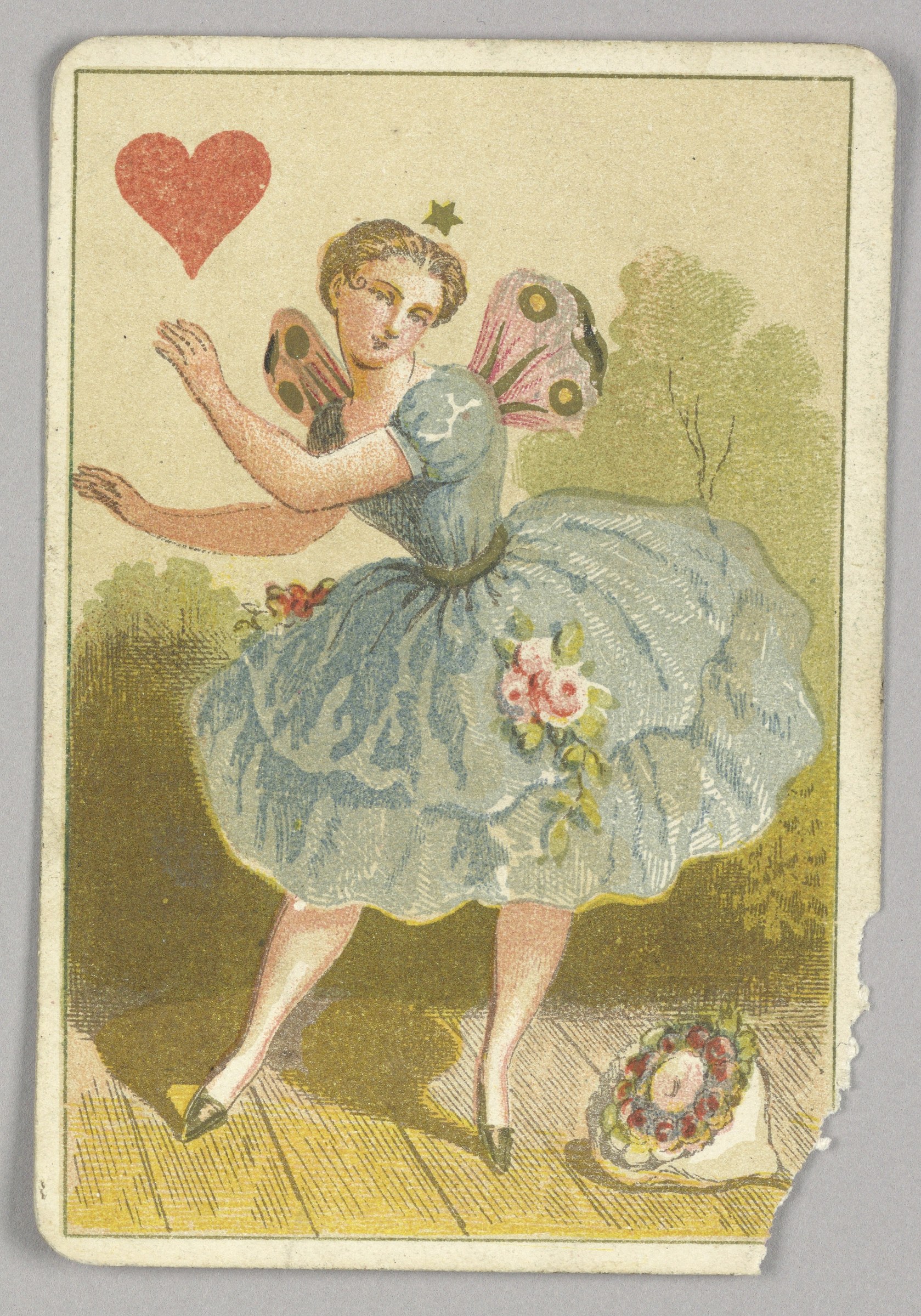
Playing Card, Queen of Hearts, late 19th century
Made by B.P. Grimaud
- Source:
- Wikimedia Commons
- Rights:
- Public domain — free to use, share and adapt.
- Recorded as:
- public_domain
For dancers and historians, this card is a rare window into how nineteenth-century audiences outside the opera house understood and consumed the imagery of romantic ballet. It shows that the fairy and sylph—characters and movement vocabularies created for the stage—became so visually dominant and culturally resonant that they could be deployed instantly, with minimal explanation, on a mass-produced object. The absence of any male dancer, partner, or dramatic narrative—and the focus on the isolated female figure in a state of weightless rapture—also reveals which elements of romantic ballet were considered most commercially and aesthetically compelling to the public imagination.
What you are looking at
A winged female figure in a pale blue tulle skirt dominates the card, posed in a dynamic leap or hovering mid-air against a soft yellow-green background. She wears a fitted blue bodice and her hair is styled in blonde waves with a small gold star hovering above her head. Her posture is open and buoyant—one arm extended upward and outward, the other raised—captured in a moment of weightless abandon. A cascade of pink and white flowers adorns the front of her skirt, and a wreath of flowers lies at her feet on the golden stage. Large pink wings with dark spots or eyespots spread from her back. In the upper left, a red heart symbol marks her as the Queen of Hearts. The figure's delicate ballet slippers, visible below the hem, and the theatrical handling of light and fabric suggest the convention of the fairy or sylph rather than earthly dance.
The dancing
A single female figure is shown in what appears to be a sustained jump or weightless suspension, not a static pose. Her body is upright and elongated, both arms raised and open—the upper arm lifted and the forearm extended, a position common in romantic-era ballet where verticality and ethereal suspension dominate. Her weight appears to rest on or just above the tips of her feet. The stance and arm carriage suggest training in theatrical dance, with the torso held proud and the movement directed upward and outward rather than toward another dancer or partner.
The dance depicted
This appears to depict a figure from romantic ballet of the mid-nineteenth century, most likely a sylph, fairy, or other supernatural character—a role type popularized by works such as *La Sylphide* (1832) and *Giselle* (1841). The winged form, celestial attributes (the star), and ethereal costume (tulle, flowers, pale colors) place her squarely in the fairy tradition of romantic ballet. Her pose—a sustained elevation with open, expansive arm placement—is consistent with the vocabulary of romantic ballet where the illusion of weightlessness and otherworldliness was paramount. The image does not show partnered dance or the close engagement with a male dancer that would characterize many of the most famous fairy scenes, but rather presents the female figure as the focus of fascination in her own right.
How it was made
This is a hand-colored transformation playing card, likely a chromolithograph or wood-engraved card with color applied by hand or in separate impressions. The delicate modeling of the figure's face and the refined gradation of colors—the pale tulle of the skirt, the subtle shading of the wings, the warm golden floor—suggest a skilled print process capable of reproducing fine detail across multiple color layers. Playing cards were a form of accessible popular art, produced in quantity and widely circulated across Europe; this card's style and subject matter suggest production in France in the latter half of the nineteenth century, when transformation decks (cards whose court figures could be read as other subjects) were fashionable novelty items.
About this work
This is a playing card—specifically a Queen of Hearts—from a transformation deck produced by B.P. Grimaud, a major French playing card manufacturer of the nineteenth century. Rather than a conventional court figure, the Queen has been reimagined as a winged aerial dancer or sylph, placing the image at the intersection of popular entertainment (playing cards), theatrical fashion (the craze for romantic ballet), and visual transformation (the conceit of the deck itself). The card captures an aesthetic moment in which ballet—particularly its supernatural and fairy-tale characters—had penetrated deep into popular visual culture, appearing not only in theaters but on objects of everyday use.
The work demonstrates how widely the vocabulary of romantic ballet had spread by the late nineteenth century. A playing card buyer in France would have recognized the winged figure, the tulle skirt, the flowers, and the ethereal pose as instantly legible references to the fairy ballets that had captivated audiences for decades. The card is both a document of theatrical taste and evidence of how images of female dancers—weightless, ethereal, barely earthbound—became a standard motif in commercial visual design.
How to look at it
The viewer should notice the paradox of the pose: the figure appears suspended in air, weightless and floating, yet her feet remain in contact with the stage—a visual contradiction that was essential to the aesthetic of romantic ballet and its illusion of supernatural presence. The artist has chosen the moment of maximum elevation and expansion, not descent or recovery, which emphasizes the magical or impossible character of the movement. The open arm carriage—a position that exposes the body and requires control—is a deliberate choice that suggests facility and lightness rather than struggle. The accumulation of ethereal attributes—the wings, the star, the flowers, the pale coloring—works in concert with the body's posture to create the effect of a being not entirely subject to gravity. Finally, observe how the figure fills the card without gesture toward action or drama; she is, simply, beautiful and suspended.
The artist
B.P. Grimaud (Société de la Manufacture de Cartes à Jouer de Belgique, later known as Grimaud) was a leading European playing card manufacturer based in Belgium and France, active from the mid-nineteenth century onward. The company produced both conventional cards and novelty and art decks, including transformation cards in which the court figures were reimagined as other subjects or characters. Their chromolithographic and color-printing techniques were among the most advanced in the industry, allowing for finely rendered detail and soft color gradations. Grimaud cards were distributed across Europe and reflected contemporary aesthetic and theatrical fashions—making them a reliable indicator of popular taste and the visual culture of their moment.
The period
By the last quarter of the nineteenth century, romantic ballet had entered its long twilight in the West, but its imagery remained potent in visual culture. *La Sylphide* (first performed in 1832) and *Giselle* (1841) had established the vocabulary of the supernatural female dancer—weightless, ethereal, associated with flowers and otherworldly light—that dominated European ballet for decades. Though the late nineteenth century saw the rise of other dance forms and the eventual eclipse of romantic ballet as a living theatrical tradition, the iconography of the fairy and sylph persisted in popular and decorative arts. Transformation playing cards like this one were fashionable luxury items, and their appearance suggests that the public appetite for ballet imagery remained high even as live performance was becoming less central to theatrical life. The card also reflects the broader nineteenth-century enthusiasm for chromolithography and color printing, which made richly illustrated popular objects newly affordable and desirable.
Where it lives
This card is held in the Wikimedia Commons collection, indicating it is in the public domain or held by an institution that has released it under a permissive license. It is a single card from a larger playing card deck, likely a complete deck of 52 cards plus jokers, produced as a commercial manufactured good rather than a unique artistic object. Such decks are typically found in museum collections of decorative arts, popular prints, or theatrical ephemera.
Dance in this work
Questions about this work
Is this a photograph of a real dancer?
No. This is a hand-colored printed playing card, not a photograph. The figure is an artistic creation—a reimagining of a conventional playing card Queen as a winged aerial dancer. The style and finish are consistent with chromolithographic printing and hand-coloring techniques used to produce luxury playing cards in the nineteenth century.
What is a transformation card?
A transformation card is a novelty playing card in which the conventional court figures (Kings, Queens, Jacks) are reimagined as other subjects—animals, mythological figures, characters from popular culture, or in this case, a dancer. The cards were still playable as ordinary decks but offered the additional pleasure of visual wit and surprise. They were luxury items, more expensive than standard cards, and became fashionable in Europe in the nineteenth century.
What does the star above her head mean?
In the visual language of romantic ballet and fairy-tale imagery, the star is a celestial attribute—a marker of the figure's otherworldly or supernatural nature. It echoes the tradition in European art of showing divine or magical beings with stars or halos. On stage, dancers portraying sylphs and fairies were often lit and costumed to suggest weightlessness and transcendence; the star reinforces this association.
Why is she called the Queen of Hearts if she has a star and wings?
The red heart in the upper left corner identifies this as the Queen from the Hearts suit of the standard 52-card deck. In transformation decks, the playing card function is preserved—the card still has its suit and rank—but the figure is reimagined as something else entirely. So this is simultaneously the Queen of Hearts (for play purposes) and a winged ballet dancer (for aesthetic purposes).
More dance artwork





