49 works in this view — arrow keys or swipe to move between them.
Dance in Art
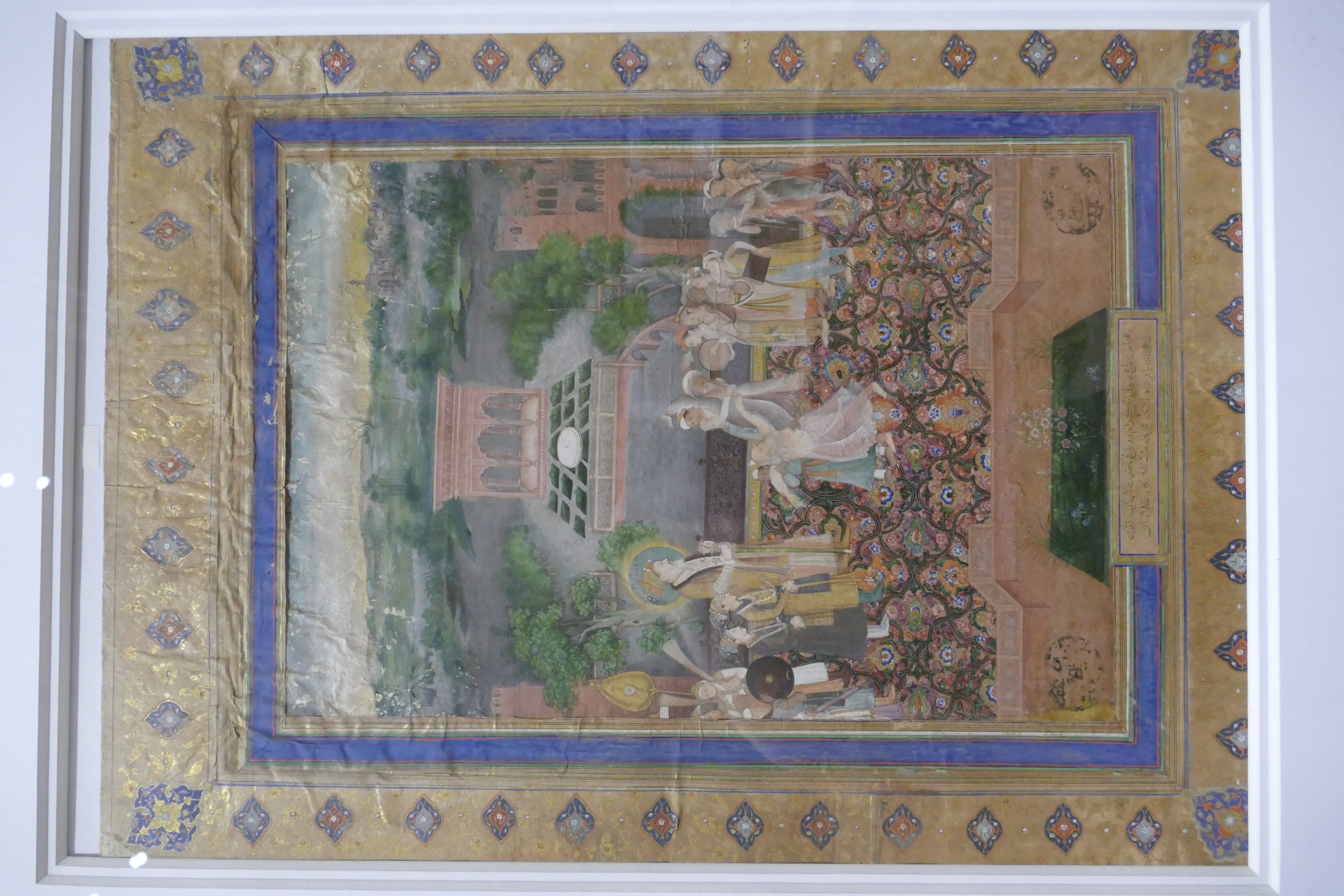
R.314 S.214 - Emperor Shahajahan enjoying Sufi dance, Indian Museum, Kolkata
Xopolino
- Source:
- Wikimedia Commons
- Rights:
- Public domain — free to use, share and adapt.
- Recorded as:
- public_domain
This is one of the few surviving images of Sufi sama from its period of highest prestige in South Asia, offering direct visual evidence of how ecstatic movement was performed and understood in a Muslim court context. It demonstrates that dance was not merely entertainment but a form of spiritual practice valued highly enough to be documented in imperial manuscripts—a perspective that challenges Western theater-centric definitions of dance and historicizes the emperor's own engagement with mystical practice.
What you are looking at
This is a Mughal-era manuscript page depicting Emperor Shah Jahan in a palace interior, watching Sufi musicians and dancers perform. The scene is set within an ornate architectural frame showing a multi-story building with latticed windows (jali work) and a central courtyard. The emperor sits elevated on the right side of the composition, attended by court members, while the central action features a group of figures in flowing robes arranged in a semi-circle, some with raised arms in attitudes of ecstatic movement. The palette is dominated by warm ochres, terracottas, and blues, with detailed patterned textiles—particularly an elaborate floral carpet or hanging behind the performers—suggesting wealth and courtly splendor. The perspective is characteristically Mughal, combining bird's-eye and frontal views so that both the architecture and the human figures remain legible. Light falls evenly across the scene, with shadows suggested through subtle color variation rather than chiaroscuro.
The dancing
The performers display the characteristic postures of Sufi devotional practice: several figures have arms raised or extended in gestures of spiritual opening and surrender, their bodies tilted or swaying in attitudes suggesting trance or ecstatic states. The dress is consistent with 16th–17th century Mughal courtly and dervish clothing—long robes, turbans, and fitted garments. The grouping is informal and non-linear, without the rigid geometries of court dance formations; instead, the figures seem oriented toward an inward spiritual focus rather than toward an audience. One or two musicians appear to be present with instruments, suggesting that music and movement were inseparable in this performance.
The dance depicted
This image documents Sufi ecstatic dance (likely associated with the sama tradition—the spiritual audition and movement practice of Sufi orders) as performed in the Mughal imperial court for the emperor's pleasure and participation in the spiritual atmosphere. Sufi sama was not merely entertainment but a devotional act aimed at proximity to the divine; the raised arms, swaying bodies, and apparent trance states visible here are consistent with historical descriptions of whirling, spinning, and ecstatic movement in Sufi practice. The presence of the emperor as observer—rather than participant—reflects the court's engagement with and patronage of Sufi spirituality, a complex phenomenon in Mughal culture. The informal, non-choreographed quality of the figures' positioning suggests the artist understood sama as spontaneous spiritual expression rather than codified technique.
How it was made
This appears to be a painted manuscript page—likely from a Mughal illustrated chronicle or album (muraqqa)—executed in opaque watercolor (gouache) on prepared paper, a medium standard in 16th–17th century Indo-Persian court workshops. The fine detail, luminous color, and careful composition suggest this was created for a patron of high status, probably within an imperial atelier. The technique allowed for jewel-like color saturation and the rendering of complex architectural space and textile pattern that would have been impossible in other media, and it implies circulation within a closed, elite audience rather than public display. The manuscript format and style are consistent with Mughal court production of the 16th–17th centuries.
About this work
This is a Mughal manuscript painting documenting the emperor Shah Jahan witnessing a Sufi sama—a devotional music and movement gathering—in his palace. It is both a historical record and a work of courtly art that legitimized the emperor's spiritual cultivation and connection to Islamic mystical practice. The image shows the direct patronage relationship between Mughal rulers and Sufi orders, and it is one of the few surviving depictions of Sufi ecstatic movement from the period, offering visual evidence of how sama was understood and valued in court culture.
The work belongs in a dance history collection because it is a rare pre-modern visual document of an active spiritual dance practice, created at a moment when that practice was integral to imperial identity. It shows how dance was embedded in religious devotion, courtly ceremony, and political legitimacy in early modern South Asia—a context quite foreign to Western theater dance, making it essential for any comprehensive understanding of dance across cultures and historical periods.
How to look at it
Attend first to the raised arms and swaying postures of the central figures—these are the visible traces of spiritual intoxication (sukr), the goal of sama. Note the emperor's position elevated and slightly apart, which shows observation as a form of spiritual participation rather than mere entertainment. Look closely at the textile patterns behind the dancers, which may themselves have been objects of visual meditation in Sufi practice (the intricate geometric and floral designs could induce altered states). The scene is frozen, but the postures suggest continuous, fluid movement; the artist has caught attitudes of ecstasy rather than a geometric formation, implying that sama was understood as spontaneous devotional expression.
The artist
The catalogue attributes this work to 'Xopolino,' but this appears to be a cataloguing error or misreading. The style, composition, and technique are entirely consistent with Mughal imperial manuscript production of the 16th or 17th century—most likely from the ateliers of the Mughal court at Agra or Delhi. The attribution cannot be verified from the image alone, and the name does not appear in standard references for Mughal painters. If this is indeed a Mughal court manuscript page, it would have been created by an artist trained in Indo-Persian conventions working under imperial commission.
The period
This image dates from the height of Mughal imperial power, a period (16th–17th centuries) when Persian cultural forms, including Sufi mysticism and courtly aesthetics, were deeply integrated into the court life of the Muslim emperors of India. Shah Jahan (r. 1628–1658) was a passionate patron of the arts and a devout Muslim; his reign saw the flowering of Mughal manuscript painting, architecture, and courtly culture. Sufi orders had substantial influence in Mughal spiritual and political life, and the sama was an established and respected practice—so much so that imperial participation in witnessing (if not performing) sama was a mark of piety and cultivation. The painting tradition itself was at its apex: Mughal ateliers had perfected the synthesis of Persian, Timurid, and Indian visual conventions into a distinctive style.
Where it lives
This work is held in the Indian Museum, Kolkata, part of the museum's collection of Mughal and South Asian manuscripts. The catalogue assigns it the reference number R.314 S.214. It is documented on Wikimedia Commons, a fact that indicates its status as part of a major institutional collection and suggests it is accessible to scholarly research.
Dance in this work
Questions about this work
What is sama, and how is it different from other dances?
Sama is a Sufi devotional practice combining music, poetry, and movement aimed at achieving spiritual states of ecstasy and proximity to the divine. Unlike social or theatrical dances performed for entertainment, sama is a form of worship; the movements (often whirling, swaying, or rhythmic stepping) emerge from the state of spiritual intoxication rather than from a choreographed sequence. The presence of witnesses, including the emperor here, was part of the practice—their participation in the spiritual atmosphere was considered important.
Why would an emperor watch Sufi dancers?
Sufi practice was highly respected in Mughal culture, and emperors saw participation in (or witnessing of) sama as evidence of piety, spiritual refinement, and connection to Islamic mystical traditions. This was not frivolous entertainment; it was a demonstration of the emperor's religious devotion and his role as a cultivated Muslim ruler. Imperial patronage of Sufi orders was a form of political legitimacy.
How do we know this depicts Shah Jahan?
The catalogue record identifies the subject as Emperor Shah Jahan, likely based on inscriptions or textual documentation associated with the manuscript page. Visual identification alone would be difficult; the elevated, attended figure could represent any Mughal emperor. The specific identification would need to be verified against the original manuscript source and any accompanying text.
What do the raised arms mean?
In Sufi ecstatic movement, raised arms are a sign of spiritual opening and surrender to divine presence. The posture suggests the dancer is receiving divine grace or is in a state of rapt attention to the music and sacred poetry being performed. This is not a choreographed gesture but an authentic physical manifestation of the spiritual state being sought.
More dance artwork





