49 works in this view — arrow keys or swipe to move between them.
Dance in Art
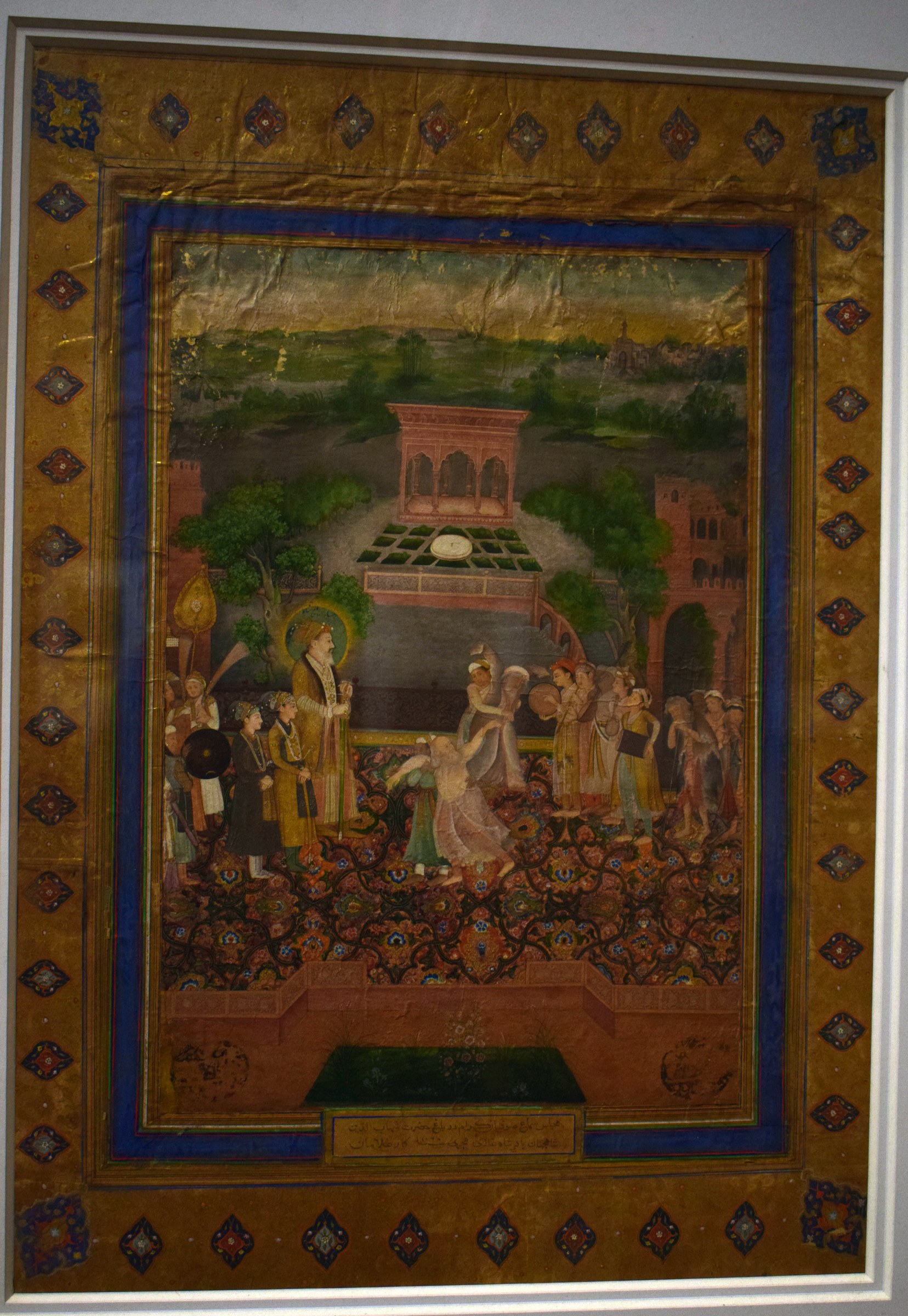
Emperor Shahjahan enjoying Sufi dance
Sneharshidasgupta
- Source:
- Wikimedia Commons
- Rights:
- Reusable with conditions: credit the creator; share any adaptation under the same licence. Source record ↗
- Recorded as:
- cc by-sa 4.0
This image preserves visual evidence of Sufi *sama*—a spiritual and movement practice with deep roots in Islamic mysticism—as it was adapted for and witnessed in imperial court settings. It demonstrates that mystical devotional dance was not only a popular religious practice but also a form of courtly entertainment, patronized and legitimized by the highest rulers. For historians of South Asian dance and Islamic spiritual practices, this is documentary material showing the historical relationship between sacred movement and political power.
What you are looking at
A Mughal court scene depicting Emperor Shah Jahan (identified by the halo) receiving Sufi dancers in an architectural setting. The composition is organized in distinct zones: the foreground shows a patterned carpet or floor with intricate floral designs in deep reds and blues; the middle ground contains the emperor seated elevated on the left, attended by courtiers in formal dress holding standards and insignia, while female dancers in pale silks perform before him; the background shows a red-brick pavilion with green decorative elements, its interior framing a formal garden beyond. The palette is dominated by gold leaf in the borders and background, deep blue in the frame, and rich earth tones in the architectural elements, characteristic of Mughal manuscript illumination. The scene captures a moment of courtly entertainment, with the dancers positioned centrally and the composition emphasizing the emperor's privileged vantage point.
The dancing
The dancers are depicted in upright, relatively static poses with arms positioned at chest and shoulder height, some with hands raised in expressive gestures. Their bodies show minimal dynamic weight transfer or the deep spinal curves associated with classical Indian dance; instead, they stand in formal, vertical alignment as befits courtly deportment. The dancers wear long, flowing transparent overgowns (likely chiffon or similar fabric) over fitted garments, with their silhouettes elongated and refined. The courtiers flanking the emperor maintain rigid postures characteristic of formal attendance, while the dancers occupy the visual center as the focus of the entertainment.
The dance depicted
This depicts Sufi devotional or ecstatic dance (likely *sama*, the contemplative music and movement practice of Sufi orders) as performed in a Mughal imperial court. The formal, non-virtuosic posturing and the spiritual context suggest this was a meditative or mystical practice rather than a secular court dance. Sufi *sama* involved rhythmic movement, often whirling or swaying, performed in response to music and poetry as a form of spiritual experience. The Mughal courts, particularly under Shah Jahan, patronized Sufi performers, and such entertainments were understood as both artistic display and spiritual practice. The static, frontal presentation here may reflect the constraints of the manuscript style rather than the full dynamism of the actual performance tradition.
How it was made
This is a gouache and gold leaf illumination on paper, the standard medium for Mughal manuscript painting of the 17th century. The technique involved laying down opaque pigments over a prepared paper surface, with gold leaf applied to create the luminous background and ornamental borders. This medium allowed for precise detail work, rich color saturation, and the characteristic bright, jewel-like quality of Mughal court art. The work belongs to a tradition of imperial manuscript production—likely part of a larger album or chronicle—created for viewing by the emperor and select courtiers, meaning the scale and intimacy were calibrated for close, personal appreciation rather than public display.
About this work
This is a Mughal court scene from a manuscript tradition documenting imperial life and entertainment under the Mughal Empire. It depicts the emperor Shah Jahan witnessing Sufi dancers in his palace, a moment that combines political theatre (the display of imperial patronage and taste), spiritual practice (Sufi devotional movement), and artistic performance. The work sits at the intersection of multiple traditions: Islamic court culture, mystical Sufi practice, and the visual conventions of Mughal manuscript illumination. For dance history, it is valuable as documentary evidence of how Sufi movement was understood and represented within elite court contexts, and of the kinds of performers and performances the Mughal court valued.
How to look at it
Observe the composition's strict vertical hierarchy: the emperor elevated and framed by architecture, the dancers positioned in the central foreground on the patterned floor, and the attending courtiers arranged symmetrically on either side. Note the contrast between the static, frontal presentation of the dancers and the lavish, jewel-like richness of the setting, suggesting that the value of the performance lay in its spiritual significance or courtly protocol rather than in acrobatic virtuosity. Look at the hands and arms of the dancers—these are raised in gestures of devotion or trance, not dramatic extension, indicating this was a form of prayer-through-movement rather than entertainment in the modern sense.
The artist
Sneharshidasgupta is a contemporary artist working in the tradition of Mughal manuscript painting. The creation date of 2023 indicates this is a modern work created in the historical style and technique of Mughal court art, rather than an historical artifact. The artist appears engaged in recreating or reimagining Mughal visual culture, using traditional materials and conventions to produce new work that references and restages imperial artistic traditions.
The period
Shah Jahan reigned 1627–1658, a period of significant Mughal imperial wealth and artistic patronage. The 17th-century Mughal court was a center for multiple artistic and spiritual traditions: Persian-influenced court painting, Sufi mysticism, classical music, and courtly dance. Sufi orders were well-established and highly respected in Mughal society, and their practices—including *sama* and ecstatic movement—were incorporated into court culture as both spiritual practice and entertainment. The visual conventions seen here—the elevated perspective, the hierarchical arrangement of figures, the use of gold and precious colors—were standard to Mughal imperial portraiture and narrative painting.
Where it lives
The work is recorded as sourced from Wikimedia Commons, suggesting it is a digital image of a work in a public collection or of a contemporary creation. The holding collection and current location are not recorded. This appears to be a modern work created by Sneharshidasgupta in 2023, rendered in the historical style and technique of Mughal manuscript illumination.
Dance in this work
Questions about this work
What is Sufi dance?
*Sama* is a form of devotional movement and music practice within Sufi Islam, experienced as a pathway to spiritual ecstasy or union with the divine. Practitioners move, often in a trance state, in response to music and poetry, and the practice is understood as prayer and meditation rather than secular entertainment. Different Sufi orders developed distinct musical and movement traditions, some involving whirling (as with the Mevlevi order), others involving swaying, rhythmic movement, or more controlled gestures.
Why would an emperor patronize Sufi performers?
Mughal emperors, despite being Muslim rulers governing a Hindu majority, cultivated Sufi mysticism as part of their religious and cultural identity. Sufi spirituality was seen as refined and sophisticated, and imperial patronage of Sufi performers enhanced the emperor's image as a pious and cultured ruler. Court *sama* performances also served diplomatic and entertainment functions, demonstrating the emperor's cosmopolitanism and power to host multiple forms of artistic and spiritual expression.
Is this painting historical or modern?
This specific work is contemporary, created in 2023 by Sneharshidasgupta. However, it is painted in the historical style and technique of Mughal manuscript illumination, so it recreates or reimagines historical scenes rather than documenting them directly. It is valuable as evidence of how modern artists engage with and reinterpret Mughal visual and cultural traditions.
More dance artwork





