49 works in this view — arrow keys or swipe to move between them.
Dance in Art
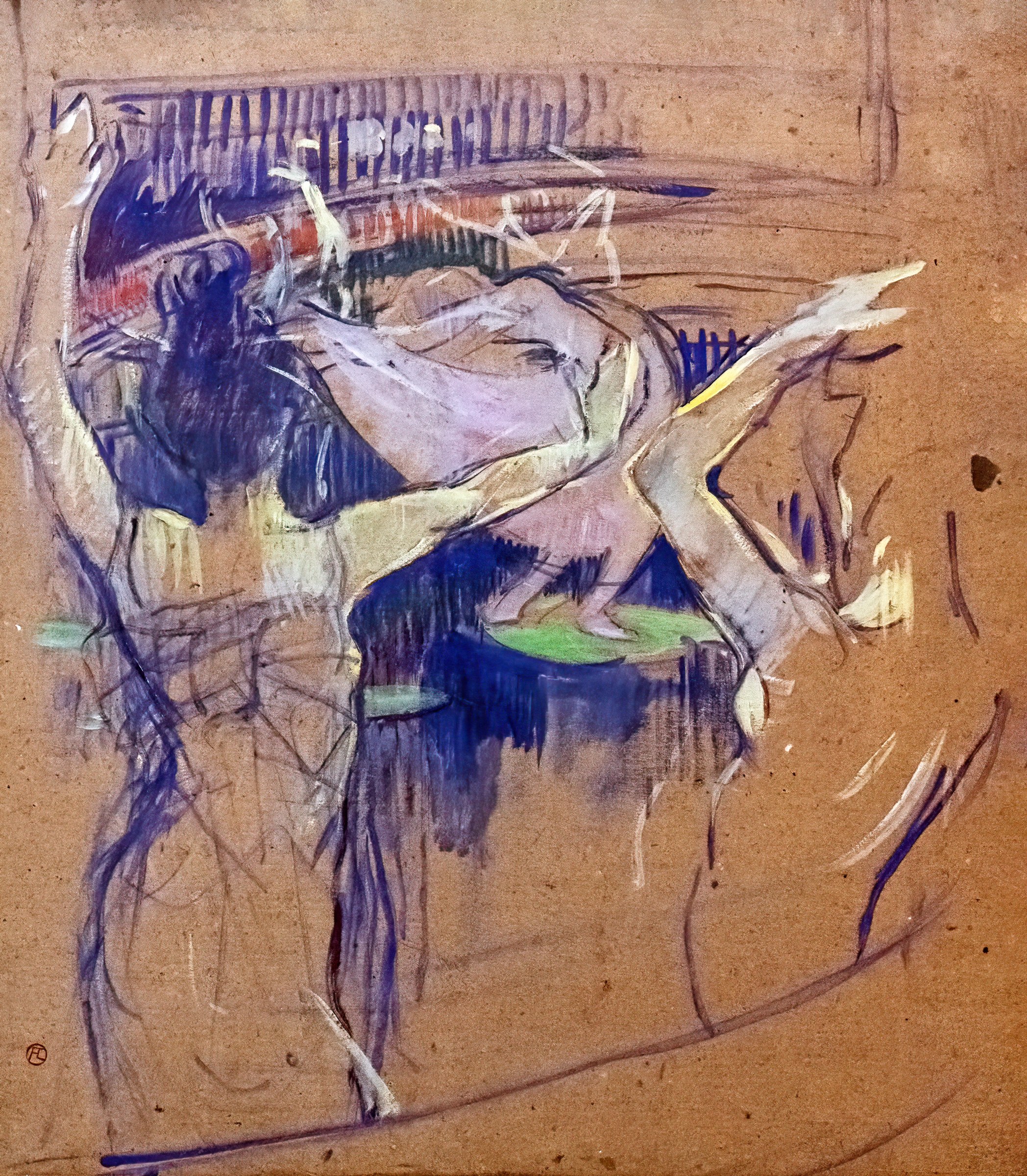
(Albi) Ballet de Papa Chrysanthème - Toulouse-Lautrec (1892) MTL.146
Didier Descouens
- Source:
- Wikimedia Commons
- Rights:
- Public domain — free to use, share and adapt.
- Recorded as:
- public_domain
This work is a direct eyewitness record of late 19th-century ballet in motion—not a codified technique manual or a designer's blueprint, but an artist's attempt to pin down the feeling and appearance of a dancer on stage. For historians and dancers, such studies are invaluable because they show how Romantic ballet actually looked in the body, outside the codified positions of classical technique. The spontaneity of the mark-making and the emphasis on the suspended, weightless quality of the pose capture something that still photographs and dance notation cannot: the lived sense of movement as a visual spectacle.
What you are looking at
A figure in Romantic-era ballet costume dominates the composition, rendered in watercolor with loose, gestural brushwork over brown paper. The dancer wears a pale lavender or mauve tutu and pointe shoes, captured mid-movement with the body angled and one leg extended. The pose suggests a moment of suspension or turning. Dark blue and purple hatching surrounds and defines the figure, creating depth and movement through color contrast rather than linear perspective. The background is minimal and abstracted—hints of architectural or theatrical setting appear in the upper left, rendered in the same broken color technique. The paper itself remains visible throughout, functioning as a mid-tone against which the whites of the tutu and skin read luminously. The overall effect is one of spontaneous notation rather than finished study: the artist has captured the essential silhouette and gesture of a dancer in motion.
The dancing
A single female dancer occupies the entire composition. Her body is arched in a three-quarter view, with her weight on one leg (appearing to be en relevé or on pointe) and the other leg extended behind or to the side—the foreshortening makes the exact position ambiguous. Her arms are positioned expressively, with at least one arm raised. The pose suggests a moment of turning or traveling movement characteristic of Romantic ballet vocabulary. The artist has prioritized the flowing line of the body and the extension of the limbs over anatomical precision; the proportions are stylized, emphasizing the elongation valued in ballet aesthetics.
The dance depicted
This is Romantic ballet, almost certainly a study for the role of Prune Blossom (Papa Chrysanthème's daughter) or another sylph-like character in the ballet *Papa Chrysanthème*, based on the catalogue title. The image captures a dancer in the suspended, weightless quality that defined the Romantic ballet aesthetic—the sense of floating or hovering that made dancers appear to defy gravity. The pale tutu, pointe work, and characteristic arm carriage are all consistent with mid-to-late 19th-century ballet technique and costuming. The specific pose and the gestural way it is rendered suggest this may be a memory or impression of a live performance rather than a costume design.
How it was made
This is a watercolor and possibly pastel or chalk study on brown paper—a format typical of 19th-century theatrical and ballet documentation. The technique is notably loose and impressionistic: the artist has used rapid, directional hatching in dark blue and purple to define and energize the figure rather than modeling form through subtle gradation. The exposed paper creates a unifying mid-tone. This approach—spontaneous, gestural, economical—suggests a working study made quickly, possibly from life or from memory, rather than a formal design. The technique was well suited to capturing the transient moment of live performance, where fixing a pose in precise line would miss the essence of movement.
About this work
This is a Romantic ballet study, almost certainly documenting a specific production or role in the late 19th century. It is not a formal costume design or choreographic notation, but rather an artist's visual record of a dancer's body in motion, preserved through watercolor and gestural color work. The work belongs in a dance archive because it captures the aesthetic and physical vocabulary of Romantic ballet at a moment when the genre was reaching its height of popularity in Europe. It is valuable as evidence of how dancers moved, how they were costumed, and how contemporary artists perceived and represented the ballet body. The loose, immediate technique conveys something essential about the ephemeral nature of live performance—the impossibility of fixing the dancer's art except through such fleeting, impressionistic records.
How to look at it
Attend to the pose itself: the way the dancer's body is caught in a moment of suspension, with limbs extended and weight apparently on the balls of the feet. This is not a static position but a transitional moment—the dancer is in the act of traveling or turning. Notice how the artist has used color (the pale tutu against dark blue hatching) rather than line to define the figure; this creates a sense of shimmer and movement. The exposed brown paper grounds the figure while allowing the tutu and skin to read as luminous. The background is deliberately undefined, focusing all attention on the body itself. This is not theatrical realism but distillation: the artist has stripped away everything but the essential fact of the dancing figure.
The artist
Didier Descouens is a contemporary French artist and printmaker known for work engaging with art history, labor, and textiles. This work, dated 2021, is a recent artistic response to or interpretation of a historical subject—not a work from the period of the ballet itself. Descouens's practice frequently involves dialogue with historical sources and media, suggesting this may be a re-interpretation or homage to Toulouse-Lautrec's own ballet and cabaret imagery.
The period
In the 1890s, Parisian theatrical life was at the center of European cultural attention. *Papa Chrysanthème*, an opéra comique by Claude Terrasse based on Pierre Loti's novel, premiered in 1894 at the Théâtre des Bouffes-Parisiens. The work satirized French fascination with Japan while offering spectacle and music-hall sensibility. This was the era when Toulouse-Lautrec and his contemporaries were making art from Parisian entertainment—cabarets, dance halls, circuses, and theaters—treating performers as subjects worthy of serious artistic attention. Ballet dancers, once thought of as minor entertainment, were becoming subjects for fine artists. The Romantic ballet aesthetic, with its emphasis on the ethereal and otherworldly, remained influential even as the fin-de-siècle brought new entertainments and ironic attitudes toward spectacle.
Where it lives
This work is documented on Wikimedia Commons and attributed to Didier Descouens, dated 2021. It appears to be a contemporary artistic interpretation or study referencing Toulouse-Lautrec's historical engagement with the Parisian theater, particularly his depictions of ballet and entertainment. The precise current location and accession number are not recorded.
Dance in this work
Questions about this work
Is this a Toulouse-Lautrec original?
No. The catalogue record attributes this to Didier Descouens and dates it to 2021. However, the title references *Papa Chrysanthème*, a ballet/opera from 1894 that Toulouse-Lautrec might well have documented. Descouens appears to be creating a contemporary dialogue with Toulouse-Lautrec's historical interest in Parisian performance. Descouens is a modern artist working with historical sources and media.
What ballet is this from?
*Papa Chrysanthème* was an opéra comique with a libretto by François de Croisset and Ernest Blum and music by Claude Terrasse, premiered in 1894. The title references Pierre Loti's 1887 novel of the same name, which satirized French fascination with Japan. The work was performed at the Théâtre des Bouffes-Parisiens and would have been part of the vibrant Parisian entertainment scene.
Why is the paper left visible?
Leaving the paper visible is a deliberate compositional choice. The brown paper acts as a unifying mid-tone and allows the pale watercolor of the tutu and the dark colored hatching to read more vividly. This technique was common in 19th-century theatrical studies and suggests spontaneity and immediacy—the artist is working quickly, capturing an impression rather than laboring over every inch of the surface.
What does the pose tell us about how ballet was danced then?
The lifted, extended position and the sense of weightlessness confirm what we know from historical sources: Romantic ballet emphasized the illusion of effortlessness and ethereality. The dancer's body is elongated, the weight appears to be on the balls of the feet (en relevé or pointe), and the limbs are extended in a way that defies gravity. This aesthetic persisted into the late 19th century and remains central to classical ballet today.
More dance artwork





