49 works in this view — arrow keys or swipe to move between them.
Dance in Art
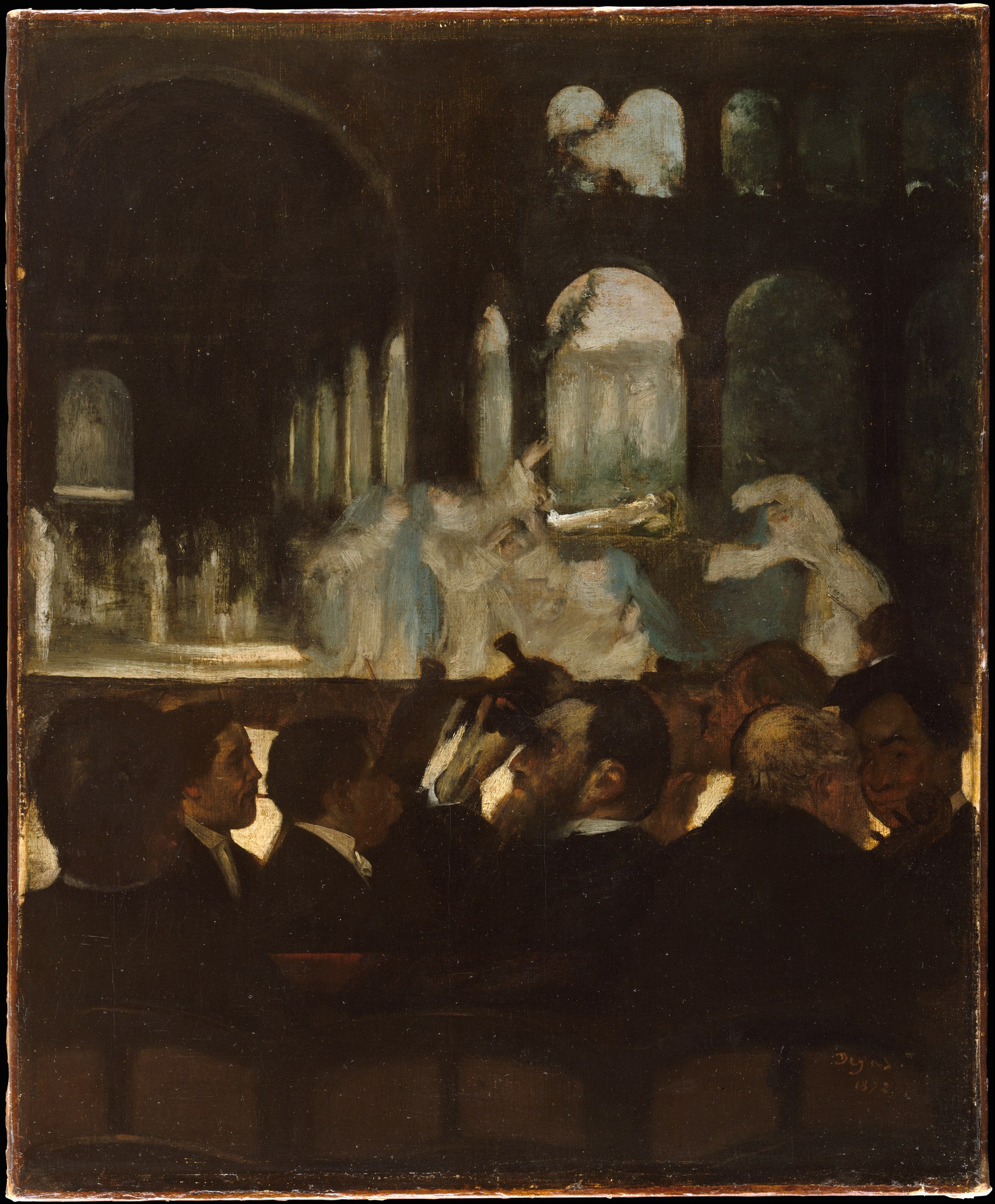
The Ballet from "Robert le Diable"
Edgar Degas
- Source:
- Wikimedia Commons
- Rights:
- Public domain — free to use, share and adapt.
- Recorded as:
- cc0
This painting documents a landmark moment in Romantic-era theatrical practice and preserves evidence of how one of the most famous ballet scenes in operatic history was staged and lit. For dance historians, it captures the aesthetic of mid-19th-century opera-ballet—the lightweight costumes, the emphasis on ethereal rather than athletic movement, and the integration of music and dance—at a moment when this hybrid form was central to elite entertainment. Degas's choice to emphasize the observers' response rather than the dancers' bodies reminds us that understanding historical dance requires attention to the experience it created, not only the movement itself.
What you are looking at
A theatrical scene set in a vaulted stone interior, lit dramatically from above through arched openings that glow with ethereal light. Center stage, three ethereal female figures in pale, billowing costumes perform amidst the architecture—one plays a wind instrument while two others gesture in expressive poses. In the foreground, a group of dark-clothed spectators—men in period dress including military uniform—watch intently from below, their faces caught between shadow and candlelight. The composition creates a stark spatial division: the supernatural, luminous world of the performers above contrasts sharply with the earthly, shadowed world of the male observers below. The painting's warm browns and ochres give way to cooler, ghostly whites in the dancers' forms, creating an otherworldly atmosphere consistent with theatrical spectacle of the Romantic era.
The dancing
The three performers wear high-waisted, classically draped costumes with long sleeves and minimal support—consistent with mid-19th-century romantic ballet dress. Their poses suggest gentle, floating movement rather than grounded steps: arms are raised and extended in lyrical attitudes, bodies appear weightless. The central figure plays what appears to be a double-reed instrument (possibly an oboe or clarinet), suggesting these are not purely dance figures but part of a staged divertissement combining music and choreography. The group of male onlookers below gesture toward the stage with evident fascination; their postures and direction of gaze anchor the viewer's attention to the performers above.
The dance depicted
This scene likely depicts the famous ballet scene from Meyerbeer's opera 'Robert le Diable' (Robert the Devil), premiered in 1831, which became one of the most celebrated and frequently painted operatic moments of the Romantic era. The ballet of nuns or ghostly female figures was a show-stopping sequence that audiences flocked to see. The ethereal costumes, arched stone setting (depicting a convent cloister or supernatural space), and the presence of musicians indicate this is the divertissement rather than abstract ballet—a hybrid form combining vocal and instrumental music with choreographed movement, typical of grand opera. The figures' poses suggest lyrical, flowing movement characteristic of Romantic ballet's emphasis on grace and otherworldliness rather than technical virtuosity.
How it was made
This appears to be an oil painting on a modest scale, executed in a loose, impressionistic manner that emphasizes atmosphere over detail. Degas worked rapidly here, using warm underpainting visible in areas like the foreground figures' clothing, and building luminosity in the arched openings through careful layering. The technique—particularly the contrast between the thinly painted, glowing architectural elements and the more densely worked figures—suggests this may be a study or smaller work, possibly a sketch for a larger composition. The painting's condition (visible craquelure, discolored varnish) indicates age and handling consistent with a 19th-century studio piece.
About this work
Degas painted this scene during the early 1870s, in the years following the Paris Commune and the reorganization of the Opéra. 'Robert le Diable' remained one of the most performed works in the repertory, and Degas returned repeatedly to theatrical subjects—backstage rehearsals, foyer scenes, and staged performances. This work captures not the dancers' technique but the audience's experience: the magic created by lighting, costume, music, and spatial illusion. The stark division between the lit, ethereal stage world and the shadowed human witnesses below speaks to what made Romantic opera so intoxicating—the promise that the theatrical frame could collapse the boundary between the earthly and the supernatural. For Degas, such scenes offered a way to investigate light, collective attention, and the subjective experience of watching rather than merely recording movement.
How to look at it
Observe how Degas has divided the canvas: the eye is drawn upward to the luminous arch and the ethereal dancers, but the painting's psychological weight lies in the foreground spectators, whose gaze directs us toward the stage. Notice the extreme tonal contrast—the near-darkness of the watching men against the glowing, almost colorless figures of the performers. This is not how the scene looked in the theater; it is how the experience *felt* to an attentive observer—the sense of watching something otherworldly emerge from darkness. The painting does not show us the dancers' feet or the mechanics of their movement; instead, it captures the moment of suspension, the collective intake of breath, the collective surrender to illusion. The arched architecture and the diffuse lighting create an atmosphere closer to religious revelation than to athletic display.
The artist
Edgar Degas (1834–1917) was obsessed with theatrical performance, particularly ballet and opera. From the 1860s onward, he haunted the Palais Garnier, sketching in the wings, the foyer, and the pit. Unlike Romantic painters who had turned to ballet as an escape into fantasy, Degas was interested in the labor, the artifice, and the viewpoint—the specific angles and distances from which an audience or a dancer perceived the stage. His paintings and pastels of dancers are ethnographic documents as much as romantic visions: he recorded costumes, rehearsal clothes, the particular exhaustion of performers, and the architectural conditions under which they worked. This scene aligns with his broader interest in theatrical lighting and the psychology of spectatorship.
The period
The 1870s saw Romantic ballet's slow eclipse in Paris. Works like 'Robert le Diable' (1831), 'La Sylphide' (1832), and 'Giselle' (1841) remained in the repertory, but new works were fewer and less ambitious. The rise of pantomime-heavy spectacles and the increasing dominance of opera over dance was reshaping the theatrical landscape. Simultaneously, the Impressionist painters—Degas's contemporaries—were developing new ways to represent light, movement, and the subjective experience of modern life. Degas's paintings of theatrical scenes belong to this Impressionist project: they capture light as it actually appeared, from unusual viewpoints, and they prioritize the immediate, subjective experience of being present at a performance over narrative or technical display. His interest in 'Robert le Diable' is partly nostalgic—documenting a Romantic masterpiece as it faded from fashion.
Where it lives
The painting is recorded as held in an unspecified collection (Wikimedia Commons). No accession number, museum, or exhibition history is documented in the catalogue record provided.
Dance in this work
Questions about this work
Is this really the famous 'Robert le Diable' ballet scene everyone talks about?
Almost certainly. Degas painted this subject multiple times in the 1870s, and all his versions depict the same distinctive moment: the appearance of ghostly female figures in a stone vaulted space, with male onlookers in the foreground. The ballet of nuns in Act III of Meyerbeer's opera was the most celebrated theatrical divertissement of the Romantic era and one of the most frequently depicted scenes in 19th-century painting. The setting and the ethereal costumes match historical descriptions exactly.
Why didn't Degas paint the dancers' faces or show us their feet?
Degas was not interested in portraiture or in recording technical virtuosity. He was interested in the phenomenology of theater—what it feels like to watch from a particular angle, in particular light. By obscuring faces and omitting legible footwork, he emphasizes atmosphere and collective response over individual performance. This reflects both his Impressionist commitment to subjective visual experience and his deeper fascination with how illusion works: the audience suspends disbelief not through the dancers' individual brilliance but through the total orchestration of light, costume, space, and music.
What was 'Robert le Diable' and why did everyone paint it?
'Robert le Diable' (Robert the Devil), Meyerbeer's grand opera premiered in 1831, became one of the most successful theatrical works of the 19th century. The ballet of nuns—who rise from their tombs in Act III to seduce the protagonist—was a sensation: it combined Romantic ballet's ethereal aesthetic with Gothic spectacle and supernatural machinery. Painters from Eugène Lami to Degas were drawn to the scene because it epitomized the era's fascination with the otherworldly and because the dramatic use of lighting and architectural framing made it visually spectacular.
Are these real nuns or are they ghosts?
They are dancers—performers in costume—representing the ghosts of fallen nuns, a supernatural vision meant to tempt the opera's protagonist. Historically, these were performed by the corps de ballet of the Opéra; they were not solo dancers but a collective, geometric ensemble. Their costumes were light and flowing, designed to suggest weightlessness and to show off the balletic silhouette of the era. Degas captures them as ethereal figures suspended in light—which was precisely the point of Romantic ballet's aesthetics.
More dance artwork





