49 works in this view — arrow keys or swipe to move between them.
Dance in Art
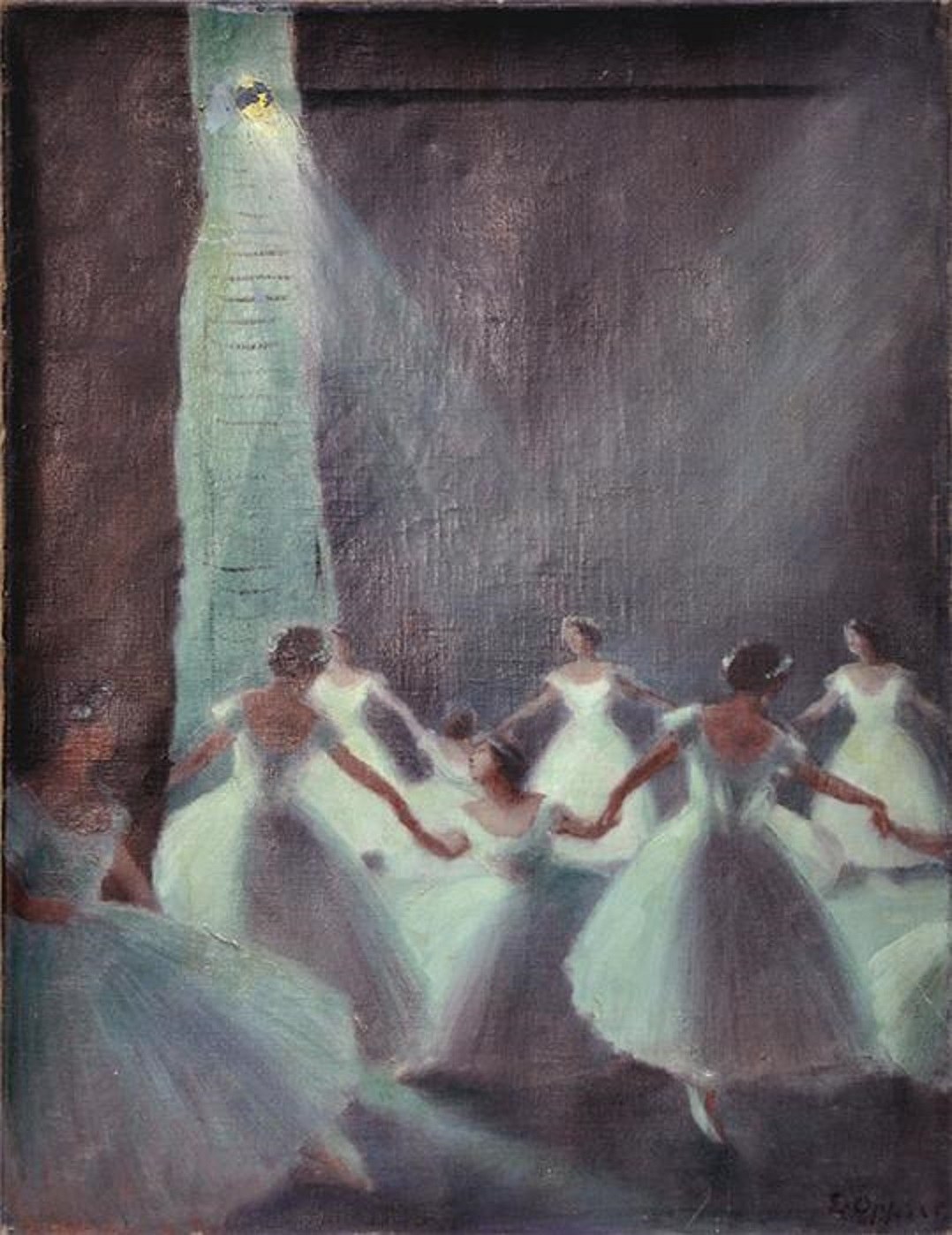
Ballet scene by Oppler
Ernst Oppler
- Source:
- Wikimedia Commons
- Rights:
- Public domain — free to use, share and adapt.
- Recorded as:
- public_domain
The work captures the moment when classical ballet shifted from a primarily narrative or technical spectacle toward abstraction and atmosphere in both choreography and visual art. It documents how early 20th-century European painters understood ballet not as entertainment but as a subject for serious artistic meditation—a shift that paralleled developments in dance itself.
What you are looking at
Five ballerinas in white tutus are arranged in a semicircle within a cavernous interior space. A shaft of pale greenish light enters from above, illuminating the figures against deep brown and grey walls that suggest the vaulted interior of a large building—possibly a church, cathedral, or theater. The light source appears architectural, perhaps a window or opening seen from within. The dancers are posed in stillness rather than captured mid-movement, their bodies arranged with formal symmetry. The foreground figure in the center is clearest; the others recede into shadow on either side, their forms becoming progressively softer and less distinct as they move away from the central light. The overall effect is dreamlike and ethereal, with the white tutus glowing against the darkness. The composition emphasizes the contrast between the luminous figures and the heavy, shadowed architecture.
The dancing
The five dancers are in a relaxed standing posture rather than an active dance position. Their arms hang loosely at their sides or rest gently on their skirts; there is no closed hold or partnering visible. The nearest figure stands with weight evenly distributed, facing slightly toward the viewer. The others are arranged in a loose line that curves away from the light source. Their posture suggests a moment of rest, gathering, or processional waiting rather than active dancing. The silhouettes and body angles suggest young women in classical ballet costume, but the positioning is contemplative rather than demonstrative of technique.
The dance depicted
This work depicts classical ballet in its late Romantic or early Modern era, most likely early 20th-century company ballet. The subject appears to be a formal group scene rather than a narrative ballet moment—possibly a corps de ballet waiting, processing, or posed for a theatrical tableau. The white tutus and pointe shoes are consistent with classical ballet of the 1910s. However, the composition and lighting suggest artistic or imaginative interpretation rather than documentary of an actual choreographed sequence. The emphasis on atmosphere and the ethereal quality suggests this may represent ballet's spiritual or allegorical dimension rather than a specific known work.
How it was made
The work appears to be oil paint on canvas, executed in a post-Impressionist or early Expressionist style. The artist has used soft, blended brushwork to model the figures and create atmospheric perspective, with the light source creating a halo effect around the dancers. The palette is limited—whites, greys, browns, and a distinctive pale green-blue for the light—which concentrates emotional effect. The technique of glazing and scumbling suggests the artist understood both academic painting and modern studio practice. This approach was typical of early 20th-century European salon and exhibition painting, suggesting circulation among educated urban audiences rather than popular reproduction.
About this work
This is an imagined ballet scene rather than a documentary one, emphasizing the poetic and spiritual dimensions of classical dance. Oppler presents five dancers not in active performance but in a moment of gathered stillness within an architectural space flooded with symbolic light. The work sits within early 20th-century modernism's engagement with classical ballet as a subject—the period when Diaghilev's Ballets Russes and avant-garde artists were reinventing how dance could be represented. The painting prioritizes mood and formal arrangement over narrative or technical display, treating the dancers as sculptural elements within a larger composition about light, space, and the sublime.
How to look at it
Attend to the composition first: the artist has chosen not a moment of energetic movement but one of stillness and gathering, with the dancers arranged like figures in a formal arrangement. Notice how the light functions—not realistically illuminating a stage, but symbolically, with the pale greenish beam suggesting something otherworldly or spiritual. The soft brushwork and muted palette create an atmosphere of reverie rather than performance. The symmetry of the arrangement suggests the artist's interest in ballet as a formal, almost architectural subject—bodies arranged in space the way a sculptor might arrange elements.
The artist
Ernst Oppler (1866–1929) was a German painter and illustrator who worked in the post-Impressionist and early Expressionist idioms. He exhibited regularly in European salons and was associated with modernist movements in painting while maintaining a focus on figurative subjects. His practice often engaged with classical and mythological themes, and this ballet scene sits within a broader artistic interest in the female form, classical restraint, and the interplay of light and shadow. He was active during the period of radical experimentation in dance and visual art in early 20th-century Europe.
The period
The work dates to 1915, a pivotal moment in dance history. Diaghilev's Ballets Russes had been active since 1909, fundamentally changing how avant-garde artists engaged with ballet as a subject. The company collaborated with Cubist, Fauvist, and Expressionist painters, elevating dance to high-art status. Simultaneously, classical ballet was undergoing formal innovation through figures like Michel Fokine, who was moving away from pure virtuosity toward expressiveness and integrated design. In painting, artists across Europe were moving beyond Impressionism toward Expressionism and abstraction, with many—including Oppler—finding in ballet a metaphor for modernist concerns: the body as form, composition over narrative, and the relationship between music, light, and movement.
Where it lives
The work is recorded as a Wikimedia Commons upload with minimal institutional documentation. The catalogue record lists only the title, artist name, and date; no accession number, holding collection, or medium is recorded. This suggests the work's current location is either unknown or not catalogued in a major public collection, and that it circulates primarily through digital reproduction.
Dance in this work
Questions about this work
Is this a specific ballet or scene?
It does not appear to depict a known narrative ballet or famous choreography. Instead, it is an imagined or idealized scene of classical ballet—a group of dancers in white tutus posed within an architectural space. The artist has prioritized mood and formal composition over narrative or recognizable plot.
Why do the dancers look so still?
The artist has deliberately chosen a moment of rest or gathering rather than active dancing. This reflects early 20th-century modernist approaches to ballet, which treated it as a subject for artistic meditation rather than pure spectacle. The stillness creates a meditative, almost ritual quality.
What is the light source?
The pale greenish light appears to come from above—possibly a window, dome, or architectural opening. It functions both as realistic illumination and as a symbolic element, lending the scene a spiritual or transcendent quality. The light is the compositional anchor of the entire scene.
What period of ballet is this?
The white tutus and pointe shoes are consistent with classical ballet of the early 20th century, around 1910–1920. The artistic treatment—emphasizing atmosphere over technique—reflects the period's modernist engagement with dance.
More dance artwork





