49 works in this view — arrow keys or swipe to move between them.
Dance in Art
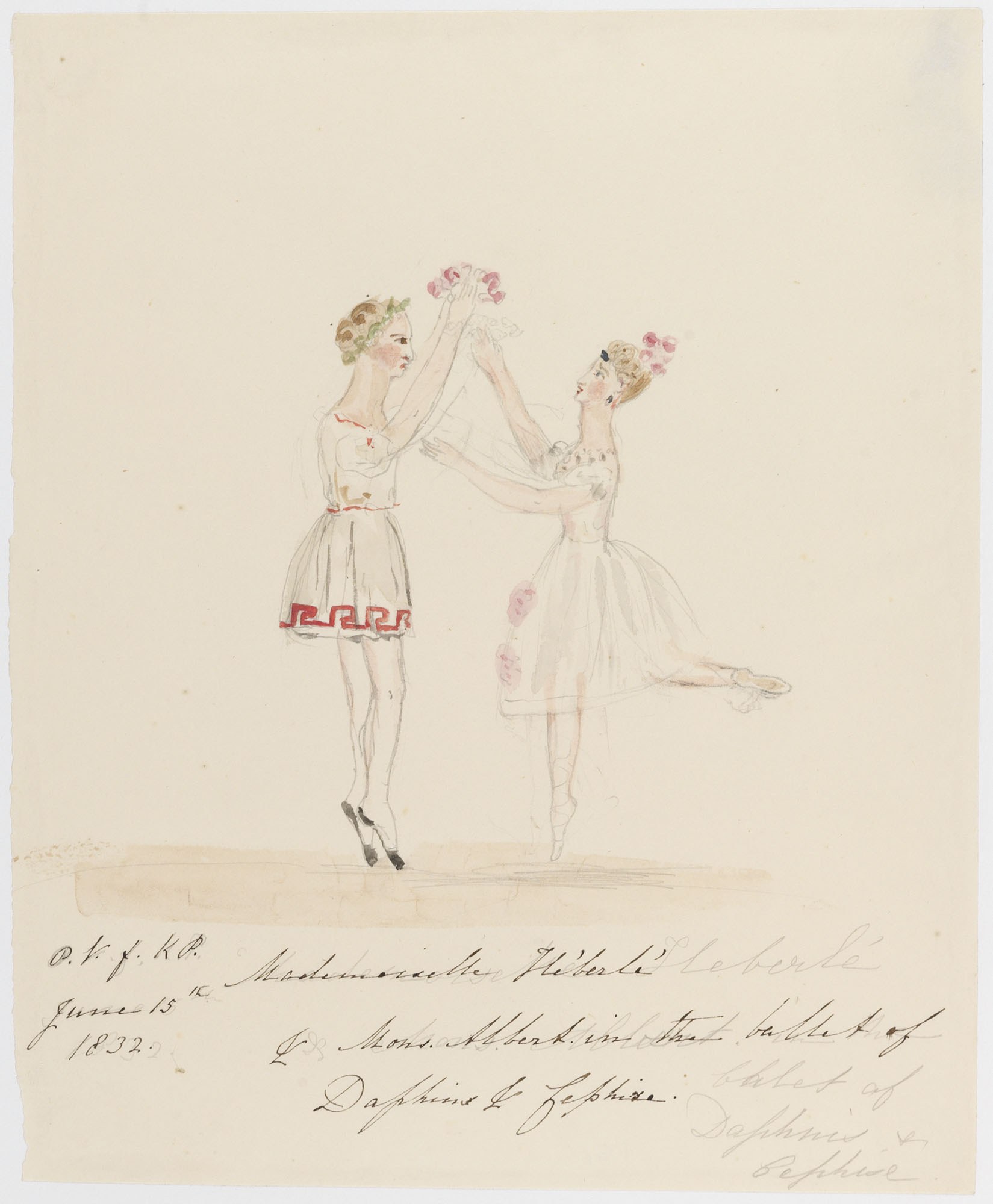
Mademoiselle Hèberlè & Mons. Albert in the ballet of Daphnis & Cephise
Queen Victoria of the Great Britain
- Source:
- Wikimedia Commons
- Rights:
- Public domain — free to use, share and adapt.
- Recorded as:
- public_domain
This drawing is rare documentary evidence of early 19th-century ballet performance practice, capturing not just the costumes and physical lines of the dancers, but the specific dramatic moment and narrative content that made the ballet meaningful to its audience. It records the work of two named principal dancers at a moment when such documentation was sparse, and it demonstrates that even royalty engaged with dance as a subject worthy of sustained artistic attention and skilled execution.
What you are looking at
Two female dancers in classical dress occupy a cream-colored stage, frozen in a moment of theatrical interaction. On the left, a dancer in a short white tunic with a red geometric border at the hem stands in profile, her body angled toward her companion. She wears her blonde hair in a classical updo adorned with pink flowers and holds aloft a length of gauzy white fabric—a veil or scarf—that billows between the two figures. On the right, a second dancer in a longer white skirt and matching floral headdress turns toward the veil, her body in a graceful contrapposto, one leg extended in a balletic line. Both dancers wear heeled shoes and are rendered in delicate watercolor with careful attention to the drapery of their skirts and the play of light on their limbs. The composition is intimate and symmetrical, centering on the veil as the focal point of their interaction.
The dancing
Both dancers occupy a classical ballet frame, with upright carriage and turned-out legs. The figure on the left holds her arms raised to shoulder height or higher, actively displaying the veil as a prop or garment of significance. The dancer on the right is caught mid-turn or mid-extension, her weight shifted onto her supporting leg in a manner that suggests elevation or controlled descent. Neither figure shows the full extension of pointe work, and both stand with considerable height and elongation through the torso. The veil binding the two suggests a narrative moment—a pas de deux in which the fabric itself becomes a secondary character.
The dance depicted
This work depicts a scene from the ballet *Daphnis et Chloé* (or *Daphnis & Cephise* as titled here), a subject that enjoyed considerable popularity in early 19th-century European dance. The narrative draws on classical mythology and was frequently staged as a short dramatic ballet or divertissement. The figures are identified as Mademoiselle Héberlé and Monsieur Albert, principal dancers of the period. The presence of the veil and the paired, symmetrical composition suggests a moment of dramatic significance—possibly a recognition scene or an exchange charged with emotional or amorous tension. The choreography appears to emphasize upper-body articulation and the integration of props, hallmarks of Romantic-era ballet technique.
How it was made
This is a watercolor drawing on cream or off-white laid paper, executed with fine pencil underdrawing visible in the delicate outline work. The artist employed transparent washes of color—pale blue, pink, and flesh tones—layered with precision to create volume and shadow. The red geometric border of the left dancer's skirt and the pink flowers in both headdresses are rendered in opaque pigment, creating focal points of color against the otherwise restrained palette. The technique allows for both the fluidity of the dancers' movements and the fine detail of their facial features and coiffure. As a watercolor sketch or study, this work likely served as documentation of a specific performance or as a record for costume and choreographic reference.
About this work
This watercolor records a moment from the classical ballet repertory as performed by named dancers of the early 19th century. The work belongs to a tradition of dance documentation through fine art—not a narrative painting about dance, but a precise visual record of a specific dramatic moment in a specific production. The intimacy of the medium and the care taken in rendering the dancers' bodies and dress suggest this was created either during or immediately after a performance, or as a detailed study for costume or choreographic purposes. Queen Victoria's interest in the theatre and her own artistic practice make this work valuable as evidence of what was being performed, how it looked, and how it was perceived by an educated, aristocratic observer.
How to look at it
Attend to the veil as the organizing element of the composition—it is neither a background detail nor a costume accident, but the point around which both dancers' bodies are oriented. Note the difference in the two dancers' positions and the implied narrative: one is offering or displaying, the other reaching or responding. The precision of the watercolor technique allows you to see the exact cut and hang of the costumes, the specific style of heeled shoe, and the placement of flowers in the hair, all of which communicate period, expense, and theatrical intention. The white-on-cream background, rather than a stage setting, focuses attention entirely on the bodies and the relationship between them.
The artist
Queen Victoria (1819–1901) was an accomplished watercolorist and sketcher who studied drawing and painting throughout her life. She attended the theatre regularly and documented performances, both as a record of what she had seen and as an exercise in capturing movement and costume detail. Her drawings were private rather than professional works, executed for personal satisfaction and archive. This sketch reflects the standards of amateur accomplishment among the educated aristocracy: precise enough to preserve specific details, yet executed with enough speed and spontaneity to suggest direct observation rather than careful studio composition.
The period
The early 1830s saw the full emergence of Romantic ballet in Europe, with an emphasis on supernatural and mythological subjects, the prominence of the female dancer, and increasingly elaborate stagecraft. Classical mythology remained a rich source for choreography, and the story of Daphnis—a shepherd caught between divine and human worlds, or between competing romantic claims—appeared in multiple choreographic versions. The ballet d'action tradition, which integrated narrative, mime, and dance, was at its height. Mademoiselle Héberlé and Monsieur Albert were professionals working in this context, likely at a major European opera house. Victoria's sketch dates to the year of her accession to the throne and reflects the culture of aristocratic patronage and amateur connoisseurship that sustained the ballet of the period.
Where it lives
This watercolor is held by Wikimedia Commons and was sourced from a collection that preserves documentation of dance and theatre from the 19th century. The inscription in Victoria's hand at the bottom of the sheet provides the title, the dancers' names, the date (June 13, 1832), and reference marks suggesting this was part of a larger archive or sketchbook.
Dance in this work
Questions about this work
Did Queen Victoria actually draw this, or did she commission it?
The inscription is in Victoria's own hand, and the delicate, confident watercolor technique is consistent with her known drawings from this period. This was almost certainly executed by Victoria herself, either during or shortly after witnessing the performance. It would have been typical for an educated, artistically trained aristocrat of her generation to preserve records of significant cultural experiences in this way.
What was the ballet *Daphnis & Cephise* about?
The title references the classical story of Daphnis, a shepherd, but the presence of Cephise (Cephalus) in the title suggests a variant in which Daphnis is caught between two romantic claims or identities. The narrative ballet tradition of the early 19th century typically emphasized moments of emotional or erotic tension, often resolved through spectacle or death. The veil in Victoria's drawing may represent a token of love, a disguise, or a moment of recognition.
Who were Héberlé and Albert?
Both were professional dancers active in Europe during the 1830s, likely performing at major opera houses such as the Paris Opéra or the King's Theatre in London. The fact that they are named in the inscription—and that Victoria took the trouble to record them—suggests they were dancers of considerable reputation. Monsieur Albert was noted for his technical skill and his ability to partner female dancers effectively, a role of growing importance in Romantic ballet.
How was this sketch used?
As a private drawing by the Queen, it likely served multiple purposes: a record of what Victoria had seen and admired, a study of costume and movement, and a means of preserving the memory of an evening at the theatre. Such sketches were often kept in albums or portfolios rather than exhibited or reproduced. The work would have been valued by Victoria as a personal keepsake, not as a public artwork.
More dance artwork





