49 works in this view — arrow keys or swipe to move between them.
Dance in Art
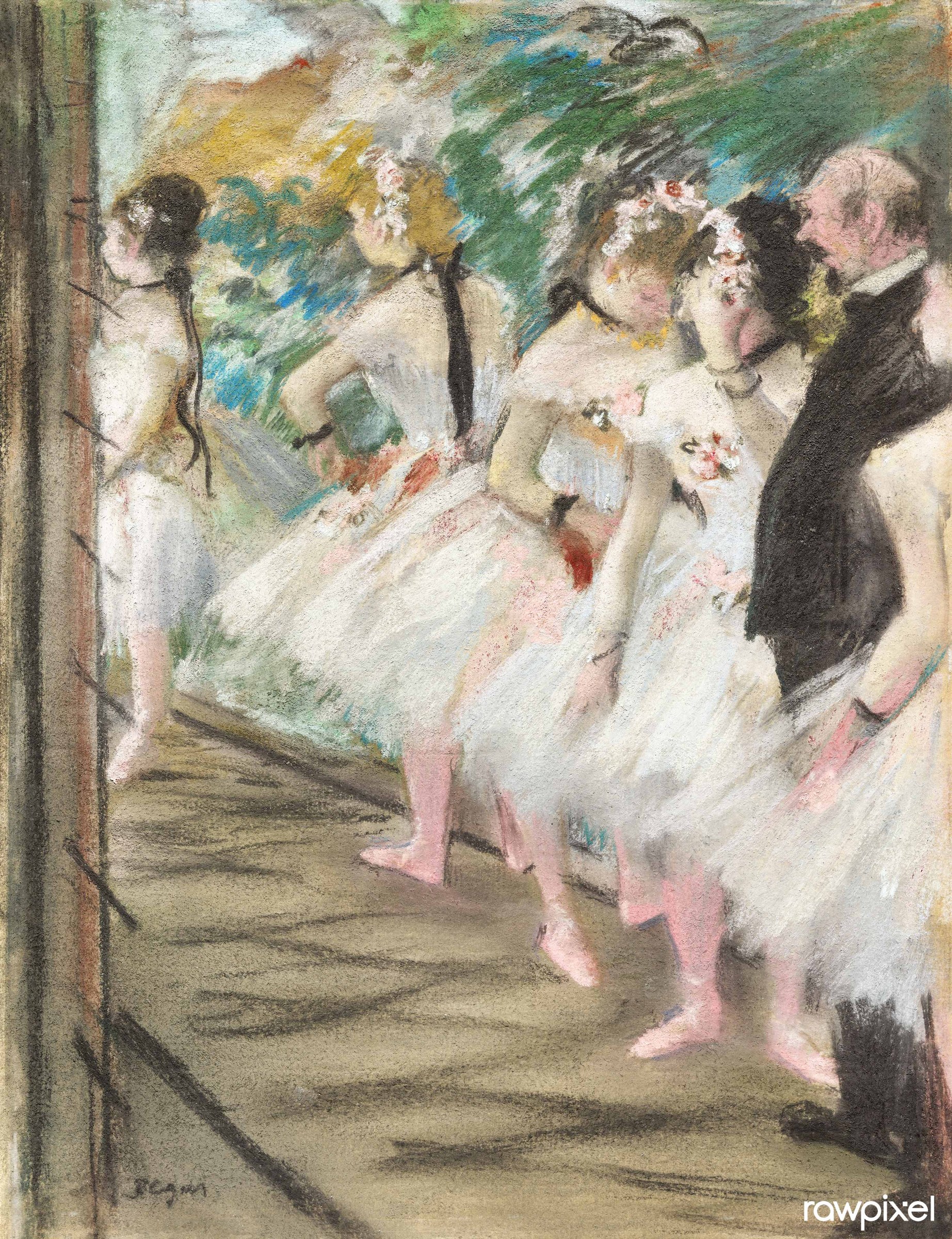
The Ballet (ca. 1880) painting in high resolution by Edgar Degas. Original from The National Gallery of Art. Digitally enhanced by rawpixel. (50635904671)
Unknown artist
- Source:
- Wikimedia Commons
- Rights:
- Reusable with conditions: credit the creator. Source record ↗
- Recorded as:
- cc by 2.0
Degas's ballet scenes are among the most historically reliable visual records of nineteenth-century professional dance practice: the costume, the studio space, the relationships between dancers and administration. For contemporary dancers, these works offer a genealogy of labor and scrutiny that remains recognizable. For art historians and dance scholars, Degas proved that a subject could be both ephemeral and monumental—that the backstage moment, the body at rest, could carry as much meaning as the leap or the formal arabesque.
What you are looking at
A ballet rehearsal or performance viewed from the wings, showing dancers in classical tutus—some white, some tinted pink—arranged on stage. The nearest figure, a dancer in white, stands at left facing away, while four more dancers in varying states of readiness occupy the middle distance. At right, three men in dark formal dress—likely choreographer, director, or patrons—observe intently. The background is a wash of green, blue, and golden-yellow pigment suggesting theatrical scenery or drapery. The viewpoint is intimate and slightly voyeuristic, as if the viewer has access to a private moment during work or rehearsal. The light is diffuse and stage-lit, with warm tones dominating the foreground figures and cooler tones receding into shadow.
The dancing
The dancers' bodies are rendered with characteristic softness in pastel, their postures suggesting fatigue or anticipation rather than mid-movement—they stand, wait, or lean slightly, weight on one leg. The nearest dancer's back is turned, emphasizing the line of the tutu and the nape of the neck. The observers at right are stiffly formal, their bodies angled to watch, creating a spatial and psychological distance between the working dancers and the authorities observing them. Arm positions are loose, not disciplined into classical frames, suggesting a moment of rest rather than performance.
The dance depicted
This is a scene of Romantic-era ballet, most likely French or Italian, depicting the professional theatrical world of the 1870s–80s. The tutus, the ballet slippers, and the classical body type of the dancers confirm the genre unmistakably. The composition emphasizes the social hierarchy of the ballet world: young, often underpaid dancers under the scrutiny of male directors and wealthy patrons. The work does not show a specific choreographed moment but rather the labor, waiting, and surveillance that structured a dancer's working day. This is ballet as labor and commerce, not as pure art.
How it was made
Pastel on paper or card, a medium Degas mastered in his later years to capture the fugitive effects of stage lighting and the softness of tutus and skin. Pastel allowed him to build color in thin layers, to blend and rework, and to suggest movement through directional mark-making. The medium was also portable and relatively quick, suitable for an artist working frequently from memory and sketchbook observation. This work circulated as a finished artwork in itself—pastels were framed, exhibited, and collected—not as a print, making it an object of considerable prestige and intimacy.
About this work
This is Edgar Degas's *The Ballet*, a pivotal work in the genre of ballet painting and a cornerstone of his lifelong engagement with dance. Degas returned to ballet imagery more than any other subject, making over 1,500 works featuring dancers between the 1860s and his death in 1917. What distinguished his ballet scenes from those of his contemporaries was his refusal to romanticize: he showed dancers as workers, often in unglamorous moments—adjusting clothing, waiting, being corrected or appraised by male authority figures. This work exemplifies that approach.
The painting belongs to a moment when Impressionism was reshaping how artists saw and rendered contemporary life, and Degas—though he rejected the label—was central to that movement. His interest in the fleeting moment, the accidental composition, and the effects of artificial light aligned him with Monet and Renoir, even as his draftsmanship and his focus on human psychology set him apart. For dancers and historians, this work is invaluable as evidence of how ballet was actually practiced and experienced in the Gilded Age—the drudgery, the power dynamics, the physical toll.
How to look at it
Notice the asymmetry of the composition and the sight lines: the dancers are scattered, unstaged, while the three men at right form a compact observing unit. This is not a painting *of* ballet; it is a painting *about* watching and being watched. The pastel application is loose in the background but more careful around the faces and bodies of the dancers, as if Degas is recording what caught his eye. Look at the play of light: the stage lights seem to come from above and front-left, creating warm tones on the dancers' bodies and cool shadows behind them. The moment is neither climactic nor romantic—it is a pause, a waiting, a moment of exposure. That is precisely the point.
The artist
Edgar Degas (1834–1917) was a founder of the Impressionist movement, though he rejected the label, preferring to call himself a "realist." Unlike the Impressionists, who painted outdoors and emphasized light and color, Degas worked indoors, from memory and from sketches, and prioritized drawing and form. He was fascinated by modern Paris—the ballet, the racetrack, the café, the laundry, the millinery shop—and saw in these everyday sites the drama of labor, commerce, and human vulnerability. He was a prolific draftsman and experimenter, working across oil, pastel, printmaking, photography, and sculpture. His ballet paintings, numbering in the hundreds, represent both his deepest artistic commitment and a complex engagement with the bodies, labor, and social position of (mostly) young women dancers.
The period
The 1870s and 1880s were a transformative moment for ballet in France and Europe. The grand Romantic ballet of mid-century—with its otherworldly heroines and supernatural themes—was giving way to new forms of spectacle, athleticism, and realism on stage. The Paris Opéra, where Degas frequently sketched, was a site of intense artistic innovation and also of troubling labor dynamics: dancers were typically young, underpaid, and dependent on male patrons and choreographers for employment and advancement. Degas's unflinching gaze at this world was radical. Simultaneously, in fine art, the Impressionist movement was challenging academic hierarchy by depicting modern, everyday life with the same ambition previously reserved for historical and mythological subjects. Degas's ballet paintings embodied this democratic ambition while also revealing the gendered and economic structures underlying the spectacle.
Where it lives
The work is held in the National Gallery of Art, Washington, D.C., a major public collection. It is one of many Degas ballet paintings in major museums worldwide; the genre has become central to how Degas is understood and displayed. As a pastel on paper, it required conservation and framing to preserve it; it is handled carefully and displayed behind glass.
Dance in this work
Questions about this work
Did Degas dance or study dance formally?
No. Degas was trained as a painter in the academic tradition and came to ballet through the visual spectacle of the Paris Opéra and the bodies of the dancers he sketched there. His knowledge was observational and intimate but not embodied. This distance gave him a particular clarity about the social and economic structures of ballet, which he saw with an outsider's eye.
Why are there men in dark suits watching the dancers?
They likely represent the choreographer, the director of the Opéra, or wealthy patrons who funded and controlled ballet production. Degas frequently included these figures to emphasize the power dynamics and the commercial nature of dance. The dancers' bodies are on display and subject to judgment; the men have authority.
Is this a finished painting or a sketch?
It is a finished work in pastel, a medium Degas chose deliberately and worked in extensively in his later career. Pastels were considered a legitimate fine art medium in the nineteenth century, and Degas's pastels were exhibited, sold, and collected as major works. The apparent informality and roughness are stylistic choices, not signs of incompleteness.
How many ballet scenes did Degas paint?
Over 1,500, making ballet by far his most frequent subject. These range from quick sketches to large finished pastels and oils. Scholars believe Degas's obsessive return to ballet reflected both aesthetic fascination and a deep engagement with questions of labor, discipline, and the female body in industrial modernity.
More dance artwork





