49 works in this view — arrow keys or swipe to move between them.
Dance in Art
Before the Ballet
Edgar Degas
- Source:
- Wikimedia Commons
- Rights:
- Public domain — free to use, share and adapt.
- Recorded as:
- cc0
This work is essential evidence that late-nineteenth-century ballet training in Paris maintained the classical vocabulary and hierarchical teaching structure that shaped theatrical ballet for generations. For art historians, it documents Degas's technical mastery in the final decade of his career and his continued innovation in compositional devices that influenced modernism. For dancers and dance historians, it provides visual testimony to the actual practice conditions and pedagogical methods of the period.
What you are looking at
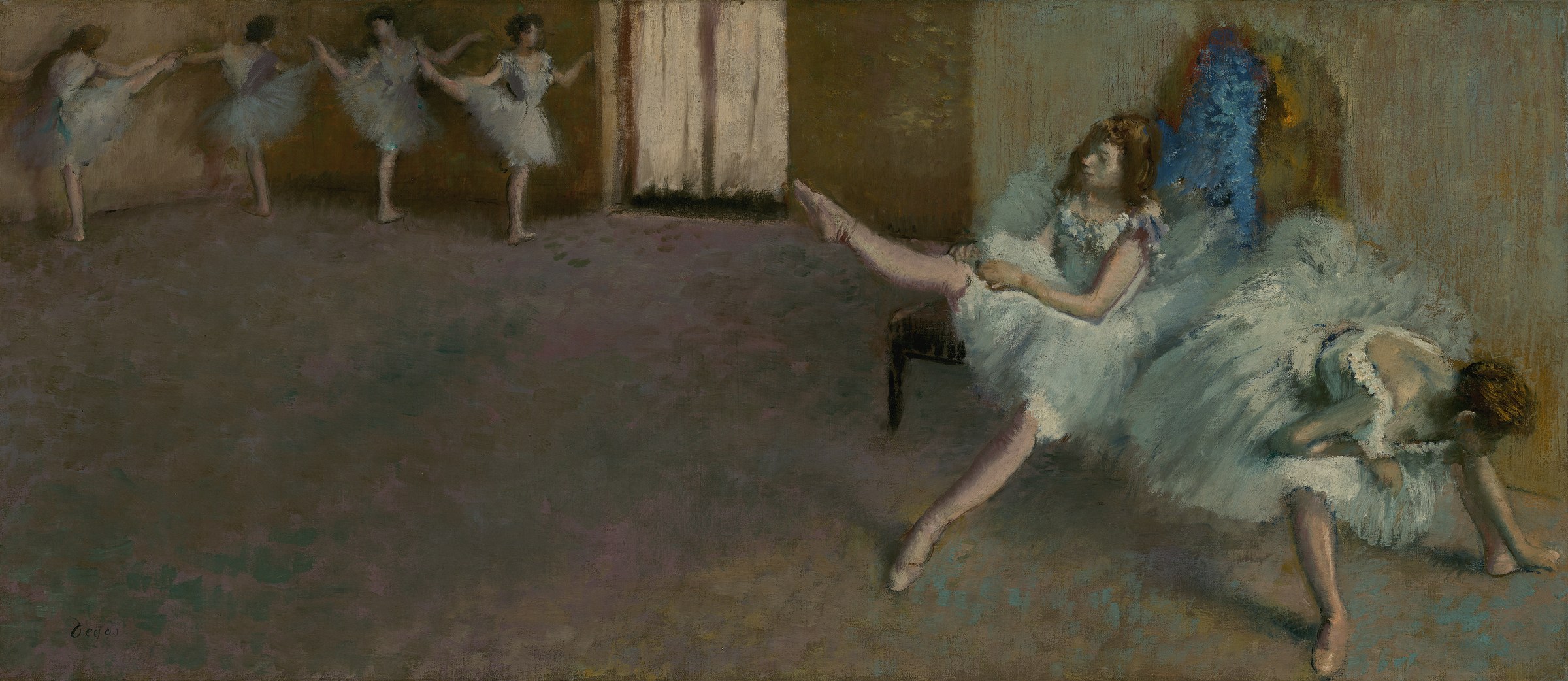
The painting depicts a ballet rehearsal or class in progress, viewed from an elevated perspective that emphasizes the spatial depth of the studio. Four dancers in pale tutus are visible in the middle distance on the left, arranged in a loose line facing toward the back wall where large windows admit soft light. In the immediate foreground on the right, a seated woman in a white dress gestures toward the dancers—likely an instructor or ballet master—while a younger dancer in white crouches or sits beside her. The studio walls are rendered in muted browns and grays, with cream-colored vertical elements that may be columns or mirror frames. A strong diagonal composition pulls the eye from the foreground figures back into the studio depth. The light is cool and diffuse, characteristic of northern studio windows, and creates soft shadows across the floor.
The dancing
The four distant dancers stand in a loose line with raised arms, bodies turned in similar directions—a formation typical of classical ballet instruction. Their posture suggests an exercise or combination being executed. The seated woman in the foreground leans forward with one arm extended, an attitude of teaching or correction. The crouched dancer beside her appears attentive, her body bent toward the seated figure. All figures wear the pale, simple practice tutus and bodices of the period; none display the elaborate stage costumes of a performance.
The dance depicted
This is a rehearsal or class scene of theatrical ballet, likely Romantic or late-nineteenth-century academic ballet practice. The painting documents the teaching and training process rather than finished performance. The dancers at a distance execute what appears to be an adagio or sustained exercise, the kind of fundamental work that formed the core of ballet training. The foreground interaction between the instructor and the attentive pupil captures a moment of individual correction or guidance, suggesting pedagogical instruction by a senior figure—possibly a ballet master or celebrated dancer—to a student.
How it was made
This appears to be an oil painting on canvas, executed in Degas's characteristic loose, sketchy technique. The forms are suggested rather than precisely delineated; edges dissolve into soft brushwork, and the composition is asymmetrical and cropped in a way that recalls photography or the Japanese prints Degas admired. The muted, earthy palette with touches of pale blue creates atmospheric depth. The technique allows Degas to capture the ephemeral quality of movement and the fleeting moments of rehearsal rather than static poses.
About this work
This is a work from Degas's sustained engagement with the world of Parisian opera ballet, executed near the end of his career when he had already become the preeminent painter of dance subjects. It belongs to a large body of his work depicting backstage and rehearsal scenes rather than staged performances—works that offered him direct access to dancers' bodies, the mechanics of training, and the unglamorous reality behind theatrical spectacle. The painting exemplifies Degas's revolutionary approach to composition and his ability to invest a moment of quiet instruction with monumental importance and visual sophistication.
How to look at it
Attend first to the spatial recession: Degas has positioned the viewer at an unusual vantage point, as if standing or sitting in the studio itself, looking across the floor toward the dancers and windows. This creates an intimate, observational quality—we are present as witnesses to a private moment. Notice the asymmetry: the four dancers occupy the distant center-left, while the primary human drama unfolds in the foreground right, between the instructor and the pupil. This compositional imbalance, influenced by photography and Japanese prints, was radical for its time and draws the eye in two directions simultaneously. The light is the third actor—soft and cool, modeling the bodies and reinforcing the sense of a specific, captured moment rather than a timeless or staged scene.
The artist
Edgar Degas (1834–1917) was a French Impressionist painter who became the dominant visual chronicler of Parisian dance in the second half of the nineteenth century. He was granted unusual access to rehearsals and classes at the Opéra, where he sketched and observed constantly. Unlike his Impressionist peers, Degas worked in a disciplined, classical tradition rooted in drawing and studio practice; he rarely painted from nature and often worked from memory and accumulated studies. His dance subjects number in the hundreds and span several decades, documenting the institution of ballet with anthropological precision while transforming rehearsal scenes and moments of instruction into compositions of extraordinary formal sophistication.
The period
In the 1880s and 1890s, ballet in Paris was undergoing transition. The Romantic era (mid-nineteenth century) had established the supremacy of the ethereal ballerina and male dancers had become secondary, a structure that persisted into this period. Academic ballet training at the Opéra was formalized and hierarchical, with classes and rehearsals conducted by aging former dancers who maintained classical technique through increasingly standardized exercises. This was also a period when visual artists were beginning to treat subjects drawn from everyday life and labor—the teaching studio, the rehearsal—as worthy of serious artistic attention. Degas was at the forefront of this shift, finding in the ballet studio a microcosm of classical discipline and human effort.
Where it lives
The work's current holding collection and accession information are not recorded in the available catalogue data. The attribution to Degas and the date of 1890 rest on stylistic analysis and likely museum records; the medium is not formally documented but is identified from the image as oil on canvas. The work is known through Wikimedia Commons, indicating it is in a public collection.
Dance in this work
Questions about this work
Why did Degas paint so many ballet scenes?
Degas had direct access to rehearsals and classes at the Paris Opéra, giving him unparalleled observation of dancers' bodies in motion and at rest. But he also valued ballet as a subject because it combined several of his deepest interests: the classical discipline of drawing the human figure, modern urban labor and pedagogy, and the formal challenge of rendering movement and ephemeral moments. Unlike most artists, he found the rehearsal as visually and humanly compelling as the performance.
Is this a finished painting or a sketch?
This is a finished painting, though Degas's mature style is characterized by apparent spontaneity and incompleteness—a technique he developed deliberately. The loose brushwork, asymmetrical composition, and atmospheric perspective are intentional formal choices, not signs of the work being unfinished. Degas often exhibited such works and sold them; they represent his mature vision of how painting should capture lived experience.
What ballet technique are the dancers practicing?
The dancers appear to be executing an exercise in classical academic ballet—likely an adagio or sustained port de bras combination, given their upright carriage and raised arms. The exact exercise cannot be identified, but the formation and posture are consistent with the daily training régime taught at the Paris Opéra during this period, which was rooted in the Cecchetti method and French classical pedagogy.
Who is the seated woman instructing the dancer?
The painting does not identify the specific individuals. However, the woman's posture and gesture indicate she holds an authority role—likely a senior ballet master, répétiteur, or celebrated dancer serving as an instructor or coach. Such figures were central to ballet training and were often former principal dancers who had transitioned to teaching.
More dance artwork





