49 works in this view — arrow keys or swipe to move between them.
Dance in Art
Una romería
José Camarón y Bonanat
- Source:
- Wikimedia Commons
- Rights:
- Public domain — free to use, share and adapt.
- Recorded as:
- public_domain
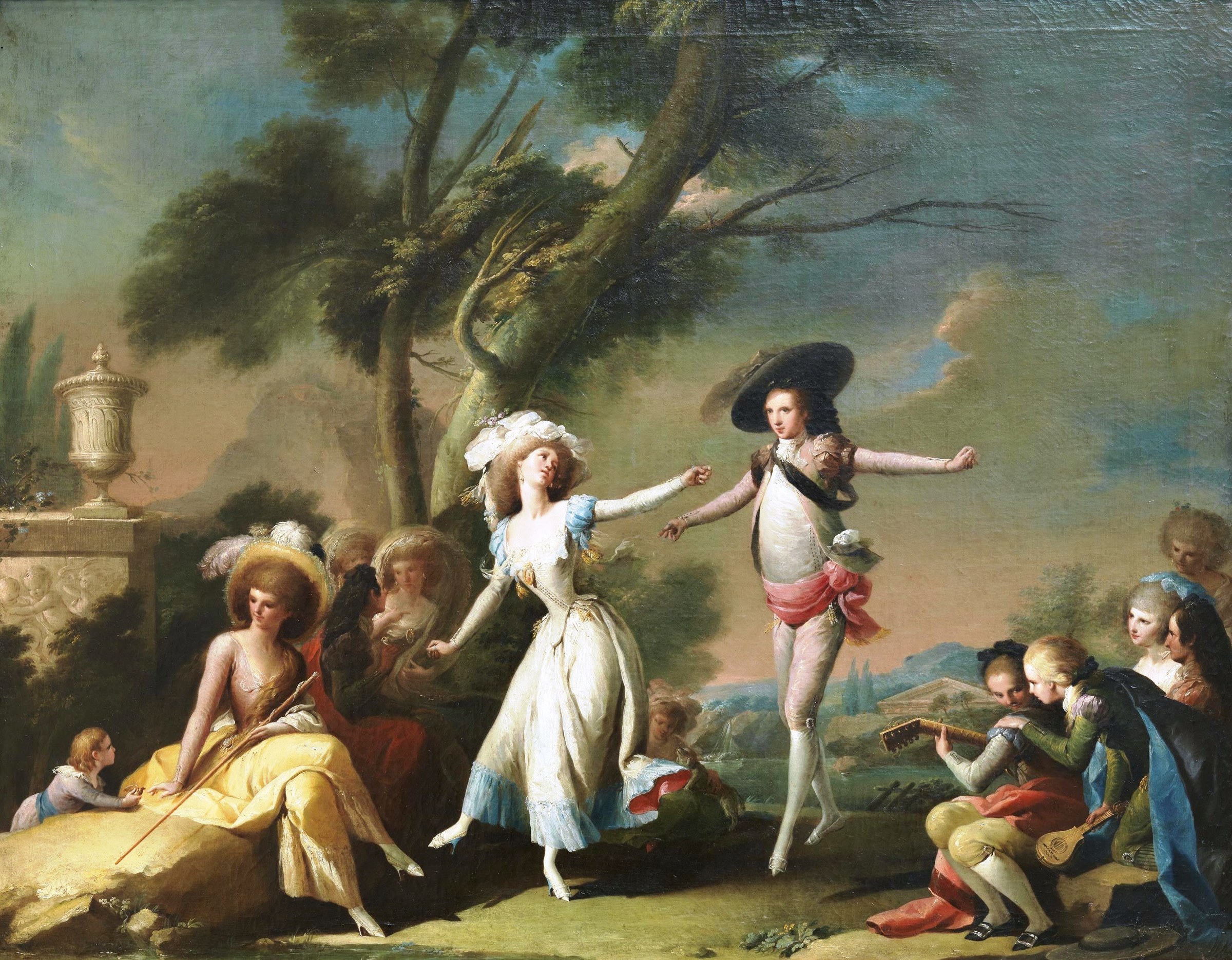
This is one of the few late rococo paintings to record the appearance and spatial frame of a contradansa in actual performance, rather than as a theoretical diagram or an idealized historical scene. The painting shows us how the open-frame, 'soft' hold of the contradansa differed from the close partnering of later ballroom dances, and how such dances functioned as a form of courtship theater within aristocratic leisure. For dancers and social historians, it is rare visual evidence of how the body was held, how the dance occupied space, and what it meant to an 18th-century spectator to watch others dance.
What you are looking at
An 18th-century garden party unfolds beneath a gnarled tree, with an ornamental urn visible to the left and a distant landscape glimpsed beyond. At center stage, a woman in a high-waisted white muslin dress with a blue sash and white lace cap dances with a bare-legged youth in a black bicorne hat and pink silk breeches; both have their arms extended in a playful, open frame. Around them, a mixed group of fashionably dressed spectators—some seated, some standing—observe the performance. On the right, a young musician plays a guitar while others hold instruments. The light is soft and diffuse, typical of rococo pastoral scenes, and the whole composition has the air of an aristocratic recreation or fête champêtre, with the dancers the focus of an attentive but relaxed audience.
The dancing
The male dancer is lifted slightly on the balls of his feet, weight forward, his arms spread wide in an attitude of invitation or exuberance. The female dancer faces him with open arms, her posture light and responsive, her body angled toward his. Their spacing suggests a social dance performed for an audience rather than a tight partnered hold—an arm's length or more apart. Both figures display the upright carriage and lifted torso expected of aristocratic dance; the woman's extended limbs and the man's balletic turnout of the legs suggest training in court dance. No visible footwork detail, but the positioning suggests a minuet or contredanse variation, with the dancers pausing in a moment of courtship or formal exchange.
The dance depicted
This depicts a *contradanza* or *contredanse*, the international social dance of the late 18th-century European salon, likely performed by young aristocrats at a country gathering. The open frame, the music provided by nearby performers, and the watching audience are all characteristic of recreational contradansa performance, where couples moved through figured patterns with other couples. The woman's muslin dress and the man's breeches costume place this in the 1780s, when the contradansa had become less formal than the minuet but retained its elegance and the expectation of trained movement. The pastoral setting signals this as an idealized representation of aristocratic leisure, a genre of 'fête champêtre' imagery popular in rococo art, where dance is both a real social practice and a symbol of courtly refinement and pleasure.
How it was made
The work is a painting in oil, executed with the soft modeling and atmospheric perspective typical of late rococo portraiture and conversation pieces. The brushwork is fluid, the colors (pale greens, warm beiges, touches of bright silk) characteristically rococo. The medium allowed Camarón to render subtle effects of light and air, the texture of muslin and silk, and the psychological nuance of the figures' expressions and poses—all crucial to a scene meant to evoke graceful sociability and the pleasures of aristocratic life. Oil painting on canvas was the standard vehicle for such ambitious genre scenes intended for aristocratic collectors.
About this work
José Camarón y Bonanat (1731–1803) was a Spanish painter working in the rococo tradition, known for historical scenes, mythological subjects, and—as here—genre scenes of aristocratic life. This work belongs to the broader 18th-century tradition of depicting dance as a social accomplishment and a marker of breeding and taste. The painting captures a moment of performance within a garden setting, merging landscape, portraiture, and dance in a single composition. For a dance historian, it documents both the costume and the open-frame carriage of contradansa dancers in the 1780s, and the cultural context in which such dances were performed: not in formal court ballrooms, but in the semi-private, semi-public spaces of country estates and garden parties, where aristocratic youth rehearsed the codes of politeness and attraction through the rhythmic, patterned movements of social dance.
How to look at it
Notice the exact moment the artist has chosen to freeze: neither the beginning nor the end of a figure, but a moment of open-armed exchange, with the dancers' bodies angled toward each other in a pose that suggests both formality and flirtation. The open-frame hold, the distance between the partners, and the upright carriage of both figures are all key to understanding how this dance differed from the closed partnering of 19th-century ballroom dances. Pay attention to the spectators, too: their placement and posture suggest that watching the dance was as important as dancing it, and that dance was a form of display within aristocratic leisure. The landscape and garden setting are not background but part of the meaning—this is dance not in a ballroom or court, but in an idealized, naturalized space where aristocratic refinement appears as effortless play.
The artist
José Camarón y Bonanat (1731–1803) was a Spanish rococo painter trained in the workshops of Antonio González Velázquez and active in Valencia and Madrid. He was known for historical and mythological compositions in the rococo manner, with a particular skill in rendering light, atmosphere, and the textures of aristocratic dress. His work shows the influence of both French rococo (in the composition and palette) and Spanish baroque traditions. He was a prolific portraitist and genre painter; scenes of social leisure and aristocratic recreation appear among his surviving works as evidence of the rococo taste for the intimate and the pastoral.
The period
In the 1780s, the contradansa (derived from the English country dance) had become the dominant social dance of the European aristocracy, displacing the minuet as the dance of choice for younger or less formal occasions. It was danced in salon and garden settings, often in the company of musicians and spectators. In art, the rococo had reached its mature phase, and painting was increasingly interested in scenes of leisure, courtship, and the representation of aristocratic youth as refined, graceful, and pleasure-seeking. The fête champêtre—the fantasy of aristocrats at play in a pastoral or garden setting—was a popular subject among rococo painters, and dance was a natural element of such scenes, signifying both elegance and the illicit pleasures of courtship away from formal supervision.
Where it lives
The work is recorded in Wikimedia Commons. No collection, accession number, or current location is recorded in the catalogue data available.
Dance in this work
Questions about this work
What dance are they doing?
This is almost certainly a contradansa (also called contredanse), the international social dance of the late 18th-century European salon. It was performed by couples in open frame—as shown here—moving through a series of predetermined figures with other couples. It was lighter and more playful than the minuet, though still requiring trained movement and good carriage.
Why is he dancing barefoot?
He is not barefoot—he is wearing flesh-colored breeches that come to the knee, revealing his calves and lower legs. This was standard male dress for social dance in the period, allowing the dancer's leg and foot position to be visible and assessed. Male dancers of the era wore fitted breeches and either slippers or dancing shoes.
Is this a real event or an imaginary scene?
It is a genre painting in the rococo tradition, which means it depicts an idealized representation of aristocratic life rather than a specific historical event. However, the costume, setting, and figures are drawn from real practice: such dances were indeed performed at country estates and garden parties, often with musicians and spectators present, exactly as shown here.
Who are the other people watching?
They appear to be members of the same aristocratic circle—other young people, musicians, chaperones, and leisured spectators. In 18th-century social dance, the audience was important: watching others dance, and being watched while dancing, was part of the ritual. The musician on the right with the guitar would have provided the music for the dancers.
More dance artwork





