49 works in this view — arrow keys or swipe to move between them.
Dance in Art
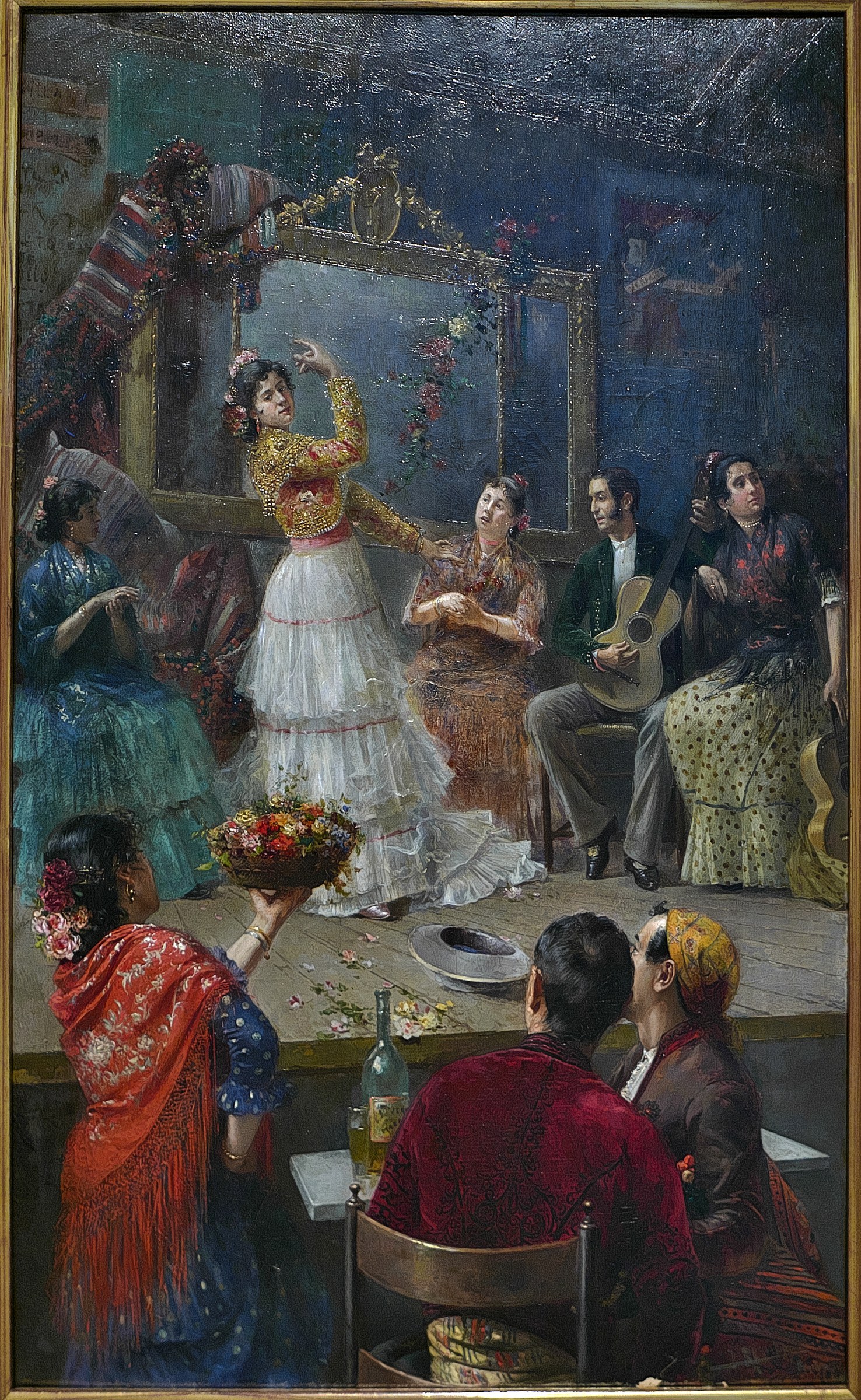
Tablao flamenco, José Rico Cejudo
José Rico Cejudo
- Source:
- Wikimedia Commons
- Rights:
- Public domain — free to use, share and adapt.
- Recorded as:
- public_domain
This is a rare contemporary document of flamenco in its pre-theatrical phase, showing the dance in the intimate social setting—the tablao—where it actually originated and developed, rather than in the concert hall or theatre context through which it is usually known to visual art. For dancers and historians, it offers evidence of 1890s flamenco technique, costume, and social practice that few other paintings provide.
What you are looking at
A flamenco performance in a modest interior space, likely a tablao (flamenco venue), painted in warm ochres and deep blues that suggest gaslight or candlelit evening. A soloist in a vibrant yellow jacket with red piping stands in the center, one arm raised in a characteristic curve, executing what appears to be a zapateado or heel-strike movement. She wears a white skirt with red trim and has flowers in her dark hair. Around her, seated and standing spectators in late-19th-century dress—men in jackets and hats, women in patterned shawls and elaborate hair ornaments—form an intimate viewing circle. One woman in the foreground holds a basket of flowers; another in red sits in profile. A seated guitarist with a classical instrument occupies the right side. The composition is theatrical but domestic: the space is confined, the lighting is warm and uneven, and the audience is close enough to touch the dancer.
The dancing
The central dancer is captured mid-movement with weight forward on the balls of her feet, her right arm raised and curved overhead in the classic línea or frame of flamenco, her body upright and controlled. Her left arm is lower, the hand at waist level. The pose suggests a moment of rhythmic intensity rather than extension or leap—the characteristic flamenco stance of containment and internal force. No pointe shoes; she dances in soft shoes or barefoot. The seated spectators are turned toward her, their bodies angled inward, creating the compact, concentrated space typical of tablao performance rather than theatre.
The dance depicted
This is unmistakably flamenco, almost certainly a palos like Alegrías, Soleá, or Tangos Flamencos, to judge by the soloist's formal dress, the presence of a classical guitar, and the intimate tablao setting. The dancer's arm position and upright carriage are consistent with late-19th-century flamenco practice. The painting documents flamenco as it was danced in Spain in the 1890s—not yet the theatrical spectacle it would become in the 20th century, but a social performance in a working or middle-class gathering space, with both musicians and a cohort of admirers who might sing or clap palmas (hand-claps) to accompany the dancing.
How it was made
This is oil on panel (tabla), as stated in the Spanish museum record. The artist has used loose, impressionistic brushwork, especially in the background figures and the blue-grey wall, while rendering the central figure and foreground faces with greater finish. The technique allows Cejudo to capture the warmth and movement of gaslit performance space while maintaining architectural clarity in the composition. The medium and style suggest a work intended for exhibition and private collection rather than public mural or decorative scheme—a fine-art document of contemporary Spanish social life.
About this work
José Rico Cejudo's *Tablao flamenco* (1895) is one of the few surviving visual documents of flamenco performance in its native Spanish domestic context at the end of the 19th century, before it was exported to concert halls and tourist venues. The painting shows not the star performer but the experience of flamenco as a communal, intimate art form—a woman dancing for an audience of peers in a small room, accompanied by a single guitarist, her movement rooted in the sharp, controlled percussion of zapateado and the formal geometry of flamenco's arm positions. The work is valuable as both social history and art history: it records how flamenco was actually practiced in Spain in this era, and it exemplifies the Spanish salon painting of the period, which often took popular entertainment and street life as its subject.
How to look at it
Watch the soloist's arm position: the raised arm with curved wrist and open hand is the foundational línea of flamenco, and Cejudo has rendered it with anatomical precision and understanding of the grace required to hold it. Notice also how the artist has frozen the moment just after a weight shift—the dancer's body is upright but her weight is forward on the balls of her feet, ready for the next strike or turn. The composition itself is instructive: rather than isolating the dancer centre-stage, Cejudo places her within the circle of spectators, showing us not a theatre performance but a gathering, and making it clear that in flamenco, the audience's presence and participation (through clapping, singing, even eye contact) is part of the form.
The artist
José Rico Cejudo (1862–1917) was a Spanish painter associated with salon painting and social realist subjects, known for his scenes of contemporary Spanish life, particularly those depicting popular entertainment, flamenco, and figures from working and middle-class culture. His work was exhibited in Madrid and gained recognition for its attention to light, colour, and the informal moments of social interaction. He was part of the generation of Spanish painters who turned to everyday Spanish culture—including music and dance—as a subject worthy of fine art at a moment when Spain was beginning to market these traditions internationally.
The period
The 1890s were a pivotal moment for flamenco in Spain. The form had roots in Andalusian popular culture reaching back centuries, but it had only recently begun to move beyond working-class tavernas and private gatherings into public performance spaces and the attention of middle-class audiences and collectors. At the same time, Spanish art was experiencing a cultural movement that looked to indigenous Spanish culture—folk music, regional dress, bullfighting, flamenco—as a source of national identity and artistic authenticity. Painters like Cejudo were documenting this culture at a moment when flamenco was transitioning from private social practice to public spectacle. The gaslit tablao setting in this painting represents that middle moment, before electric light and large concert halls became the norm.
Where it lives
The painting is held in the Museo Bellver in Palma de Mallorca and is documented in the museum's collection as an oil on panel by Cejudo dated 1895. The source information indicates it is a historical Spanish museum holding, part of a public collection.
Dance in this work
Questions about this work
Is this a real tablao, or did the artist invent it?
The setting is consistent with tablaos that existed in Spain in the 1890s—small, intimate rooms in tavernas or private houses where flamenco was performed for a gathered audience, often with food, drink, and guitar music. While this may be a particular venue or a composite scene, the type of space was very real and very common. The term *tablao* (literally 'platform' or 'stage') was not formalized until the mid-20th century, but the practice of intimate flamenco performance in private or semi-public rooms dates back much earlier.
What is she dancing?
We cannot be certain, but the formal dress, the arm position, and the presence of a classical guitar suggest she may be dancing one of the more structured, rhythmically complex palos like Soleá, Alegrías, or Tangos Flamencos. The upright posture and the controlled arm work rule out the freer, more narrative forms like Bulerías or Martinete. The tight skirt and the emphasis on footwork suggest something with significant zapateado (heel-strike).
Why was flamenco painted by fine artists in this period?
Flamenco, along with bullfighting and regional folk costume, became a symbol of Spanish national identity and authenticity in the late 19th century, at a moment when Spain was culturally and politically anxious about its place in modern Europe. For painters, flamenco represented the 'real' Spain—visceral, passionate, rooted in the people—and offered a way to make art from contemporary social life that was both popular and serious.
How different is this from modern flamenco?
The costume, the technique, and the setting are all from a specific historical moment. The dress and hair ornaments are 1890s; the technique shown here emphasizes formality and control rather than the virtuosic footwork and improvisation that became dominant after the 1920s; and the social context—intimate, non-commercial performance—vanished as flamenco was commercialized for tourism and theatre. This painting shows flamenco before those changes.
More dance artwork





