Soleá
Also known as: Soleares, Soledad, Soleá grande
- Origin
- Triana (Seville), Utrera, Lebrija, Alcalá de Guadaíra and Cádiz, Andalusia, Spain
- Era
- 1862–1900
- Rhythm
- 12-beat compás, one 6/8 bar plus one 3/4 bar per cycle, with accents on beats 3, 6, 8, 10 and 12; counted from 1 and resolving on 12, the slowest reading of the soleá family cycle
- Tempo
- Approximately 60-100 bpm
- Character
- Grave, contained and tragic in bearing; solemn marking punctuated by abrupt, weighted remates
History & Cultural Context
Soleá emerged among Calé Romani communities of Seville and Cádiz; the earliest documented mention comes from the poet Gustavo Adolfo Bécquer in 1862. Its nickname, the mother of the palos, is affectionate rather than literal — seguiriya is older and the fandango family has separate roots — but soleá does supply the 12-beat compás that alegrías and bulerías share. The cycle alternates 6/8 and 3/4 bars with accents falling on 3, 6, 8, 10 and 12, and it is played in the altered Phrygian mode por arriba, with the tonic on the sixth string. Stanzas use the cuarteta romanceada, three or four assonant lines. The dance is slow, vertical and withheld: long marcaje passages, deep braceo, then a llamada that snaps the section shut. Its golden age was the last quarter of the nineteenth century in the cafés cantantes, shaped by Enrique el Mellizo (1848-1906) and Joaquín el de la Paula (1875-1933). Antonio Mairena later rebuilt its recorded canon, and Triana's potters' quarter gave the soleares alfareras their name.
Cultural Significance
Soleá belongs to the cante jondo core built in Gitano households of Triana, Utrera, Lebrija and Alcalá, then professionalised in the cafés cantantes after Silverio Franconetti's Seville venue. It is treated as a test of a dancer's maturity: the compás is slow enough that nothing can be hidden.
Characteristic Movement & Technique
Sustained marcaje with a lifted, arched torso; wide slow braceo and floreo; measured zapateado that never overruns the cante; llamadas to cue the singer; escobilla built in stepped rhythmic tiers; final desplante. Frequently danced with bata de cola or mantón.
Partnering Dynamics
Solo dance. The real partnership is the triangle of bailaor or bailaora, cantaor and tocaor, negotiated live through llamadas, remates and jaleo rather than physical contact.
Competitive Context
Essentially non-competitive. Soleá has nonetheless been a set form at the Concurso Nacional de Arte Flamenco de Córdoba, founded in 1956 and held triennially, which is the only Spanish flamenco contest empowered to award the title of Premio Nacional.
Regional Variations
Distinct schools in Triana (including the soleares alfareras of El Zurraque), Alcalá de Guadaíra, Utrera, Lebrija, Jerez and Cádiz, differing in melodic contour and in how freely the compás is stretched.
Common Misconceptions
That mother of the palos means soleá is the oldest form — seguiriya predates it and the fandangos descend separately. That its slowness makes it easy; it is the opposite. That castanets belong to it — they do not; soleá uses palmas, feet and silence.
Peak Popularity
Signature Figures
- Enrique el Mellizo
- Joaquín el de la Paula
- La Andonda
- Pastora Pavón 'La Niña de los Peines'
- Antonio Mairena
- Manuela Carrasco
- Israel Galván
Notable Codifiers
- Antonio Mairena
- Matilde Coral
Dance Lineage
Soleá Music & Tempo
Drawn from 15 Soleá tracks in the LODance music library.
Example tracks at practice tempo
- Soleá, Tempo 90 (Sólo Compás Lenta) — Arcángel90 BPM
- Soleá, Tempo 76 (Sólo Compás Muy Lenta) — Arcángel76 BPM
- Escobilla Lenta, Tempo 80 — Arcángel80 BPM
- Escobilla Muy Lenta, Tempo 70 — Arcángel70 BPM
- Soleá (Muy Lenta con Foque Para Cante y Baile) — Arcángel
- Solea Corta subida moderada — Sólo Compás Flamenco
Who governs Soleá
Federations, councils and examining bodies with a recorded role in this style. No single organisation can tell you this — each one knows only itself.
Legends of Soleá
Dancers, choreographers and teachers whose work shaped this style.
Soleá on screen
Films and television where Soleá appears, with the sequences worth watching for.
 Flamenco (1995)1 sequence indexedSoleá del Farruco · chor. Farruco
 Flamenco, Flamenco (2010)1 sequence indexed“Llanto” — Soleá
Poster artwork from TMDB.
 This site uses TMDB and the TMDB APIs but is not endorsed, certified, or otherwise approved by TMDB.
What to Wear
Attire guidance for Soleá and other Flamenco dances. Each card below is sized to the moment — class, practice, social, or competition — because the wardrobe shifts as the stakes do.
Reading the cards
In Class
Shoes are the instrument, not an accessory: proper flamenco shoes are leather with clavos — nails hammered into the toe and heel — which is what makes zapateado audible and correctly pitched. Character shoes and tap shoes are not substitutes; tap plates are the wrong sound and too loud for a flamenco room. A sturdy hard-soled shoe with a low heel is acceptable for a first class or two, but never bare feet — you need the sound, and studio floors give splinters. Wear a practice skirt (falda de ensayo) with genuine weight and a wide hem so you can see and feel where the fabric is, or fitted leggings and a fitted top so the teacher can read your hip and knee alignment. Hair back and off the face.
Social Dancing
Flamenco is not a social partner dance, so there is no equivalent of a milonga or a salsa night; the closest thing is a juerga or a fin de fiesta at a peña, where people take turns dancing bulerías and everyone is in normal clothes. Sevillanas is the genuinely social form — danced in couples at ferias and romerías, where the traje de gitana is worn at the feria and plain clothes everywhere else. If you're attending a tablao as an audience member, dress as you would for any small theatre; nothing is expected of you.
Competition
Flamenco is not a competitive form and has no scored rulebook. The equivalents are the tablao, the peña, the theatre and the classroom, and what they call for is craft equipment rather than costume. A bata de cola is a working garment with a weighted, structured train — a beginner's usually has three ruffles in front and five behind, and a light one is actually harder to control because the fabric flops instead of landing when you kick it. The mantón is a large fringed silk shawl (at least 52 inches square before the fringe) whose weight and swing are the whole technique. Both take dedicated study, and neither is decoration.
Shoes
Leather flamenco shoes with clavos — nails hammered into the toe and heel — are the instrument, not an accessory: without them zapateado has no volume and no pitch. Heels run around 5–6 cm on the standard women's model and roughly 4 cm on a men's boot, over a leather sole with a rubber pad, laced or strapped so the foot is locked in for percussive work. Character shoes and tap shoes are not substitutes; tap plates are the wrong timbre and far too loud for a flamenco room. A hard-soled, low-heeled street shoe is fine for a first class or two, but never bare feet — no sound, and studio floors give splinters.
In Practice
Serious practice means shoes and a weighted skirt every time — technique that only works in leggings collapses the moment there is fabric to manage. A falda de ensayo with real weight teaches your hands, hips and eyes where the skirt is, with leggings underneath so the teacher can still read knee and hip alignment. Practise on a surface that can take clavos: a wooden board or a tarima at home, never tile or concrete, which destroys both the nails and your joints. Hair back and off the face, since the head and gaze are part of the technique.
Common Pitfalls
- ✗Substituting tap shoes or character shoes — the sound is wrong and tap plates are unusably loud in a flamenco room.
- ✗Dancing barefoot: no sound, and studio floors will give you splinters.
- ✗Practising zapateado on tile or concrete, which wrecks the clavos and your knees, ankles and hips.
- ✗Buying a bata de cola that is too light because it seems easier — an underweight train flops instead of landing, and teaches you nothing.
- ✗Training only in leggings and meeting the skirt for the first time in performance.
Price Range
- Budget: Beginner nailed shoes roughly $60–125 (Miguelitos and similar sit near the bottom of that range), a simple practice skirt $50–90. Some schools keep a loaner box of second-hand shoes for new students — ask before buying.
- Mid: Semi-professional nailed shoes roughly $150–250 (Senovilla, Arte FyL), a proper weighted falda de ensayo, a real silk mantón at roughly $120–150, an abanico under $20.
- Premium: Professional and custom shoes from Menkes, Gallardo or Begoña Cervera at roughly $250–450 and up, and a bata de cola from $400 upward — buy the skirt version for training, not a dress. Budget for re-nailing and re-soling as a recurring cost, not a one-off.
Key Terms
- Clavos
- Nails hammered into the toe and heel of flamenco shoes. They make the percussion audible and tuned; a shoe without them is a different instrument.
- Zapateado
- Percussive footwork. It is why the shoe, the floor and the surface you practise on all matter more here than in most styles.
- Falda de ensayo
- Weighted practice skirt. The weight is functional — a light skirt flops instead of landing where you throw it.
- Bata de cola
- Skirt with a long weighted train, typically three ruffles in front and five behind for a beginner. A working garment with its own technique and years of study behind it, not a costume.
- Mantón
- Large fringed silk shawl, at least 52 inches square before the fringe. Its weight and swing are the entire technique.
- Tarima
- Wooden platform built to resonate under zapateado — what a flamenco floor is supposed to be, and why concrete is not an acceptable substitute.
Quick Tips
- •Suede-soled shoes allow controlled sliding and pivoting — essential for most partner dances.
- •Avoid rubber soles on dance floors; they grip too much and can cause knee injuries.
- •Bring a separate pair of clean shoes for the dance floor to keep it in good condition.
Sources & Further Reading
Cultural & Historical Context
Soleá emerged from Triana (Seville), Utrera, Lebrija, Alcalá de Guadaíra and Cádiz, Andalusia, Spain during 1862—1900s. Understanding the cultural roots, musical traditions, and social circumstances of this era enriches appreciation for the dance's characteristics and significance.
Formative Influences
Codifiers & Standardizers:
Antonio Mairena, Matilde Coral
Signature Movement Vocabulary:
Enrique el Mellizo, Joaquín el de la Paula, La Andonda, Pastora Pavón 'La Niña de los Peines', Antonio Mairena, Manuela Carrasco, Israel Galván
Primary Source Documents
The Library of Dance contains public-domain primary sources for dance history. Copyrighted modern syllabi are indexed with purchase links to their respective copyright owners. Search by dance name or codifier to discover primary source documents.
Last reviewed: September 2026 — This dance profile synthesizes historical research, cultural documentation, and contemporary practice knowledge to provide authoritative context.
More in Flamenco
Alegrías
The bright major-key 12-beat palo from Cádiz, the most formally structured flamenco dance, moving through salida, paseo, silencio, castellana, escobilla and bulerías de cierre.
Bulerías
The fastest 12-beat palo, born among Jerez Gitano families as a runaway ending to soleares and alegrías and now the standard festive closer of any flamenco gathering.
Seguiriya
The deepest form of cante jondo, a 12-beat palo whose accent pattern displaces the soleá cycle, danced as a slow ceremonial lament of grief, imprisonment and death.
Tangos Flamencos
The core 4-beat flamenco palo, earthy and hip-driven, entirely unrelated to Argentine Tango despite the shared name and a common nineteenth-century Atlantic ancestry.
Fandangos de Huelva
The danceable, community-rooted branch of the fandango family, kept in strict triple-time compás and tied to specific Huelva villages, romerías and local festivals.
Farruca
A sombre 4-beat palo in A minor, traditionally the male showcase, built on sober bearing, fast turns and the most exposed zapateado in the flamenco repertoire.
Taranto
The mining palo of Almería and the Levante, a metred cousin of the free-rhythm taranta, danced with heavy, dragging weight and a brooding minor-inflected guitar sound.
Guajira
The major-key ida y vuelta palo adapted from the Cuban punto guajiro, danced with a large Spanish fan in a languid, flirtatious 12-beat cycle.
Martinete
A cante a palo seco sung without any guitar, born in the Gitano forges and danced against hammer strokes on an anvil rather than harmony.
Zapateado
The purely percussive palo in 6/8, where dancer and guitarist trade a repeated melodic theme and footwork becomes the melody rather than the accompaniment.
Rumba Flamenca
The most popular ida y vuelta palo, a 4/4 form built on a 3+3+2 tresillo that carried flamenco into mass-market pop through Catalan Gitano musicians.
Nuevo Flamenco / Flamenco Fusion
The era opened by Paco de Lucía and Camarón de la Isla in the 1970s, in which flamenco absorbed jazz, rock and Latin music and baile entered contemporary theatre.
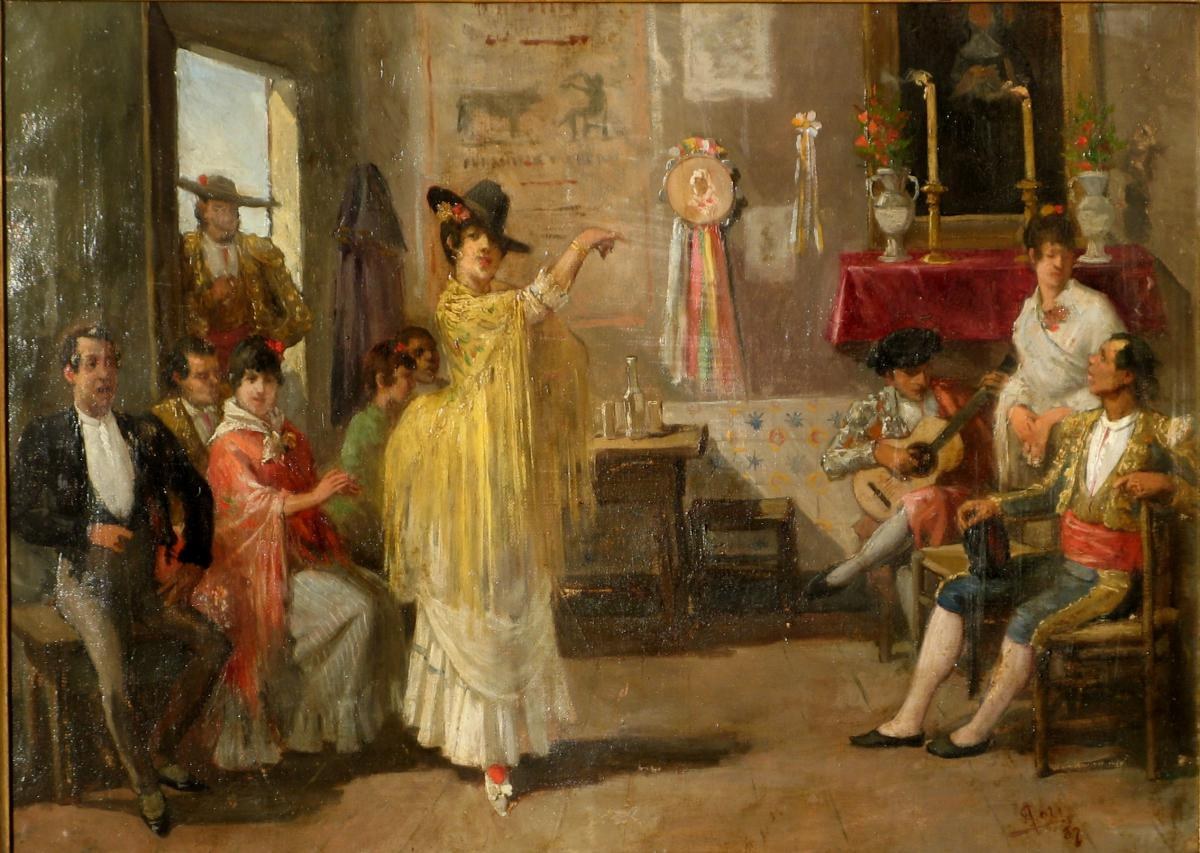
Soleá in art
Browse the gallery →Works our catalogue identifies as depicting soleá.
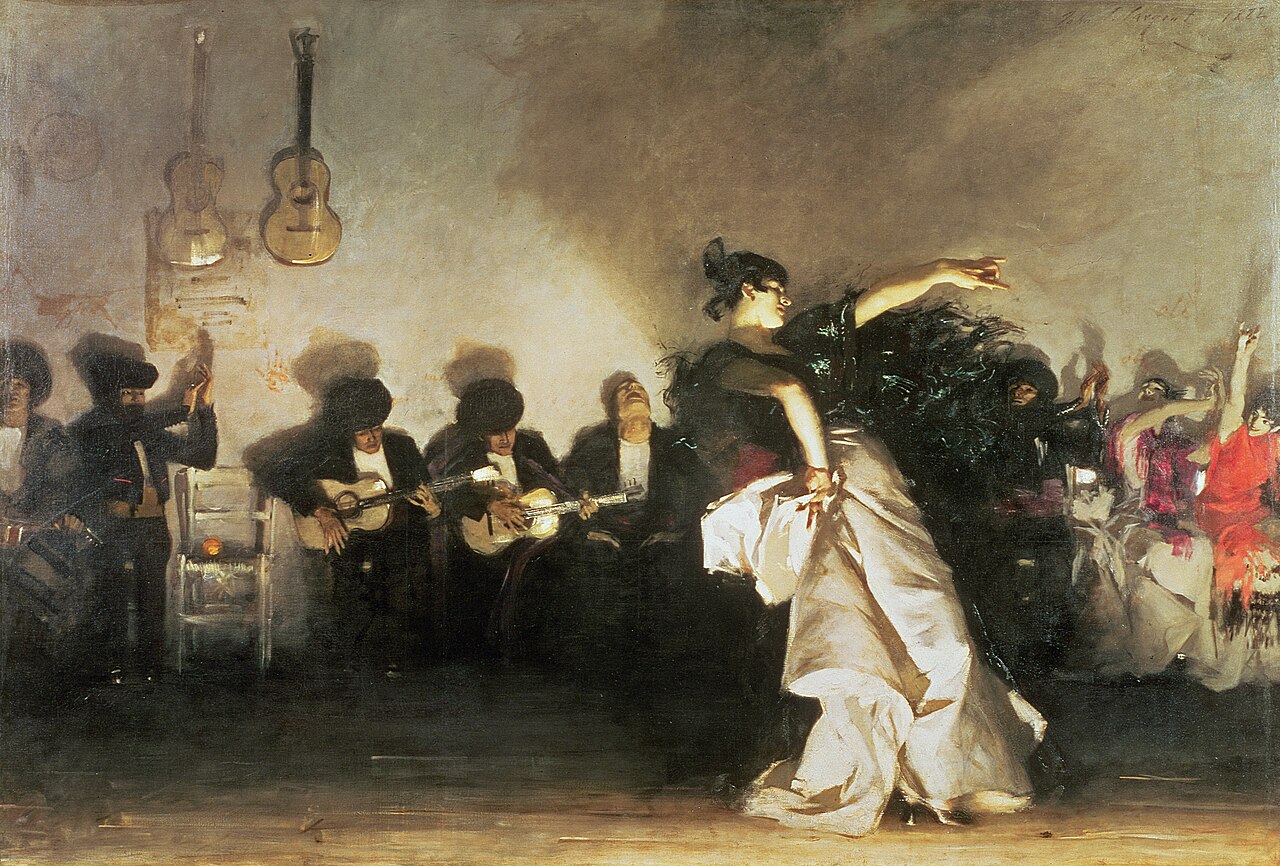
El Jaleo
John Singer Sargent
public_domain
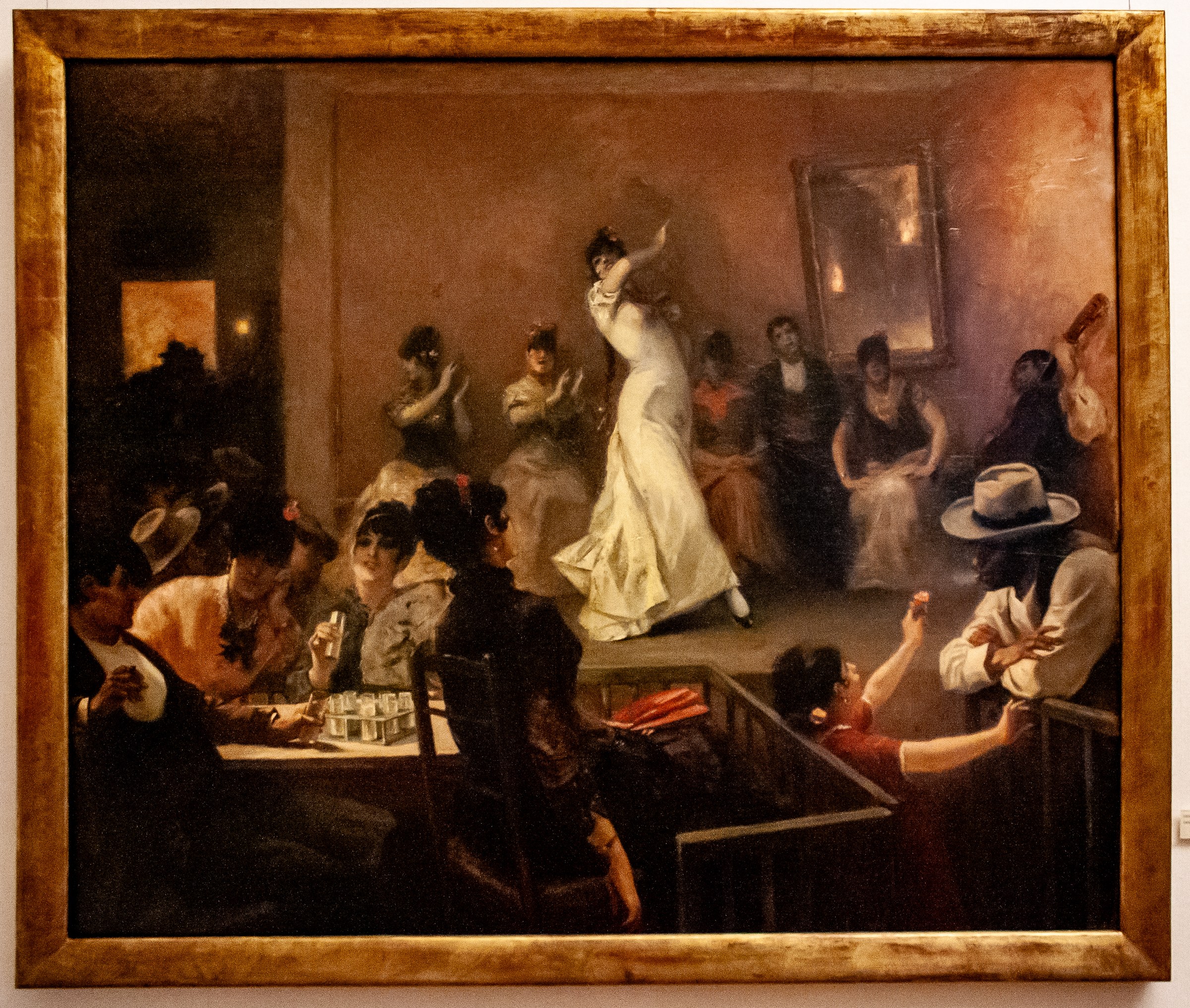
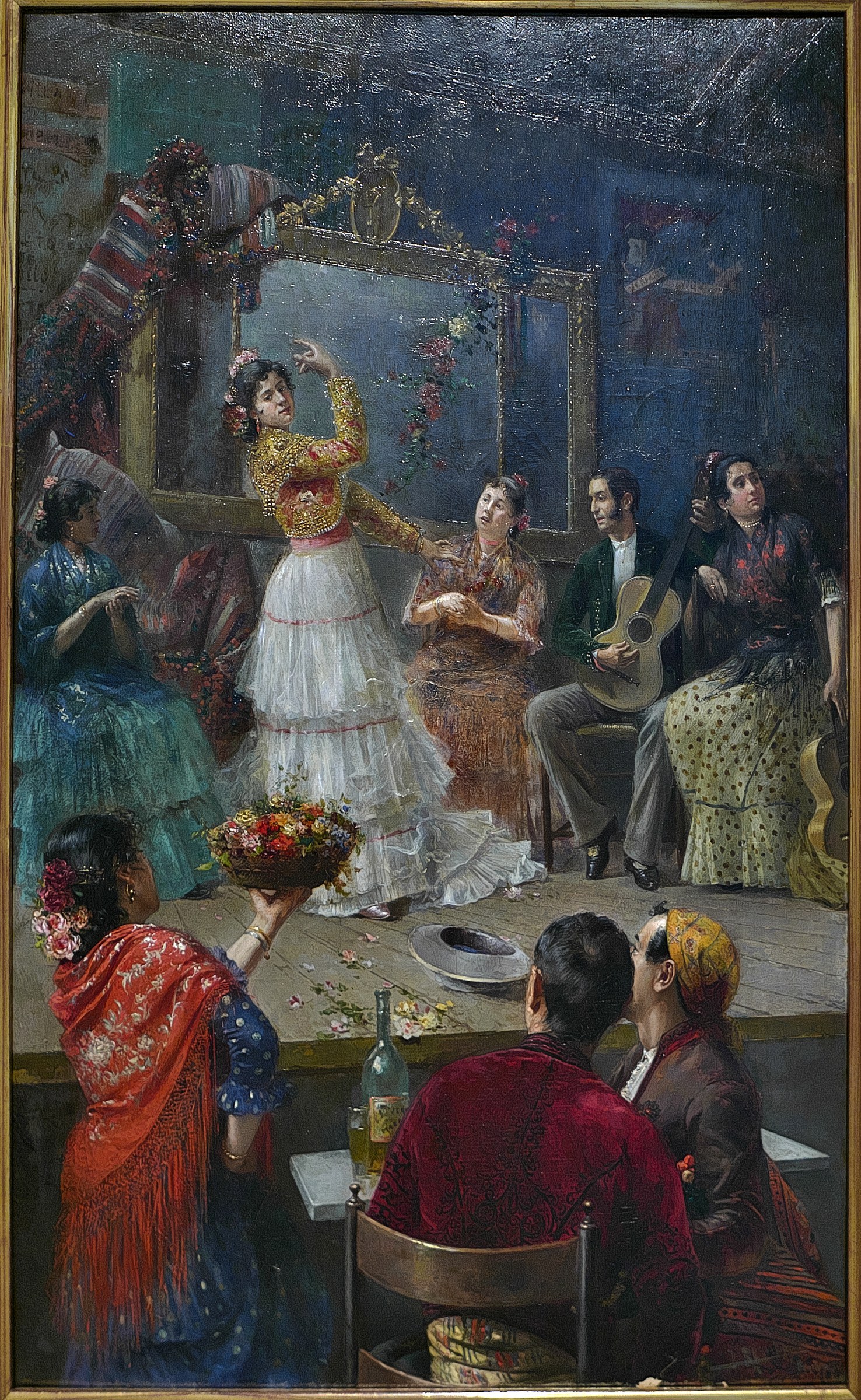
Tablao flamenco, José Rico Cejudo
José Rico Cejudo
public_domain
Continue Exploring
Lineage of Dance
500 years of dance evolution
Champions of Dance
Winners of marquee national & world titles
Language of Dance
161 dance terms & translations
Listening of Dance
Tempo, timing & musicality tools
Gallery of Dance
5,700+ artworks from museum collections
Attire of Dance
Evolution of dance dress across eras
Keep the thread going
Dance history, technique, and the occasional rabbit hole — in your inbox. Thoughtful, infrequent, unsubscribe anytime.
Free. No spam. One click to leave.