49 works in this view — arrow keys or swipe to move between them.
Dance in Art
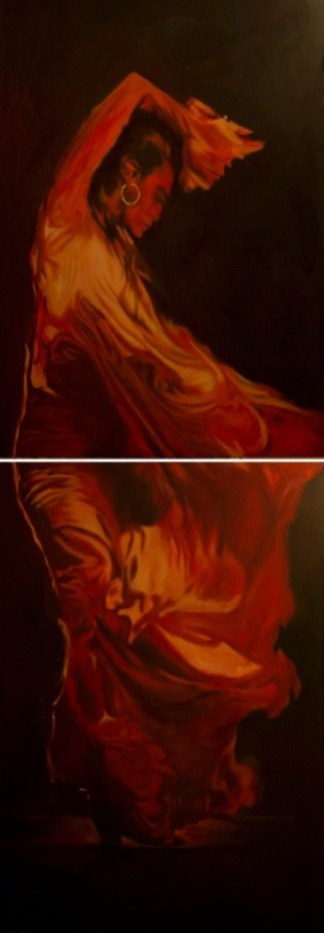
Adam Marian Pete - Flamenco -2012
Adam Marian Pete
- Source:
- Wikimedia Commons
- Rights:
- Reusable with conditions: credit the creator; share any adaptation under the same license. Source record ↗
- Recorded as:
- cc by-sa 4.0
This work is significant for contemporary dance artists and historians because it engages seriously with flamenco as a form requiring both extreme physical sophistication and emotional depth. The painting's scale, technique, and emotional intensity assert that dance—and particularly flamenco—deserves the same serious artistic attention as any other subject in fine art. The divided composition also raises questions about how to represent movement in static media, and how sequence and time function in painting.
What you are looking at
A single figure dominates this vertical composition, captured in a moment of intense, passionate movement against a dark background. The dancer wears a flowing garment in deep red and gold tones that swirls around the body, creating a dramatic spiral of fabric. The photograph is divided horizontally across its center, suggesting either a diptych structure or a doubled exposure showing the same dancer in two successive positions. In the upper half, the figure arches backward with the head tilted and arm extended upward, the body twisted into a deep curve. In the lower half, the pose shifts: the torso leans forward and the fabric pools and lifts around the legs and lower body, as though caught mid-spin. The lighting is theatrical and selective, with warm amber and orange tones illuminating the fabric's folds while deep shadows define the musculature and contours of the body. The background remains nearly black, isolating the figure entirely. The overall effect is one of passion, intensity, and fluid motion—the work captures the dancer mid-performance, in a moment of complete physical commitment.
The dancing
A single dancer's body is the entire subject. The figure demonstrates extraordinary flexibility and control, moving through positions that suggest deep spinal extension in the upper section and forward folding or turning movement in the lower. The arms are used expressively—reaching, extending, framing the face and upper body. The dancer's weight appears fully committed to each position, with no sense of tentative movement; the body demonstrates the muscular engagement necessary for sustained turns or sustained extension. The flowing costume—likely a traditional or theatrical garment—becomes part of the expressive vocabulary, moving with the body and adding visual weight to the gesture.
The dance depicted
This work depicts flamenco dancing, as confirmed by the catalogue record and supported by several visual elements: the intense, emotionally charged quality of the movement; the flowing, voluminous garment suggesting a flamenco dress or similar traditional Spanish costume; and the passionate, inward-focused quality of the gesture that characterizes flamenco's emotional expression. The specific flamenco style cannot be definitively identified from the photograph alone, but the dancer's extreme flexibility, the use of the torso and spine, and the emotional intensity suggest a form emphasizing cuerpo (body work) and emotional depth rather than footwork spectacle. The doubled or sequential composition may suggest the artist's interest in capturing the continuity and transformation of movement through time.
How it was made
The catalogue record identifies this as oil on canvas, 120 × 320 cm, painted in 2012. The scale is monumental and the composition deliberately divided, treating the full canvas as a single unified field interrupted by a strong horizontal line. The photorealistic technique—the precise rendering of musculature, fabric texture, light and shadow—suggests the artist worked from photography, a common practice in contemporary figurative painting. The size and technical precision indicate this was not a sketch but a finished work of significant ambition, intended for exhibition and serious contemplation of the flamenco form.
About this work
This is a 2012 oil painting by Adam Marian Pete depicting a single flamenco dancer in a moment of intense emotional and physical expression. The work uses a divided composition and photorealistic technique to capture the continuity of movement and the passionate inward focus characteristic of flamenco dance. The monumental scale and theatrical lighting transform the image into a meditation on the emotional and physical commitment required by the form.
The painting belongs to a contemporary tradition of dance portraiture that seeks not merely to document movement but to convey its emotional and spiritual content. By isolating the single figure against near-total darkness and rendering the body with anatomical precision, Pete emphasizes the dancer's physical commitment and emotional authenticity. The work acknowledges flamenco's roots in Spanish tradition while treating it as a universal human expression of passion and vulnerability.
How to look at it
The viewer should attend first to the horizontal line dividing the canvas: it is not accidental but structural, inviting comparison between the upper and lower halves and suggesting the continuous transformation of the dancer's body through time. Look at how the fabric moves differently in each section—it is not simply repositioned but shown responding to different directions and speeds of movement. Notice how the lighting isolates the figure and emphasizes musculature; this is not soft or forgiving illumination but harsh theatrical light that demands the viewer see the dancer's physical effort. The dark background is not neutral but active—it presses in on the figure and intensifies the sense of the dancer's inward emotional focus.
The artist
Adam Marian Pete is a contemporary painter whose practice focuses on figurative and dance subjects. His work is characterized by large-scale, photorealistic technique and an interest in capturing both the physical and emotional dimensions of human movement and performance. Pete's approach to flamenco suggests a deep respect for the form's traditions and an interest in representing it not as exotic spectacle but as a serious artistic discipline requiring genuine mastery.
The period
This painting was made in 2012, a moment when contemporary figurative painting was reasserting itself after decades of conceptual and abstract dominance. In dance, flamenco was experiencing renewed international interest and serious critical examination as a form worthy of academic and artistic study, distinct from its popular or folkloric associations. The photorealistic technique reflects a broader contemporary interest in how photographic and painted representation differ, and what painting can achieve that photography cannot—here, the combination of anatomical precision with emotional intensity and theatrical scale.
Where it lives
The work is recorded as held in Wikimedia Commons, indicating it is in the public digital record. The catalogue record lists only the title, artist, date, medium dimensions, and source, with no information about current institutional location or exhibition history.
Dance in this work
Questions about this work
Is this a photograph or a painting?
It is an oil painting. The catalogue record specifies oil on canvas, 120 × 320 cm. The photorealistic technique—the precise rendering of light, shadow, and anatomical detail—may create the illusion of photography, but this is the result of the artist's technical skill in paint. Contemporary painters often work from photographs as reference, which can produce this effect.
Why is the canvas divided in half?
The horizontal line appears to show the same dancer in two successive moments or positions, inviting the viewer to read the canvas as capturing movement through time. This structure emphasizes the continuity and transformation of movement, rather than freezing a single instant. It is a deliberate compositional choice that reflects contemporary painting's interest in representing temporal and spatial complexity.
What flamenco style is depicted?
The specific style cannot be definitively identified from the image alone. However, the emphasis on upper-body articulation, spinal flexibility, and inward emotional expression suggests a form centered on cuerpo (body work) and emotional depth. The extreme backbend and forward folding visible in the two sections are not characteristic of forms emphasizing footwork, such as tangos or bulerías, but rather of forms such as alegrías or soleá where torso and emotional expression predominate.
Who was the model?
The catalogue record does not identify the dancer, and the painting itself offers no documentation of identity. Contemporary practice in figurative painting often separates the model's identity from the work's meaning; the subject is flamenco dancing, not a particular individual's biography.
More dance artwork





