49 works in this view — arrow keys or swipe to move between them.
Dance in Art
Spanish: Flamencolabel QS:Les,"Flamenco"
Antoni Coll i Pi
- Source:
- Wikimedia Commons
- Rights:
- Public domain — free to use, share and adapt.
- Recorded as:
- public_domain
This painting is one of relatively few nineteenth-century visual documents of flamenco as it was actually danced in private settings, before its transformation into a staged theatrical form. For historians of flamenco and Spanish culture, it provides evidence of how the dance was performed, in what spaces, and with what emotional intensity in the period before commercial flamenco establishments became dominant. For art historians, it exemplifies the Spanish costumbrista tradition's interest in capturing indigenous cultural practices at a moment when industrialization and tourism were beginning to remake them.
What you are looking at
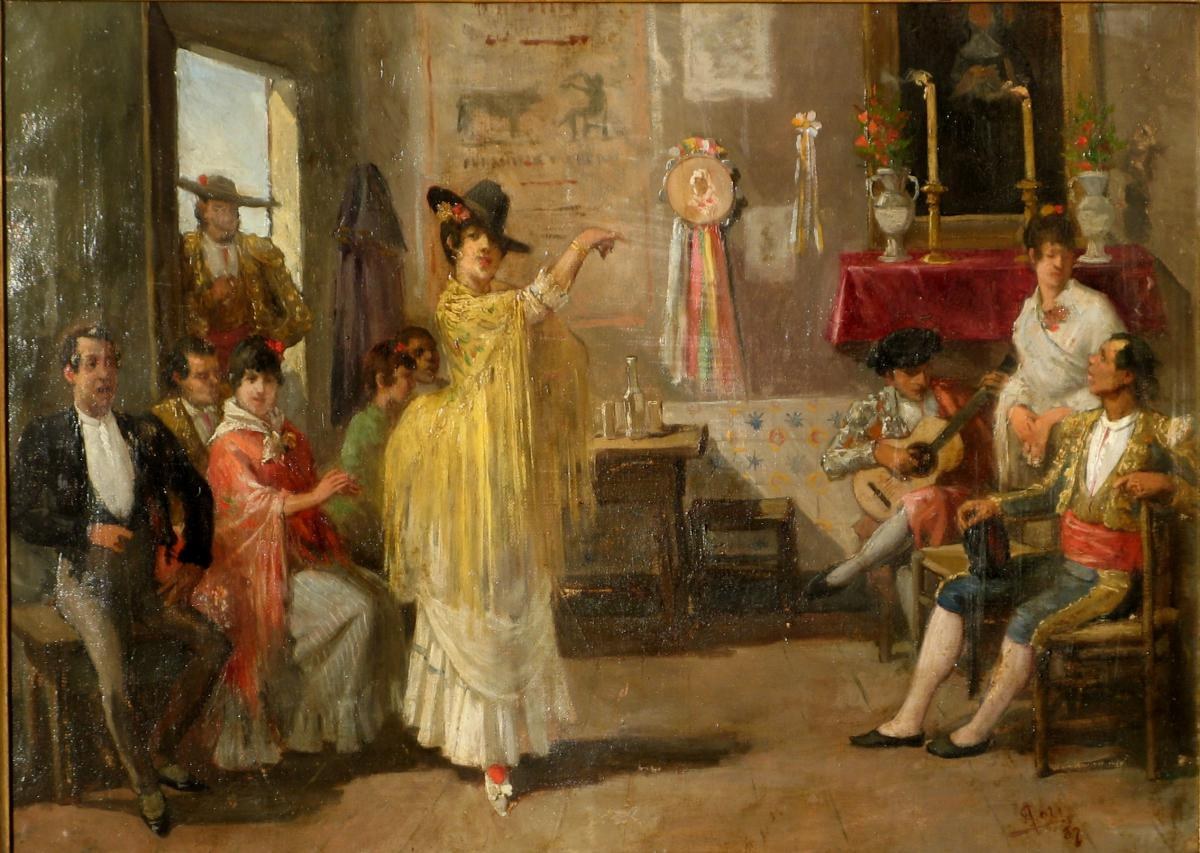
A crowded interior scene set in what appears to be a modest Spanish dwelling or studio, with ochre-toned walls and a low ceiling. The composition is busy with figures arranged around the edges of the space, watching a woman in a brilliant yellow dress who dominates the center of the canvas. She stands with her body twisted, one arm raised and extended, her pose suggesting a moment of intense movement or emotional expression. Her white underskirts are visible beneath the yellow gown. To the right, a red-draped table holds vases and what appears to be a religious image or devotional object. On the left, a doorway opens to another room where a figure in a wide-brimmed hat is visible. The lighting is warm and diffuse, creating deep shadows that give the interior a sense of intimacy and heat. The gathered onlookers—some seated, some standing—wear period dress in reds, greens, and dark tones, their faces turned toward the central figure with interest and attention.
The dancing
The central dancer is captured in an off-balance, asymmetrical pose with her upper body twisted, her left arm raised high with fingers extended, and her right arm bent across her torso. Her weight appears to shift between her feet, and her gaze is directed upward. The surrounding figures sit or stand in informal arrangements, their postures relaxed and observational rather than participatory. No visible partner or formal dance hold is present; this is a solo performer and an audience. The gestural language is expressive and emotionally charged rather than formally structured.
The dance depicted
The work is titled *Flamenco*, and the image shows a woman performing solo in an intimate, domestic setting rather than a professional stage. Her pose—the raised arm, the twisted torso, the apparent loss of balance or surrender to the music—is consistent with flamenco movement vocabulary, particularly the emotional intensity and bodily expressiveness of cante jondo (deep song) traditions. The setting suggests a private or informal gathering (possibly a peña or family gathering) rather than a theater performance. The presence of a religious image on the wall and the devotional quality of the onlookers' attention lends spiritual or cultural weight to the moment. The specific flamenco style cannot be definitively identified from the pose alone, though the emotional tenor and the woman's apparent self-absorption suggest palos like soleá or seguiriya rather than the more rhythmic or cheerful forms.
How it was made
This is an oil painting on canvas (or panel), executed in a loose, sketch-like technique with broad brushwork and soft modeling of form. The artist has used warm, earthy tones and allowed the canvas ground to show through in places, creating an atmospheric rather than precisely detailed effect. This approach—economical and impressionistic—was characteristic of late-nineteenth-century Spanish genre painting, allowing the artist to capture movement, emotion, and the quality of indoor light without photographic finish. The technique supports rapid composition and suggests the work may have been made from life or memory rather than studied from posed models.
About this work
This painting documents the intimate, domestic practice of flamenco in late-nineteenth-century Spain, capturing not the professional theater but the private gathering where the dance retained its deepest cultural roots. The artist has chosen to freeze a moment of apparent abandonment or ecstatic expression, with the dancer's body off-balance and her gaze turned inward, surrounded by the quiet attention of family or friends. The work is significant as evidence of flamenco as lived cultural practice—spiritual, informal, and grounded in domestic space—rather than as a fashionable spectacle. It records both the movement vocabulary and the social context in which that vocabulary carried meaning.
How to look at it
Attend first to the central figure's pose: the twist of the torso and the raised arm are not balanced or symmetrical, suggesting the artist was interested in capturing a moment of apparent loss of control or emotional intensity rather than technical precision or beauty. Note the contrast between her absorbed, inward focus and the quiet, steady attention of the onlookers—this contrast is the real subject. The warm, brownish light and the modest setting (no theatrical drapery, no orchestra, no professional stage) are intentional: they place this dance in the realm of intimate, familial, or spiritual practice rather than entertainment. The work asks you to read dignity and meaning into a private moment rather than a public performance.
The artist
Antoni Coll i Pi (1823–1903) was a Catalan painter known for genre scenes and religious subjects. He trained in Barcelona and Rome, and his work often depicted scenes of everyday Spanish and Italian life with an eye for local character and domestic intimacy. He was active during a period when Spanish costumbrismo (realist genre painting) was at its height, and artists like him documented regional customs, dress, and social practices with a mix of documentary interest and romantic sympathy. Coll i Pi's work sits at the intersection of academic training and folk ethnography.
The period
This painting was made in 1887, a moment when flamenco was beginning its transition from a regional, often private, or lower-class Spanish practice into an international theatrical spectacle. The late nineteenth century saw the opening of the first permanent cafés cantantes (singing cafés) in Seville and Cádiz, where flamenco was performed for paying audiences. Simultaneously, artists and writers across Europe were developing an intense romantic interest in Spanish and Andalusian culture, fed by tourism, literature, and visual imagery. Coll i Pi's choice to document the dance in its domestic, pre-commercial context reflects both nostalgia for a disappearing form of life and the ethnographic impulse of the period. In art history, this was the era of late-nineteenth-century realism and impressionism, when painters increasingly abandoned academic finish for looser, more atmospheric techniques to capture immediacy and mood.
Where it lives
The work is catalogued as held in a collection (not further specified in the record provided) and is known through Wikimedia Commons, suggesting it is in public holdings and digitally accessible. No accession number or institutional location is recorded.
Dance in this work
Questions about this work
Is this a trained professional dancer performing on stage?
No. The setting is clearly a modest interior—a home or informal gathering space—not a theater. The woman dances alone for an audience of family or friends, not a paying public. This was how flamenco was practiced before the late nineteenth century and how it retained its deepest cultural meaning.
What flamenco style is this woman dancing?
The specific style cannot be named with certainty from the pose alone. However, her emotional intensity, the inward focus of her gaze, and the apparent loss of balance suggest one of the deeper, more spiritually weighted palos such as soleá or seguiriya, rather than the more rhythmic or cheerful forms like alegrías or tangos.
Why is there a religious image on the wall?
Flamenco was historically entangled with Spanish Catholicism and Gypsy spirituality. The presence of what appears to be a religious devotional object reflects the fact that flamenco was not secular entertainment but a form of cultural and spiritual expression. The image hints at the sacred dimensions of the practice.
When was this painted and what was Spain doing with flamenco then?
This was painted in 1887, precisely the moment when flamenco was being transformed from a regional, informal practice into a commercialized theatrical spectacle. Coll i Pi's choice to document it in its domestic context suggests a nostalgic awareness that this older way of practicing the dance was disappearing.
More dance artwork





