49 works in this view — arrow keys or swipe to move between them.
Dance in Art
Vitascope
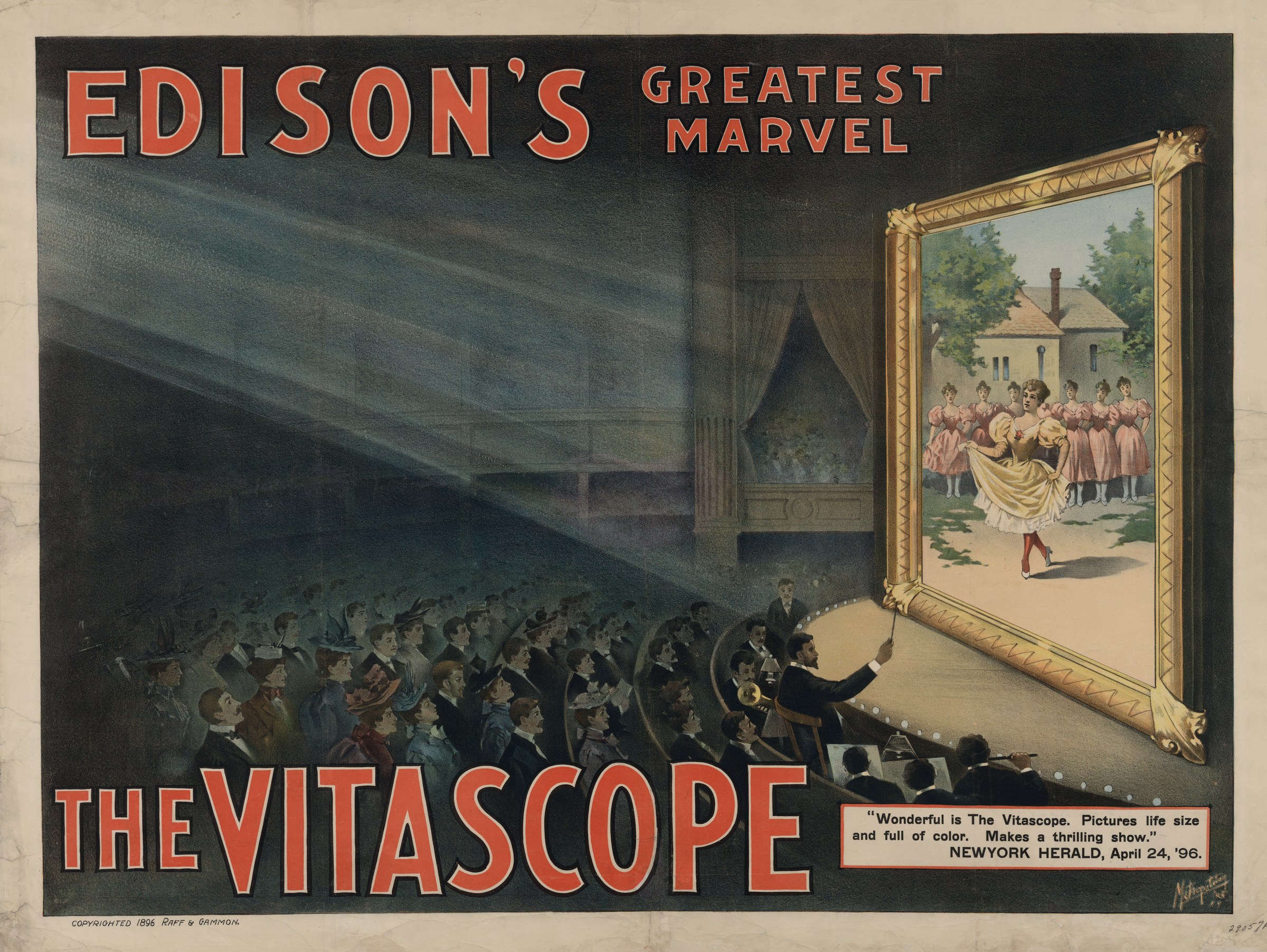
Metropolitan Print Company; Copyright 1896 by Raff & Gammon
- Source:
- Wikimedia Commons
- Rights:
- Public domain — free to use, share and adapt.
- Recorded as:
- public_domain
This poster marks the beginning of cinema's obsession with dance and dancers, a relationship that would define film art for over a century. More fundamentally, it documents the technological rupture that allowed dance—a live, ephemeral art—to become mechanical, recorded, and mass-distributed, fundamentally altering what dance *could be*.
What you are looking at
This is a chromolithographic poster advertising Edison's Vitascope, the pioneering motion-picture projector. The composition is split into two zones, divided by a large ornate gilded frame. On the left, silhouetted against deep shadow and rendered in darker tones, sits an audience of men in late Victorian dress—bowler hats, formal jackets—crowded together on what appears to be theater seating, their faces turned upward in rapt attention. On the right, visible *within* the frame as if projected onto a screen, is a brightly colored outdoor scene: a woman in a flowing yellow dress dances or gestures dynamically in the center, her body twisted, one arm raised high, while a group of women in pale pink dresses stand watching behind her. The building behind them is colonial or rural in character. The poster text frames this as a marvel of modernity: the ability to project life-size, colored images.
The dancing
The dancing figure on the screen occupies a dynamic, unsupported pose—weight shifted, torso twisted, arms asymmetrical, suggesting movement caught mid-moment rather than a posed, balanced attitude. The onlookers behind her stand in informal clusters, not in any formal dance position. On the audience side, the men are seated and static, their posture bent forward with attention; they are spectators, not dancers. The contrast between the frozen, witnessing bodies of the audience and the animated, gestural body of the woman on screen is the poster's central point.
The dance depicted
The woman's pose is too fragmentary and too specific to motion-picture capture to identify a particular dance style with confidence. The raised arm, twisted torso, and apparent forward movement suggest a skirt dance or cakewalk—popular novelty dances of the 1890s that were especially suited to early cinema because they relied on large, readable gestures and dramatic costume movement. The Vitascope was marketed explicitly for its ability to show such *movement*; still photography could not capture these transitory, kinetic moments. The identity of the dancer and the specific origin of the film clip are not apparent from the poster alone.
How it was made
This is a chromolithograph—a color printing process that separates the image into multiple stones or metal plates, each inked in a different color and printed in sequence. The technique allowed bold, luminous color (the yellow dress, pink costumes, and gold frame) and high-contrast effects (the dramatic shadow on the audience side) that reproduced well at large scale. The medium implies this poster was mass-produced for wide distribution to theaters and public spaces, aimed at a general audience unfamiliar with moving pictures. The hand-drawn quality and the idealized, slightly theatrical rendering of the scene are typical of chromolithographic advertising of the 1890s.
About this work
This 1896 poster documents one of the pivotal moments in entertainment history: the introduction of the Vitascope, Thomas Edison's motion-picture projector, which made cinema a public spectacle rather than a peep-show novelty. The image is fundamentally about *cinema as revelation*—the astonished, upward gaze of the audience witnessing the impossible, a woman dancing in full color and life size before them. For dance history, it captures the moment when bodily movement entered the mechanical eye and became reproducible, distributable, infinitely repeatable. It is also a record of how dancing bodies—specifically, the gestural vocabulary of popular novelty dances—became the earliest, most compelling subject matter for film. The choreography matters less than the shock of its projection.
How to look at it
Notice the two bodies of the image and the frame between them: the audience is *un*framed, informal, shadowed; the dance scene is *framed*, bright, and formal, as if locked in the apparatus of cinema itself. The woman's pose is not a classical position but a snapshot, a single moment extracted from motion. Her raised arm and twisted spine would be held for perhaps a second on film; the poster freezes it into a hieroglyph of 'dancing.' The audience's forward-leaning posture tells us that this is a revelation, not a familiar entertainment—these are witnesses to something unprecedented.
The artist
The poster was copyrighted by Raff & Gammon, the production company behind the Vitascope, and printed by the Metropolitan Print Company. Both were commercial enterprises in the business of manufacturing and promoting Edison's projector technology. The artist or designer of the chromolithograph is not identified in the record. The poster reflects the advertising conventions of the 1890s: oversized figures, saturated color, dramatic lighting contrasts, and a narrative structure designed to communicate wonder and modernity to viewers with no prior experience of motion pictures.
The period
The Vitascope was publicly demonstrated in April 1896 in New York, making this poster's copyright date historically precise. Edison's competing technologies (the Kinetoscope, a peep-show device, had existed since the early 1890s) had already established moving pictures as a novelty, but projection to a room full of viewers was genuinely new and sensational. In the same years, theatrical dance was dominated by music hall, vaudeville, and the emerging 'skirt dances' and 'serpentine dances' that, like the Cakewalk, relied on costume and bodily undulation—movements that translated powerfully to the silent, motion-capture aesthetics of early cinema. The poster's implicit claim—that cinema could capture and replay the ephemeral magic of the live dancer—was both accurate and revolutionary.
Where it lives
This chromolithographic poster is held in the U.S. Copyright Office records and is publicly available via Wikimedia Commons. It was produced as a commercial advertisement for theatrical distribution, intended to publicize public screenings of the Vitascope. Such posters survive in cultural collections and archives as evidence of early cinema's marketing and its relationship to live entertainment.
Dance in this work
Questions about this work
Was this an actual film, or a fabricated image made for the poster?
Almost certainly an actual film clip from an Edison Vitascope production, given that the company's catalog by 1896 included dozens of short films, many featuring performers and novelty acts. However, the poster may also stylize or enhance the colors and composition for advertising effect; chromolithography allowed considerable artistic license. The figure and scene are too specific to be purely invented, but the poster's rendering is heightened and theatricalized.
What was the Vitascope, and why was it important?
The Vitascope was Edison's motion-picture projector, demonstrated publicly in 1896. Unlike the earlier Kinetoscope, which required viewers to look through a hole at a small image, the Vitascope projected moving pictures onto a screen large enough for a theater full of people to see simultaneously. This transformed cinema from a private novelty into a public spectacle and a new form of mass entertainment.
Can we identify the dancer or the film?
Not from the poster alone. The woman's costume and the setting suggest a novelty dance or cakewalk popular in the 1890s, but Edison's early Vitascope catalog included hundreds of brief clips, and attribution is difficult without archival documentation.
Why was dance such a popular subject for early cinema?
Dance was ideal for early film: it required no dialogue, was visually legible even at small screen sizes, relied on large gestures that the camera could capture clearly, and offered novelty and spectacle that justified the price of admission. The bodily movement and especially costume—swirling skirts, dramatic postures—created visual interest that compensated for the lack of sound and color fidelity in these earliest films.
More dance artwork





