49 works in this view — arrow keys or swipe to move between them.
Dance in Art
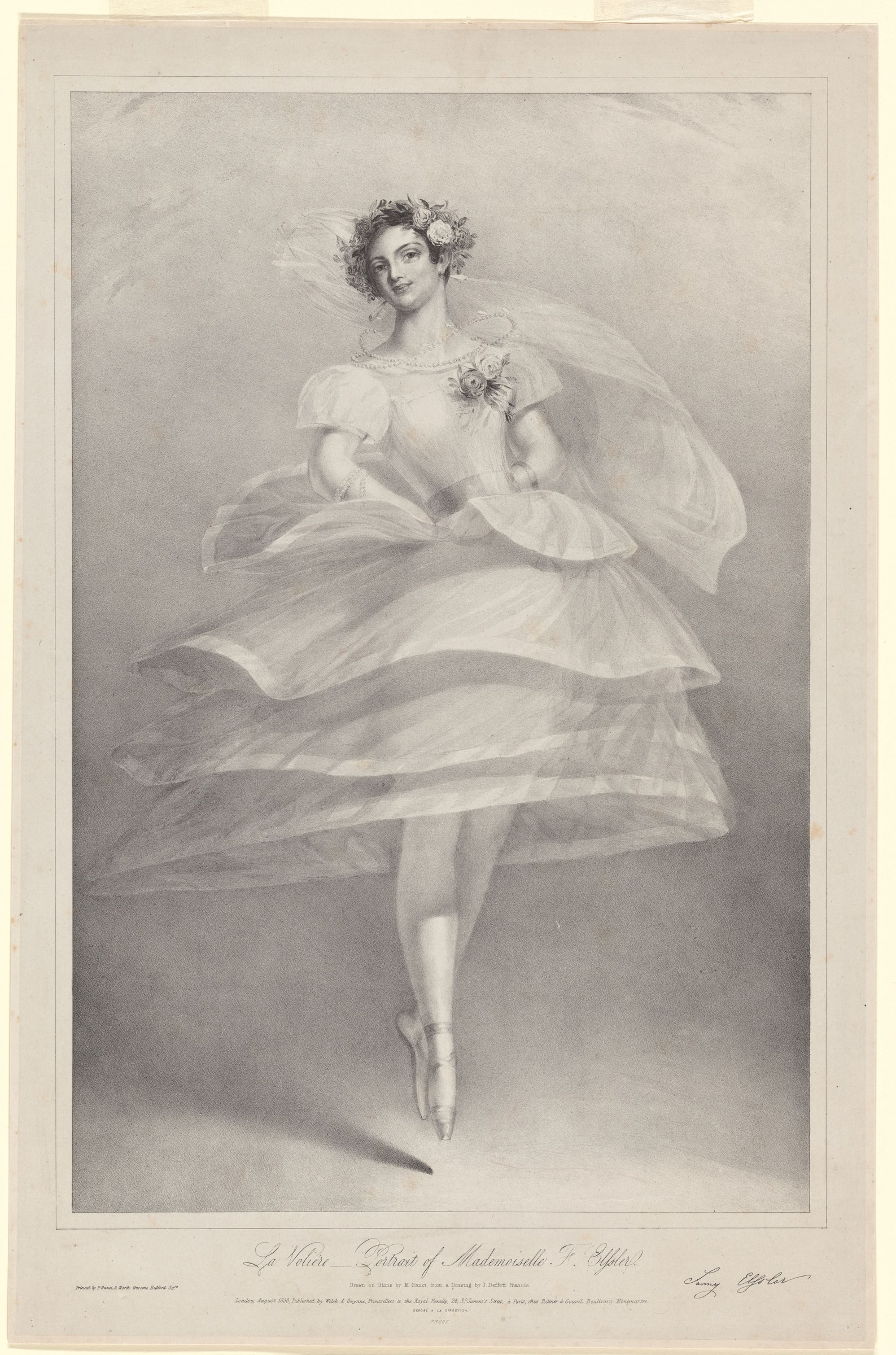
Fanny Elssler in La Volière, lithograph by Gauci from drawing by J. Deffett Francis 1838
Drawn on stone by M. Gauci, from a drawing by J. Deffett Francis. Printed by P. Gauci.
- Source:
- Wikimedia Commons
- Rights:
- Public domain — free to use, share and adapt.
- Recorded as:
- public_domain
This print documents not only a celebrated dancer but the visual conventions and technical ideals of romantic ballet at the moment of their crystallization. It shows us, with documentary precision, what romantic ballet was understood to look like: ethereal, weightless, technically accomplished yet apparently effortless. For historians of dance and theatre, it is evidence of how Elssler was seen by her public, and what audiences valued in a prima ballerina.
What you are looking at
A young woman in a diaphanous white tutu and fitted bodice with short puffed sleeves is caught mid-leap, her body weightless and elongated. She wears a wreath of flowers in her hair and a light veil trails from her shoulders. Her right leg extends behind her in a high arabesque or attitude derrière while the left supports her in a relevé or rise on pointe; her arms are softly positioned, her head inclined with a serene expression. The setting is undefined—a neutral gray ground fades to pale sky—which throws the figure into stark relief and suggests the ethereal space of the stage. The composition is a three-quarter-length portrait oriented vertically, the dancer occupying most of the frame, her gauzy skirts billowing around her in layers of motion.
The dancing
The dancer is poised in a single-leg supporting position with her working leg raised high behind her body in a clear romantic-era arabesque or attitude. Her weight is on the balls of her feet, the supporting leg turned out. Her arms are held in a graceful, soft frame—not a classical closed position but a looser, more expressive carriage typical of romantic ballet. Her upper body is upright but with a gentle forward inclination from the hips that creates an illusion of flight. The pose is one of balance and control, held for the artist to capture, rather than a transient moment of violent action.
The dance depicted
This is a romantic-era ballet, almost certainly a pas or solo from the early-to-mid 19th century. The title *La Volière* (The Aviary) suggests a light, whimsical piece—the name evokes images of birds and flight. Fanny Elssler was one of the dominant ballerinas of the 1830s and 1840s, and this lithograph captures the aesthetic that made her reputation: a figure of apparent weightlessness and grace, yet with a muscularity and technical control evident in the precise line of her supporting leg. The costume—white tutu, flowers, diaphanous layering—is the canonical dress of romantic ballet, and the pose demonstrates the technical vocabulary of the era: turned-out limbs, elongated line, and the illusion of effortlessness.
How it was made
This is a lithograph drawn on stone by M. Gauci from a drawing by J. Deffett Francis and printed by P. Gauci, as recorded in the inscription. Lithography allowed for a soft, tonal rendering impossible in line engraving; the artist has used the greasy crayon to build subtle gradations across the figure, creating a sense of volume and atmosphere. The technique was well suited to theatrical portraiture and could be reproduced in multiple impressions for circulation to audiences and collectors. By the 1830s, lithography had become the standard medium for disseminating images of celebrity performers, particularly ballerinas, making such prints both cultural documents and instruments of celebrity marketing.
About this work
This lithograph preserves Fanny Elssler in a moment of romantic ballet stardom, likely from a specific performance of *La Volière* in the late 1830s. It is a work of celebrity portraiture in the theatrical medium most suited to it: a flattering but technically accomplished record of a dancer at the height of her fame. The image circulated among audiences to commemorate a performance or to advertise the dancer's talents and availability. It sits at the intersection of fine-art printmaking and popular entertainment—the skill of Gauci's rendering and the prestige of the subject elevate it beyond a crude advertisement, yet its purpose was always to promote the dancer and encourage attendance at her performances.
How to look at it
The artist has chosen to freeze the moment of suspension—the instant at which the dancer appears weightless, her supported leg locked in turnout and relevé and her working leg flung high behind her. This is the conventional pose for a romantic ballerina's portrait, the one that best conveys the aesthetic ideals of the style. Notice the precision of the turned-out legs, the soft carriage of the arms, and the slight forward inclination of the torso—all markers of the romantic ballet vocabulary. The billowing tutu is rendered with particular care, its multiple layers and the translucency of the material suggesting the theatrical effect of the actual garment on stage.
The artist
M. Gauci was a lithographic printer and draughtsman active in London in the early-to-mid 19th century, known for theatrical and sporting prints. J. Deffett Francis was a painter and lithographer specializing in theatrical subjects and portraiture. Both were working in the established English tradition of theatrical printmaking, producing commercially successful likenesses of celebrated performers of the day.
The period
The 1830s and 1840s were the apex of romantic ballet, a movement that privileged ethereal female dancers, supernatural subjects, and an aesthetic of weightlessness and grace. Fanny Elssler was one of the two reigning ballerinas of the era (the other being Marie Taglioni), and she was celebrated for a style that emphasized speed, technical brilliance, and a certain earthy sensuality beneath the romantic veneer. This print was made in the wake of her London debut and tours, when her image was in high demand. Lithography had recently become the dominant medium for theatrical celebrity portraiture, allowing for rapid reproduction and wide circulation.
Where it lives
This print comes from Wikimedia Commons, a repository of public-domain images. The original is likely in the holdings of a major library or museum with theatrical collections, though the current location is not recorded here.
Dance in this work
Questions about this work
Who was Fanny Elssler?
Fanny Elssler (1810–1884) was an Austrian ballerina who dominated European ballet in the 1830s and 1840s. She was known for her technical virtuosity, speed, and a style that emphasized the sensuality and athleticism of the body as much as its grace. She partnered and competed with Marie Taglioni as one of the two greatest ballerinas of the romantic era.
What is La Volière?
La Volière (The Aviary) was a ballet or divertissement performed in the romantic era, likely a short solo or pas choreographed to showcase a dancer's technique and grace. The title suggests a light, whimsical piece with avian themes, though few details of its choreography survive.
Why was lithography used for theatrical portraits?
Lithography allowed artists to produce multiple high-quality prints quickly and cheaply, making it ideal for disseminating images of celebrated performers. Unlike engraving, it could render soft tones and subtle modeling, making it well suited to flattering portraits of female dancers. Prints were sold as souvenirs and used for promotion.
What do the flowers and veil signify?
The wreath of flowers and diaphanous veil were standard costume elements for romantic-era ballet, particularly for lighter, more whimsical pieces. They contributed to the ethereal aesthetic of the period and suggested youth, innocence, and otherworldliness—qualities central to romantic ballet ideology.
More dance artwork





