49 works in this view — arrow keys or swipe to move between them.
Dance in Art
Oskar Schlemmer Sketch of figural movement for dance 1921
Oskar Schlemmer
- Source:
- Wikimedia Commons
- Rights:
- Public domain — free to use, share and adapt.
- Recorded as:
- public_domain
Schlemmer's movement diagrams were foundational to twentieth-century dance theory and pedagogy. They demonstrate that an artist-choreographer could teach movement through geometry, proportion, and structural logic rather than through example or narrative. This approach—treating the body as a variable system rather than a fixed form—became central to modernist dance, particularly in the Bauhaus context where dance and design merged.
What you are looking at
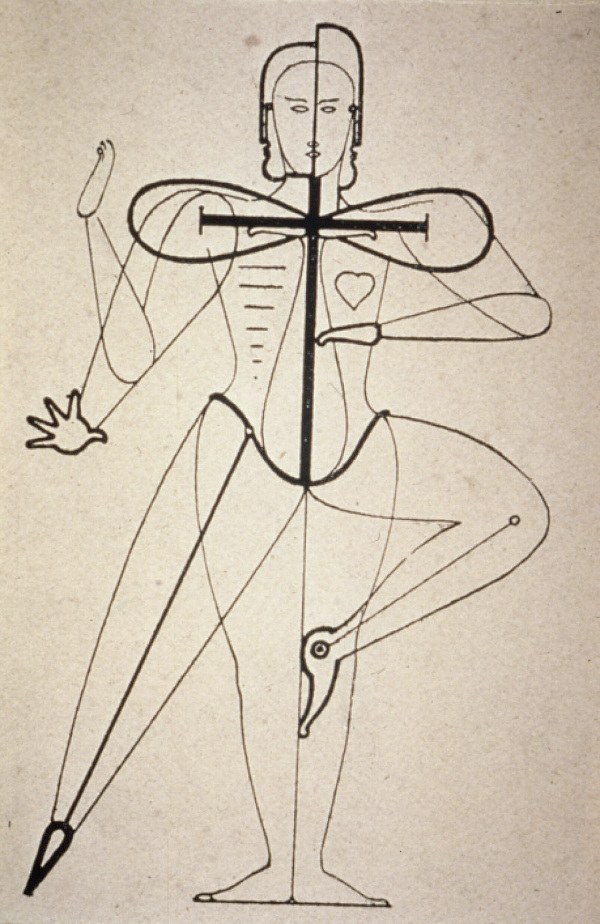
A single figure stands at the center of the composition, rendered in bold black line drawing against a cream background. The body is constructed as a geometric abstraction, with the torso organized around a prominent vertical axis that extends from head through legs, crossed at the chest by a horizontal line forming outstretched arms. The head is simplified into two overlapping profiles facing opposite directions, suggesting multiple viewpoints or rotational movement. The figure wears a geometric costume with a heart shape marked on the right side of the chest and vertical divisions suggesting segmentation or articulation of the body. The left arm curves upward in an elegant arc, fingers delicately posed; the right arm extends straight outward. The legs are rendered in an elongated, mannequin-like manner—one straight and supporting, the other bent and extended backward in a balletic line. A small spiral or explosive mark appears near the left hand, suggesting a burst of energy or an accent of movement. The entire composition is remarkably spare and linear, using the minimum of mark-making to suggest three-dimensional form and dynamic action.
The dancing
The single figure demonstrates an extended, balletic frame organized around a central vertical axis. The shoulders remain broadly open, with arms held at varied heights—the raised left arm describes a graceful curve while the right maintains a rigid horizontal extension, suggesting either two moments of movement or the artist's intent to show rotational potential. The lower body shows clear weight placement: one leg appears grounded and straight, while the other extends behind in a fully pointed position characteristic of classical ballet vocabulary. The head's double-profile construction implies rotation or the notation of spatial orientation rather than naturalistic anatomy. The geometric costume—particularly the marked heart and vertical segmentations—suggests the artist was thinking about the body as a structure to be articulated, not merely described.
The dance depicted
This is a movement study or dance notation rather than a realistic depiction, designed to capture the essential geometry of theatrical dance, most likely classical ballet given the extended leg line, the upright posture, and the balletic arm positions. The double-profile head and the symmetrical axis organization recall early twentieth-century modernist approaches to representing the moving figure, where multiple simultaneous viewpoints (influenced by Cubism) replace single-perspective illusionism. The notation appears didactic: the marked heart suggests the body's vital center, and the skeletal line framework implies that the artist was teaching or analyzing how movement distributes weight and energy along the spine. This is not a record of an actual dance moment, but an idealized schematic—a diagram for understanding or choreographing bodily action.
How it was made
The work is rendered in ink line drawing, likely pen or brush on paper, using bold, confident strokes with no modeling, shading, or tonal variation. The technique is fundamentally graphic and reductive, employing only contour and accent marks. This linear approach is characteristic of modernist figure studies and movement diagrams of the 1920s, where clarity and conceptual abstraction took priority over optical illusion. The sparseness of means—the refusal of realistic detail—suggests this was made for circulation among artists, dancers, or students, perhaps as a teaching document or a study for larger theatrical work. The medium allows rapid revision and is well-suited to schematic representation.
About this work
This is Oskar Schlemmer's schematic diagram of a single dancer's body, reduced to its essential geometric structure and movement potential. Rather than depicting a specific choreographed moment, it presents the figure as an articulated frame—a system of joints, axes, and force-lines organized to suggest how a trained body moves through space. The heart marked at the center and the doubled head are not literal; they are notational marks indicating the vital center and the rotational capacity of the spine. This work belongs in a gallery about dance because it represents one of the most influential modernist approaches to understanding movement: the notion that dance is fundamentally about the organization and transformation of the human form in space, and that this can be taught, scored, and transmitted through graphic abstraction rather than mimetic reproduction.
How to look at it
Attend first to the organizing principle of the central vertical line and the horizontal cross it forms. This is not accidental: it establishes the body as a cross-shaped structure capable of rotation and extension. Next, observe how the artist has rendered the head—as two profiles simultaneously visible—which cannot be seen from a single viewpoint but must be understood as a notational device showing the head's rotational capacity. Look at the contrast between the two arms: one is curved and ornamental, the other rigid and geometric, suggesting that Schlemmer understood the arm as both an expressive tool and a structural element. Finally, note the extended back leg and the marked heart: these indicate not realism but intentionality—the artist is directing your attention to the body's center of gravity and its line of extension through space.
The artist
Oskar Schlemmer (1888–1943) was a painter, sculptor, designer, and choreographer at the Bauhaus who directed the Bauhaus Theatre Workshop from 1923 to 1929. His practice was radically interdisciplinary: he worked simultaneously as a visual artist and a dance theorist, creating costume designs, set designs, movement notation systems, and choreography for the Bauhaus. Schlemmer believed that the human body was the fundamental unit of all visual and kinetic design, and he systematically explored how geometric form, costume, light, and spatial organization could transform the body's expressive capacity. His movement diagrams and notational drawings were not illustrations of existing dances but conceptual tools for imagining new movement vocabularies.
The period
This sketch dates to 1921, during the early years of the Bauhaus and the height of European modernism's formal experimentation. By this date, Cubism had already established the validity of multiple viewpoints and geometric abstraction; Russian Suprematism and Constructivism were exploring the reduction of form to essential elements; and dancers like Vaslav Nijinsky were beginning to engage with modernist visual languages in their choreography. In dance specifically, this period saw the rise of new, non-naturalistic movement vocabularies: Mary Wigman and German Expressionist Dance were rejecting classical ballet's aesthetic in favor of more abstract, sculptural forms, while in Paris the Ballets Russes under Diaghilev were collaborating with Cubist and Constructivist artists to create radically new visual and kinetic vocabularies. Schlemmer's work sat at the intersection of all these currents.
Where it lives
The work is recorded as a sketch held in Wikimedia Commons, suggesting it exists in a public collection or is documented in a digitization project. The exact holding institution is not specified in the catalogue record.
Dance in this work
Questions about this work
Is this a real dance or a made-up diagram?
It is a diagram or conceptual study, not a transcription of an existing choreography. Schlemmer created these movement sketches as teaching tools and as explorations of how the human body could be abstracted and reorganized through modernist design principles. The sketch is idealized and schematic rather than documentary.
Why is the head drawn twice?
The double profile is not meant to represent how the head looks in reality, but to show that it can rotate. This is a notational convention: by showing two views of the head simultaneously, Schlemmer indicates the head's range of movement and rotational potential around the vertical spine.
What does the heart symbol mean?
The heart marks the body's vital center and likely also its center of gravity—the point around which movement radiates. For Schlemmer, the body was not a collection of parts but a unified system organized around a core. The heart is both literal and symbolic.
What kind of dance is this?
The extended leg line, the upright posture, and the refined arm positions suggest Schlemmer was thinking within a classical ballet vocabulary, but abstracted and reorganized according to modernist principles. This is not a ballet as it would be danced, but an exploration of what ballet's formal language could reveal about the structure of the moving body.
More dance artwork





