49 works in this view — arrow keys or swipe to move between them.
Dance in Art
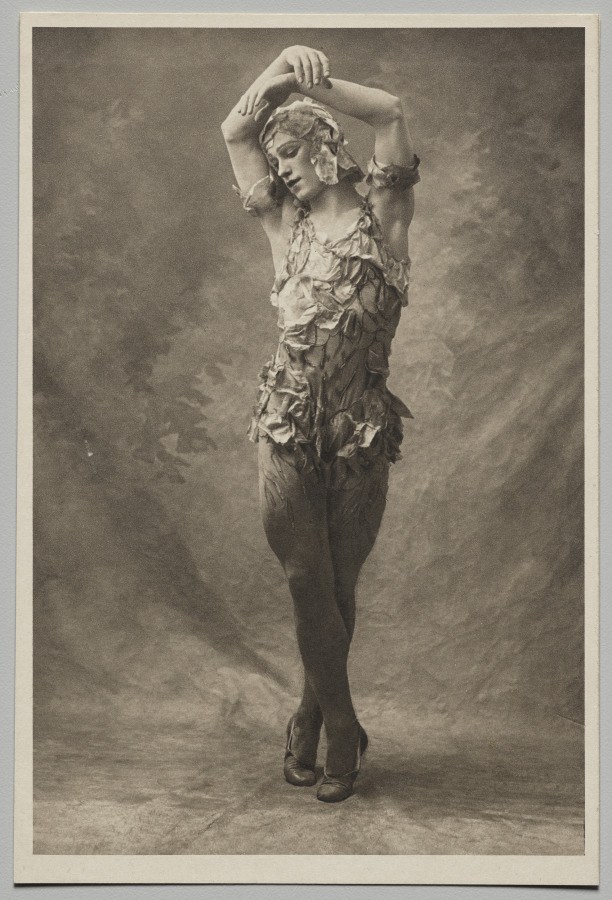
Vaslav Nijinsky in Le Spectre de la Rose
Auguste Bert (French, 1856–before 1945)
- Medium:
- Halftone photogravure
- Collection:
- Photography
- Source:
- Cleveland Museum of Art
- Rights:
- Public domain — free to use, share and adapt.
- Recorded as:
- CC0
Nijinsky's interpretation of the Rose phantom fundamentally changed how male dancers were perceived in European ballet. This photograph documents not only a celebrated performer but also a moment when the male dancer could embody softness, beauty, and interiority rather than virtuosity alone. For historians of dance and gender in performance, it is an essential image of how Fokine and Nijinsky reimagined the Romantic vocabulary for the early 20th century.
What you are looking at
A single male dancer stands in a vertical pose against a plain, softly modeled backdrop characteristic of early 20th-century studio photography. He wears a decorative costume of layered, asymmetrical fabric—the upper body bare-shouldered with draped material and ornamental detail, the lower body clad in fitted tights and heeled shoes—suggesting a Romantic or fantasy character. His posture is vertical and lifted; he gazes downward with a dreamy, inward expression. His arms are raised above his head, elbows bent, hands positioned gently near his face in a pose of languor or reverie. The photograph is a halftone photogravure, which renders the figure in soft tones of gray and sepia. The lighting emphasizes the contours of his body and the fall of the drapery, creating a sense of weightlessness and ethereal grace.
The dancing
A single male dancer in a vertical, supported stance with both arms raised overhead in a soft, rounded frame. The weight appears lifted and centered; the head is inclined downward in a contemplative attitude. The leg line suggests a demi-pointe or relevé position. The overall silhouette is tall and elongated, and the arm placement—overhead and curved rather than extended—conveys softness and introspection rather than athleticism or display.
The dance depicted
This is a studio portrait of Vaslav Nijinsky in costume for *Le Spectre de la Rose* (*The Phantom of the Rose*), the Ballets Russes ballet choreographed by Michel Fokine in 1911. The pose captures not a moment of active dancing but rather a character study—the Rose phantom in a state of dreamy reverie. The softness of the arm placement and the downward gaze align with the narrative of the role: a flower spirit materializing in a young woman's dream. Nijinsky's technique here is expressed through line, lift, and an almost feminine grace; the pose suggests the fluid, weightless quality Fokine sought in the role, quite different from the technical virtuosity Nijinsky was famous for.
How it was made
This is a halftone photogravure, a photomechanical printing process that translates a photographic original into a halftone screen and then engraves the image into a printing plate. The technique allowed for mass reproduction of photographic images with fine tonal gradation—crucial for capturing the subtleties of studio lighting and fabric texture. Halftone photogravure was common for theatrical and portrait documentation in the 1910s, allowing theatrical companies and photographers to distribute images of celebrated performers to a wide audience. The soft focus and romantic lighting are products of both the photography and the printing process.
About this work
This is a studio portrait of Vaslav Nijinsky, one of the most celebrated male dancers of the 20th century, photographed by Auguste Bert in 1913 while Nijinsky was performing *Le Spectre de la Rose* with the Ballets Russes. The image captures Nijinsky in full costume and character, posed in a moment of introspective grace rather than dynamic movement. The work belongs in a dance gallery both as a document of a historically significant performer and as a visual record of how a revolutionary choreographer and dancer understood the role of the male body in theatrical fantasy—not as a display of strength, but as a vessel for ethereal, dreamlike presence.
How to look at it
Attend to the stillness and verticality of the pose: this is not a moment of motion but of suspension, even reverie. The arm placement—soft, rounded, overhead—is the key gesture; it speaks to the character's dreamy, otherworldly quality rather than to virtuosity or strength. Notice how the costume's asymmetrical drapery follows the line of the body, emphasizing the elongation of the figure. The lighting from the side and slightly above creates a sense of luminosity and weightlessness. The downward gaze is crucial: it turns the image inward, asking the viewer to imagine the character's inner life rather than to witness an act of display.
The artist
Auguste Bert was a French photographer (1856–before 1945) who specialized in theatrical and portrait photography. He worked extensively with the Ballets Russes during its early years in Paris and London, documenting major productions and celebrated performers. His photographs are among the primary visual records of early 20th-century theatrical dance and were widely distributed as postcards and promotional materials.
The period
The image dates to 1913, during the height of the Ballets Russes' fame in Europe. *Le Spectre de la Rose* had premiered in 1911 and became one of the company's most celebrated works, revived frequently and beloved by audiences across Europe and the Americas. The early 1910s saw a major shift in ballet aesthetics: Fokine's reforms rejected the rigid academic conventions of late 19th-century Imperial ballet in favor of naturalistic movement, historical authenticity (or the appearance of it), and emotional depth. The role of Nijinsky—a male dancer performing a character of ethereal beauty—was part of this revolution. The photograph also reflects the broader cultural moment of Orientalism and Symbolist aesthetics that shaped early Ballets Russes production design and costume.
Where it lives
This halftone photogravure is held in the Photography collection of the Cleveland Museum of Art. It is a fine example of early 20th-century theatrical documentation and was likely issued as a promotional or souvenir print in connection with performances of the Ballets Russes.
Dance in this work
Questions about this work
Who was Vaslav Nijinsky?
Nijinsky (1889–1950) was a Russian male ballet dancer and choreographer who became an international icon of the early 20th century. He joined the Ballets Russes in 1909 and became celebrated for both his extraordinary technical ability and his innovative interpretations of roles. He danced with the company until 1913, creating works including *L'Après-midi d'un faune* and *Le Sacre du printemps*.
What is *Le Spectre de la Rose*?
*Le Spectre de la Rose* (*The Phantom of the Rose*) is a one-act ballet choreographed by Michel Fokine in 1911. The scenario is simple: a young woman returns from her first ball with a rose; as she falls asleep, the flower's spirit materializes and dances with her. The role of the Phantom became one of Nijinsky's most celebrated roles and has remained a signature work of male ballet.
Why is this photograph important?
The image documents Nijinsky in a role that redefined what a male ballet dancer could represent. Rather than emphasizing the acrobatic display that had dominated 19th-century male ballet, Nijinsky's Phantom embodies beauty, grace, and interiority. The photograph is also valuable as a record of early Ballets Russes costume and characterization during the company's most influential years.
What technique was used to make this image?
This is a halftone photogravure, a process that combined photography with engraving to allow theatrical images to be reproduced in quantity. The technique was standard for documenting major theatrical productions in the 1910s and made images of celebrated performers widely available to audiences across Europe and North America.
More dance artwork





