49 works in this view — arrow keys or swipe to move between them.
Dance in Art
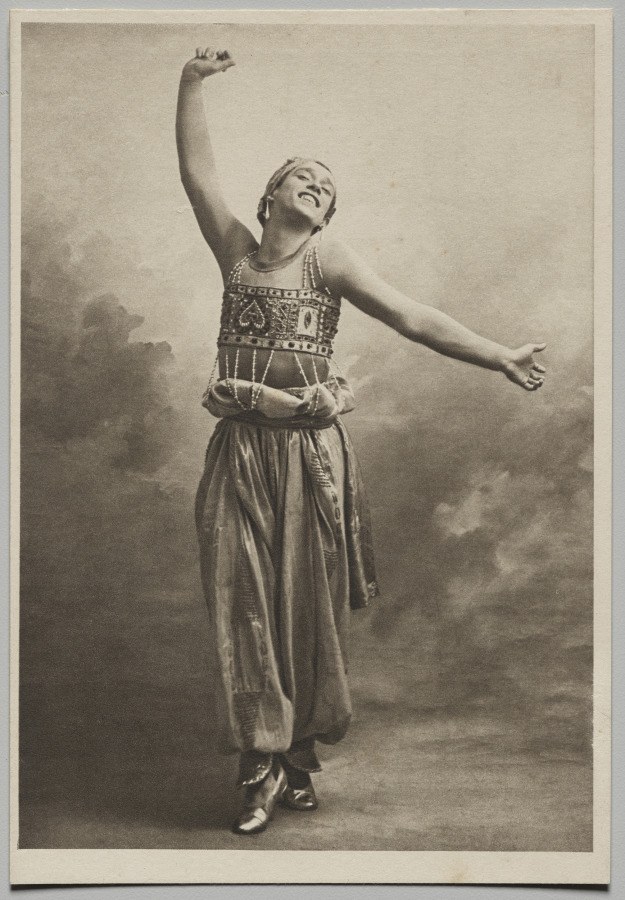
Vaslav Nijinsky in Scheherazade
Auguste Bert (French, 1856–before 1945)
- Medium:
- Halftone photogravure
- Collection:
- Photography
- Source:
- Cleveland Museum of Art
- Rights:
- Public domain — free to use, share and adapt.
- Recorded as:
- CC0
Nijinsky redefined what a male dancer could be and do: he brought muscularity, sexuality, and dramatic presence to the male form in classical ballet at a moment when such things were still being debated. *Scheherazade* was one of the roles that did this most powerfully. This photograph, made by the state photographer and distributed as a fine-art print, shows how that revolution was understood and sanctioned by official culture—and how a pose of arabesque or extension could carry psychological and erotic weight beyond the classical vocabulary that contained it.
What you are looking at
A male dancer stands alone against a clouded, atmospheric background in a moment of arabesque-like extension. His body is lifted and elongated, with his raised left arm reaching upward in a graceful arc while his right arm extends outward, creating an open, expansive frame. He wears an ornate sleeveless tunic or bodice decorated with geometric patterns and what appear to be jeweled or beaded embellishments across the chest and torso, paired with loose, gathered trousers that fall to mid-calf. His feet are bare or in soft ballet slippers, and his head is tilted slightly upward with an expression of rapture or exultation. The lighting is soft and diffuse, creating a sense of weightlessness and otherworldly grace. The photograph is rendered as a halftone gravure, which gives the image a refined, velvety tonal quality and suggests this was a work of considerable artistic and technical ambition.
The dancing
The dancer's weight appears to be supported on or through one leg, with the other extended or lifted behind or to the side in a classical ballet line. The upper body is open and expanded—shoulders relaxed back, chest lifted, both arms engaged in an expressive port de bras. This is not a pose of tension or struggle but of buoyant release. The frame is entirely classical: long lines, fluidity through the limbs, a clarity of silhouette that allows the eye to read the shape of each limb independently. A trained ballet eye would recognize the vocabulary immediately.
The dance depicted
This is Nijinsky in the role of the Slave in Sergei Diaghilev's *Scheherazade*, the 1910 Ballets Russes production that scandalized and electrified European audiences. Nijinsky was the company's male star, and *Scheherazade* was among his most celebrated roles—a part that allowed him to move beyond classical virtuosity into a new register of sensual, exotic, and psychologically complex male dancing. The costume—the jeweled tunic and loose trousers—is recognizably the Orientalist fantasy that Léon Bakst designed for the production. The moment captured here is one of abandon or ecstasy, quite possibly from the finale when the Slave is discovered with the Favorite Wife and faces his doom. The pose reads as a moment of either rapturous abandon or defiant resignation.
How it was made
This is a halftone photogravure, a photomechanical reproductive process that translates a photograph into an etched or engraved plate. The process was used for high-quality art reproduction and press imagery in the early 20th century, and it allowed photographs to be printed in regular publications and as fine-art prints without loss of tonal subtlety. The soft, luminous quality of the image—the way the background dissolves into cloud-like atmosphere—is characteristic of the photogravure process and also reflects the soft-focus or atmospheric photography favored in pictorial and theatrical portraiture of the period. That Auguste Bert, the official state photographer, created this suggests it was made for formal documentation and circulation.
About this work
This is a studio portrait of Vaslav Nijinsky as the Slave in *Scheherazade*, captured by the French official state photographer Auguste Bert in or around 1913. It is a record of one of the most revolutionary male dancers of the early 20th century in one of the most talked-about roles in the Ballets Russes repertoire. The image is not a candid stage shot but a carefully composed studio study, which allowed Bert to light and frame the dancer in a way that emphasizes the line of the body and the exotic beauty of the costume. For historians of ballet, the Ballets Russes, and early 20th-century theater, this is a primary document: it shows exactly how the role was danced, how the costume was worn, and how the European artistic establishment understood and represented Nijinsky's revolutionary art.
How to look at it
Look at the way the body is organized in space: every limb is in a relationship to every other, and there is no accident or slack in the pose. The lifted face, the open arms, the extended line through the leg—all of these are classical ballet language, but the atmosphere and the costume pull them toward something else: ecstasy, exoticism, danger. The moment chosen is not one of virtuosity (no leap or turn) but of expressive stillness—which is harder to achieve and more revealing of a dancer's artistry. Attend also to the halftone texture: the way the background is built up from dots of ink creates an immaterial, dreamlike quality that supports the reading of the pose as one of rapture rather than strain.
The artist
Auguste Bert (French, 1856–before 1945) was the official photographer of the French presidency, government ministries, embassies, and state-sponsored theaters. He was a photographer of state and institutional power, and his work documenting the Ballets Russes and other theatrical productions belongs within that remit: these were the arts of the French cultural establishment. The photogravure technique and the refinement of his portraiture suggest a artist of considerable technical skill and artistic ambition, working at the intersection of photography, printmaking, and theatrical documentation.
The period
The Ballets Russes, founded by Sergei Diaghilev in 1909, revolutionized European dance and visual culture. *Scheherazade*, with its music by Rimsky-Korsakov, its fantastical Orientalist design by Léon Bakst, and its erotic narrative, was the company's most controversial and popular work. Nijinsky was the company's principal male dancer and the embodiment of the new male dancer—trained in classical Russian technique (from the Imperial Ballet school in St. Petersburg) but liberated into a new expressiveness. By 1913, when this photograph was likely made, Nijinsky was at the height of his fame and influence. The photogravure process itself was at its peak as a medium for fine-art reproduction, and theatrical portraiture was a major genre in both popular and fine-art circles.
Where it lives
The photograph is held in the collections of the Cleveland Museum of Art, identified as Photography. It is a halftone photogravure, likely one of a series of studio studies Bert made of the Ballets Russes and its dancers during his tenure as official state photographer.
Dance in this work
Questions about this work
Who was Vaslav Nijinsky?
Nijinsky (1890–1950) was a Russian-born dancer trained at the Imperial Ballet school in St. Petersburg and the principal male dancer of Sergei Diaghilev's Ballets Russes. He is widely considered the greatest male dancer of the early 20th century. He revolutionized the role of the male dancer by bringing new levels of athleticism, expressiveness, and sensuality to classical ballet, and he also choreographed groundbreaking works. His career was brilliant but brief: he danced professionally for only about a decade, and mental illness ended his performing life in his mid-twenties.
What is Scheherazade?
*Scheherazade* is a ballet created for the Ballets Russes in 1910, with music by Nikolai Rimsky-Korsakov, choreography by Michel Fokine, and design by Léon Bakst. It tells the story of the Favorite Wife of a shah, who has a secret liaison with her favorite slave. The slave (Nijinsky's role) is discovered, and the shah orders the death of all the harem. The work was scandalous for its erotic content and exoticism, and it became the Ballets Russes' most popular work.
What does the costume tell us?
The jeweled tunic, loose trousers, and bare feet are part of Léon Bakst's Orientalist fantasy design for *Scheherazade*. The geometric patterns and beadwork were meant to evoke an exotic, Eastern luxury, and the loose-fitting garments allowed for movement quite different from the fitted bodices of classical ballet. The costume was as revolutionary as the dancing: it signaled a new kind of subject matter and a new freedom in how the body could be dressed and moved.
Why is this a halftone photogravure and not just a photograph?
The halftone photogravure process allowed photographs to be printed at high quality in books, magazines, and as fine-art prints without losing tonal subtlety or detail. By 1913, it was the standard method for reproducing photographs in art and theater publications. The process also introduced a distinctive texture—visible as tiny dots when examined closely—that gives the image a painterly, slightly soft quality. This was often preferred for theatrical portraiture, as it enhanced the atmospheric and artistic character of the image.
More dance artwork





