49 works in this view — arrow keys or swipe to move between them.
Dance in Art
Bacchanale
Malvina Hoffman (American, 1887–1966)
- Medium:
- bronze, copper, brass
- Collection:
- American Painting and Sculpture
- Source:
- Cleveland Museum of Art
- Rights:
- Public domain — free to use, share and adapt.
- Recorded as:
- CC0
Hoffman's sculpture documents a crucial moment in early 20th-century ballet—the brief window when the Ballets Russes and individual dancers like Pavlova expanded what ballet could express beyond classical form. For dance historians, this work is evidence of how Hoffman responded to live performance with technical precision and without the narrative prettification that often characterized dance imagery of the period. For artists, it demonstrates how sculpture could arrest and honor a moment of human virtuosity.
What you are looking at
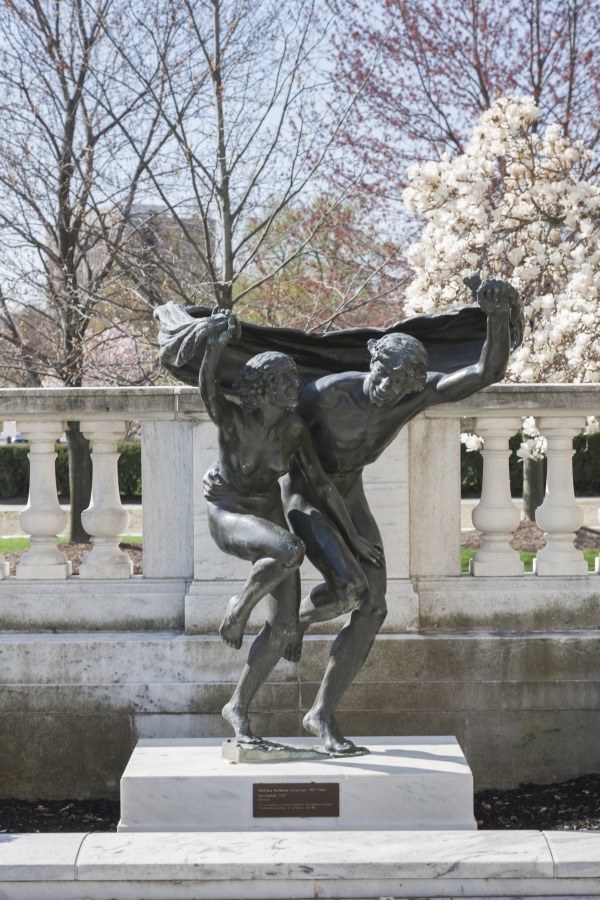
A bronze sculpture depicts a single male figure in a moment of ecstatic, acrobatic movement against a neoclassical stone balustrade and colonnade. The man is captured mid-leap or suspension, his body arched dramatically backward with one leg extended high and his torso lifted and twisted. His left arm sweeps upward and behind his head, while his right arm extends outward, suggesting the gathering or manipulation of fabric—likely the gauze veils mentioned in the catalogue. The figure wears only a brief garment at the hips, leaving the musculature of the torso, limbs, and abdomen fully visible. Behind him, a flowering tree in full white bloom echoes the vitality of the moment. The sculpture is mounted on a white stone base with a dark plaque. The work emphasizes virtuosic physicality and uninhibited expression rather than formal pose.
The dancing
A single dancer occupies the composition, captured in a moment of extreme flexibility and weight displacement. His spine is hyperextended, his pelvis tilted sharply upward, and his legs are splayed in a position between an arabesque and a sustained lift. The extended arm and overhead gesture suggest the manipulation of lightweight drapery (the gauze veil) in space. The entire pose prioritizes buoyancy and suspension—the figure appears weightless, defying the usual pull of gravity through balletic line while also exceeding what classical ballet vocabulary would contain. The musculature is rendered with anatomical precision, emphasizing the demanding physical work required to sustain such a position.
The dance depicted
The work depicts a moment from the bacchanale performance Hoffman witnessed, featuring the Russian ballet stars Anna Pavlova and Mikhail Mordkin. A bacchanale is rooted in ancient Roman revelry and the followers of Bacchus, and in this 1910s-era theatrical context represents an uninhibited, erotically charged ballet with emphasis on improvisation, drapery work, and virtuosic, asymmetrical movement. The sculpture captures the masculine physicality and acrobatic freedom of the work rather than the codified positions of classical ballet. The emphasis on the manipulation of veils and the extreme spinal flexibility suggests a movement vocabulary that mixed orientalist influences common in early 20th-century European ballet with the classical technique both dancers possessed.
How it was made
This is a cast bronze sculpture, a medium that allows Hoffman to capture three-dimensionality and preserve a single arrested moment in permanent form. Bronze permits fine anatomical detail—the musculature, the precise angle of each limb, the tension in the extended veils—while the permanence of the material transforms a fleeting stage moment into enduring sculpture. The work would have been modeled in clay or wax before casting, allowing Hoffman to refine the gesture repeatedly and achieve the exact degree of extension and torque. The choice of bronze and monumental scale suggests this was created as a serious artistic statement rather than a sketch, and reflects the early 20th-century appetite among sculptors for capturing movement and modernity.
About this work
Malvina Hoffman's *Bacchanale* (1917) is a bronze sculpture documenting a pivotal theatrical moment: Hoffman's response to seeing Pavlova and Mordkin perform a work inspired by ancient Roman revelry. Rather than depicting both dancers or a narrative scene, Hoffman isolates a single moment of extreme physicality—a male figure suspended in near-impossible extension, manipulating veils. The work sits at the intersection of early modernist sculpture and dance documentation, capturing not the codified vocabulary of classical ballet but the uninhibited, experimental energy that characterized the Ballets Russes era. It is simultaneously a study in human anatomy pushed to extremes, a record of a specific performance, and an assertion that such fleeting moments of human achievement deserve permanence in bronze.
How to look at it
Attention should go first to the spinal extension and the distribution of weight: the figure is captured in a moment where the body is genuinely suspended, not merely posed. The sweeping arm gestures and the implied movement of drapery suggest momentum and fluidity rather than a held position. Note how the face is largely unmarked—Hoffman is interested in the body as the primary means of expression, consistent with the period's assertion that ballet was a purely physical art. Finally, observe the anatomical precision: Hoffman renders every muscle group, suggesting that she understood the extreme physical demand of what she was witnessing. The work asks the viewer to recognize that such uninhibited, acrobatic movement requires mastery equal to any classical form.
The artist
Malvina Hoffman (1887–1966) was an American sculptor who achieved prominence for her dance-inspired works and for a monumental ethnographic project. She studied with the French sculptor Rodin and was directly influenced by his emphasis on capturing movement and gesture in three dimensions. Hoffman had a sustained relationship with the dance world: she created portrait busts of major dancers, attended performances obsessively, and often traveled to witness artists in their craft. Her *Bacchanale*, created while she was relatively young and still in the orbit of Rodin's aesthetic, captures her conviction that the ephemeral art of dance deserved preservation in the most permanent material available. She later became known for her *Races of Mankind* series, monumental ethnographic sculptures, but her dance works remain among her most alive and intimate creations.
The period
In 1917, the year *Bacchanale* was created, the Ballets Russes under Sergei Diaghilev was at its height of artistic daring, having already mounted controversial works like *Nijinsky's L'Après-midi d'un faune* (1912) and *The Rite of Spring* (1913). The company's emphasis on visual spectacle, exotic themes, and expansion of ballet's formal vocabulary had electrified European and American audiences. Anna Pavlova, perhaps the period's most celebrated individual dancer, was known for bringing ballet to remote audiences and for her own choreographic experiments. The bacchanale as a subject reflected the period's appetite for ancient and oriental themes, and for movement that broke with Victorian restraint. In sculpture, Hoffman was working in the tradition of Rodin, who had revolutionized the medium by showing figures in asymmetrical, dynamic poses. Her *Bacchanale* applies this modernist sculptural language to the documentation of a contemporary dance.
Where it lives
The work is held by the Cleveland Museum of Art as part of their American Painting and Sculpture collection. This suggests it was acquired as a significant example of early 20th-century American sculpture with cultural-historical importance, not merely as dance ephemera. The institutional holdings confirm that this work has long been understood as serious art.
Dance in this work
Questions about this work
Who were Pavlova and Mordkin and what was a bacchanale?
Anna Pavlova (1881–1931) and Mikhail Mordkin (1880–1944) were celebrated Russian Imperial Ballet dancers who performed together in various works, including the bacchanale Hoffman witnessed. A bacchanale in this context is a theatrical dance inspired by the ancient Roman god of wine Bacchus and his uninhibited followers. The work emphasized freedom of movement, sensuality, and theatrical spectacle rather than the formal codification of classical ballet—exactly the kind of modernist experiment that appealed to early 20th-century audiences.
Why did Hoffman choose to sculpt only one figure instead of both dancers?
By isolating a single moment and a single body, Hoffman emphasizes the virtuosity and extreme physicality of the movement itself. Sculpture is better suited to the study of a single form in space than to narrative complexity. The choice also reflects Hoffman's interest in the body as the primary vehicle of dance expression. The viewer's attention is undivided, forced to confront the demands of the posture.
Is this really what the bacchanale looked like, or is Hoffman interpreting freely?
Hoffman attended the performance and was clearly moved by it, but sculpture captures a moment, not a sequence. What we see here is her distillation of the essential energy and physicality of the work—the extension, the freedom, the use of drapery. It is interpretation, not documentation, but it is interpretation grounded in direct observation of accomplished dancers.
More dance artwork





