49 works in this view — arrow keys or swipe to move between them.
Dance in Art
Le Ballet
Alexandre Lunois (French, 1863–1916)
- Medium:
- lithograph
- Collection:
- Prints
- Source:
- Cleveland Museum of Art
- Rights:
- Public domain — free to use, share and adapt.
- Recorded as:
- CC0
For dance historians, this image is valuable evidence of how ballet training and rehearsal were understood and portrayed in the 1890s—the posture, spacing, costume, and the role of the instructor all speak to pedagogical practice of the period. For art historians, it exemplifies how dance had become a subject of serious artistic interest among French printmakers, reflecting the cultural prestige of the Opéra and the Romantic ballet legacy that still dominated the aesthetic imagination.
What you are looking at
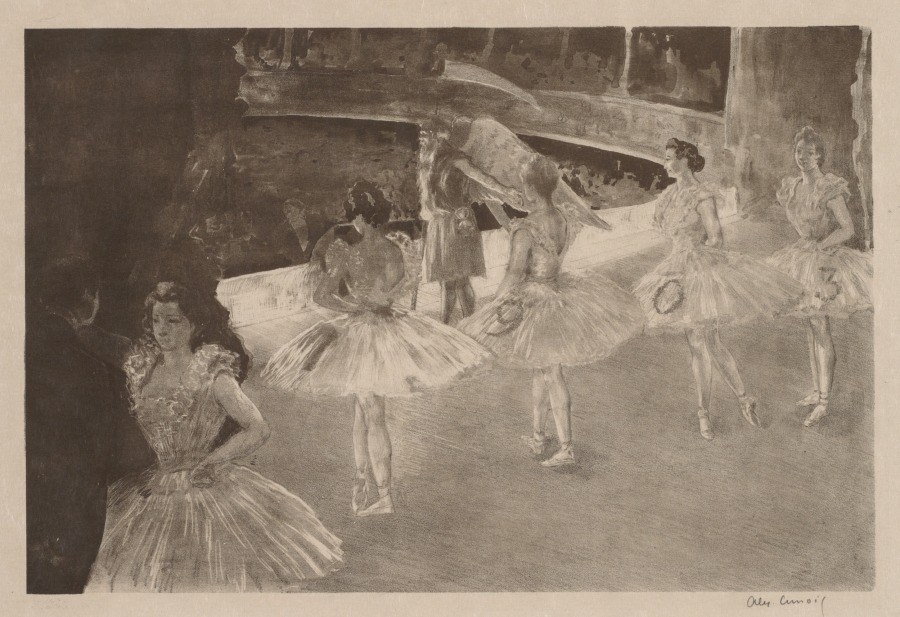
A lithograph depicting a ballet rehearsal or performance set in a studio or theatre space. In the foreground at left, a woman in an ornate dress with patterned detail sits watching, her posture attentive. The space opens to reveal multiple dancers in classical ballet dress—pale tutus and pointe shoes—arranged across the floor in various poses and positions. The lighting is soft and atmospheric, created through the lithographic process with areas of deep shadow contrasting with illuminated figures. In the background, stage architecture is suggested: a beam or architectural element frames the upper portion of the composition. The overall mood is one of artistic concentration; this is dance being studied, refined, or presented in a formal setting rather than a casual gathering.
The dancing
At least four dancers are visible in classical ballet positions, wearing short tutus characteristic of the era. Most are standing or in preparation, with the frame capturing a moment of readiness rather than dynamic movement—bodies are upright, shoulders back, in the formal carriage of classical ballet technique. One figure appears to be demonstrating or moving with slightly more energy. The seated woman in the foreground provides scale and context: she is clearly an observer with authority (her dress and posture suggest a teacher, rehearsal director, or patron). The spatial relationship suggests a hierarchy common in nineteenth-century dance training: the master or mistress positioned to view and assess.
The dance depicted
This is unambiguously classical ballet, most likely Romantic-era ballet given the date (1898) and the aesthetic. The setting—a studio or rehearsal space with multiple dancers in tutus—depicts the formal training and presentation of ballet as a theatrical art. The composition suggests this may be a specific ballet or a generalized scene of rehearsal, though without identifying inscriptions it is impossible to say whether this depicts dancers from the Opéra or a celebrated performance. The presence of the seated observer suggests the work is about pedagogy and artistic direction as much as about the dancers themselves.
How it was made
This is a lithograph, a process that allowed for fine tonal gradation and atmospheric effects. The artist has used the medium to create soft modeling of form and a subtle play of light and shadow that suits the intimate setting. Lithography was a major reproductive medium in the late nineteenth century, allowing this image to reach a broad audience interested in theatre and dance—not only specialists but the educated middle class that followed Paris's cultural life. The technique required skilled draftsmanship and an understanding of how the image would read in print, suggesting Lunois worked from careful observation or memory.
About this work
This lithograph by Alexandre Lunois captures a moment in late-nineteenth-century classical ballet training or rehearsal. It belongs to a tradition of dance imagery that emerged from the Romantic era onward, when ballet became a subject worthy of serious artistic attention and reproduction. The work documents not a moment of performance drama but rather the disciplined, formal world of ballet technique—the studio, the teaching relationship, the refinement of classical form. It sits alongside other fin-de-siècle French depictions of Parisian theatrical life, part of a larger conversation about modernity, aesthetics, and the body.
How to look at it
Attend to the compositional choice to include the seated observer in the foreground: she is not marginal but central to understanding what this scene means. The spatial recession—from the watcher through the dancers to the architectural frame—suggests a hierarchy of attention and control. Notice how the lithographic technique softens and unifies the space, creating atmosphere rather than sharp documentary clarity. The poses of the dancers are formal and held, not caught mid-movement; the image celebrates the discipline and carriage of classical technique rather than the illusion of effortless flight.
The artist
Alexandre Lunois (1863–1916) was a French painter and lithographer known for scenes of Parisian life, particularly theatre and entertainment subjects. He worked in the context of fin-de-siècle interest in modern urban experience and theatrical spectacle. His prints and paintings documented the world of the stage—ballet, theatre, music halls—with careful attention to light, composition, and the social rituals surrounding performance. He was part of a cohort of artists for whom dance and theatre were legitimate subjects for serious artistic treatment.
The period
By 1898, classical ballet in France was undergoing significant change. The Romantic era had given way to a new aesthetic influenced by the Russian Imperial Ballet, which would eventually dominate European dance after Diaghilev's 1909 Paris debut. At the same time, the Paris Opéra remained the center of French ballet tradition, still teaching and performing the classical repertoire. The late nineteenth century saw an explosion of theatrical imagery in the visual arts—Degas's dancers, Toulouse-Lautrec's cabaret scenes, and images like this one testify to the cultural obsession with performance and the body in motion. Lithography was at the height of its popularity as a medium for documenting contemporary life.
Where it lives
This lithograph is held in the Prints collection of the Cleveland Museum of Art. It is an example of the kind of affordable, reproducible artwork that brought theatrical subjects into middle-class homes and collections in the late nineteenth century.
Dance in this work
Questions about this work
Is this a real rehearsal or an imagined scene?
It is likely a composite or generalized scene rather than a documentary record of a specific rehearsal. Lunois was creating an image that captured the aesthetic and social character of ballet training—the roles, spaces, and formal discipline involved—rather than reporting on a particular event. The lithographic medium and the careful composition suggest an intentional artistic construction.
What can you tell about ballet technique from this image?
The dancers are in classical positions, standing upright with turned-out legs and formal carriage. They wear the short tutu and pointe shoes standard in the 1890s. The arrangement and poses suggest a training session or formal presentation of classical form rather than the kind of dynamic narrative action that might appear in a full theatrical production.
Why is there a woman sitting down watching?
She is almost certainly a dance master, mistress, or directrice—the authority figure overseeing the rehearsal or class. Her prominent placement in the composition, her attentive posture, and her formal dress all signal her role as observer and judge. This reflects the real pedagogy of the period, in which a senior instructor would position herself to see and correct the dancers.
What does the lithographic technique add to the image?
Lithography allowed Lunois to create soft atmospheric effects and subtle tonal gradations that suit the intimate setting of a studio or rehearsal space. The technique also made the image reproducible and affordable, allowing it to reach a broad audience interested in theatre, dance, and Parisian culture. It was not a unique artwork but a print meant for circulation.
More dance artwork





