49 works in this view — arrow keys or swipe to move between them.
Dance in Art
Ballet Dancers
Alexandre Lunois (French, 1863–1916)
- Medium:
- lithograph
- Collection:
- Prints
- Source:
- Cleveland Museum of Art
- Rights:
- Public domain — free to use, share and adapt.
- Recorded as:
- CC0
The work is valuable evidence of how ballet training was organized and practiced in professional French companies in the 1880s, and of how artists chose to represent the dancer's body at rest and in discipline rather than in virtuosic display. It also illustrates the broader 19th-century fascination with backstage and rehearsal scenes as subjects worthy of serious artistic attention.
What you are looking at
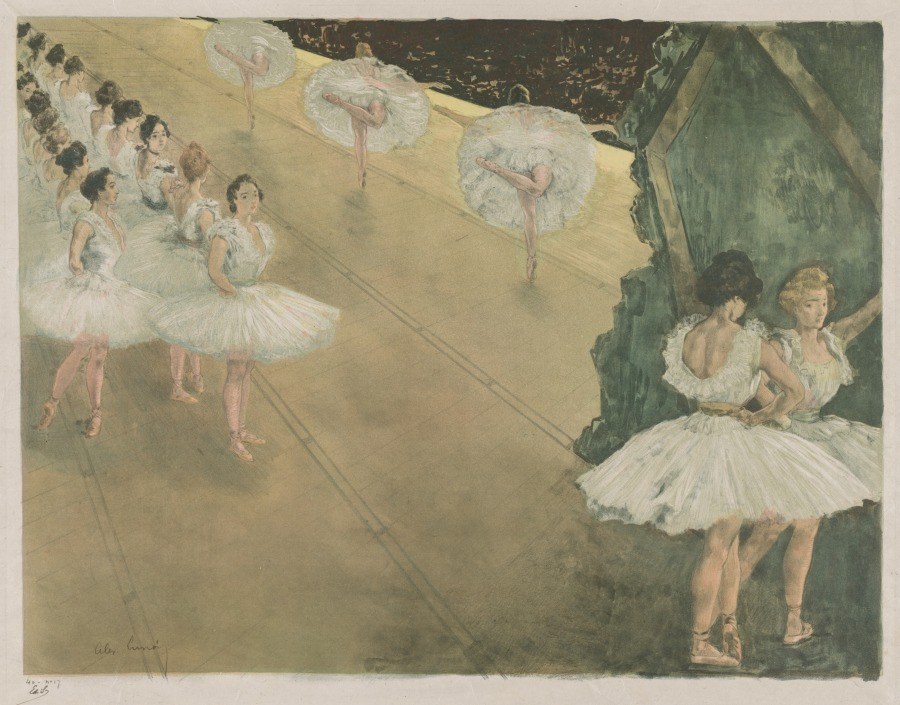
A lithograph depicting a backstage or rehearsal scene at a ballet studio, divided into two spatial zones. On the left, a line of dancers in white tutus recedes into the middle distance, each holding a similar pose with one arm raised, creating a rhythmic visual sequence. The foreground right shows two dancers in closer detail: one in profile facing left, the other turned toward the viewer, both in white practice tutus with bare shoulders and arms. The setting is rendered in muted earth tones—ochre, grey-green, and brown—suggesting interior walls or theatrical architecture. A dark architectural element, possibly a doorway or curtain, occupies the upper right. The lighting is soft and diffuse, typical of indoor studio work, with particular attention paid to the pale fabric of the tutus and the bodies' pale skin tones.
The dancing
The dancers are depicted in an upright, elongated line position with raised arms held in a classical ballet frame. The two figures in the foreground show the characteristic posture of ballet training: straight backs, lifted chests, and arms held in a second or third position. The rear figures, receding in perspective, maintain the same arm position, suggesting they are demonstrating or drilling a single movement or pose rather than moving through a sequence. The artist demonstrates understanding of ballet's vertical alignment and the repeated, held quality of positions rather than dynamic motion.
The dance depicted
This is a scene of theatrical ballet, almost certainly depicting a rehearsal or class in a professional company or academy. The dancers' classical tutus, pointed feet, and the formal studio setting all indicate Classical or Romantic ballet training. The repetition of the same pose down a line suggests an exercise or demonstration typical of ballet pedagogy, where dancers hold or repeat a position under instruction. The late 19th-century Paris setting and the formal composition indicate this is likely French ballet practice of the Romantic or early modern classical period.
How it was made
This is a lithograph, a printmaking technique that allowed for soft gradations of tone and a broader reach than painting alone. The artist worked in a reduced, naturalistic palette and exploited lithography's capacity for tonal subtlety—notice the delicate modulation of the tutus from pale cream to shadows, and the atmospheric recession of the back row. Lithography was the dominant medium for art prints in late 19th-century France and allowed both wide circulation and relatively affordable production, making theatrical subjects accessible to a broad public interested in ballet.
About this work
This lithograph records a moment of ballet training or rehearsal in late 19th-century France, capturing the quiet discipline of a studio rather than the spectacle of performance. The composition privileges the body's formal alignment and the repetition inherent in ballet pedagogy, showing dancers in a held or drilled position rather than executing a narrative. It is a document of how ballet looked in practice, not onstage, and reflects the growing artistic interest in the everyday life of professional dancers during the Romantic era's aftermath.
How to look at it
Observe the frozen, held quality of the bodies: this is not a moment of transition but of demonstration or drilling. Notice how the lithographer has used tonal variation to suggest the three-dimensional form of the tutus and the solidity of the bodies, rather than line alone. The recession of the back row into softer focus and smaller scale creates depth and emphasizes the foreground pair; attend to how the artist has used spatial compression to show many dancers at once without crowding the image. The soft palette and lack of dramatic lighting suggest the matter-of-fact reality of the studio rather than the theatrical spectacle of performance.
The artist
Alexandre Lunois (1863–1916) was a French painter and printmaker known for theatrical subjects, particularly ballet and circus scenes. He worked primarily in lithography and was associated with the broader fin-de-siècle interest in entertainment, urban life, and the human figure. His work sits within the tradition of artists like Degas who documented ballet as both art form and social practice, though Lunois's approach tends toward greater formal clarity and less psychological intensity.
The period
By the 1880s, ballet in France was transitioning from the Romantic era's ethereal narratives toward a more structured, technically demanding classical vocabulary. The rise of professional ballet companies, the codification of training methods, and the growth of an educated audience created new demand for images of dancers. In art, the period saw a broadening of what counted as a suitable subject: Impressionists and their successors were documenting not just the finished performance but the rehearsal, the waiting, the labor behind spectacle.
Where it lives
The work is held in a prints collection, indicating it is one of an original edition or series of impressions. As a lithograph, it would have been reproducible and circulated among collectors and theatregoers interested in ballet imagery, suggesting it was made for public consumption rather than as a unique artwork.
Dance in this work
Questions about this work
Is this a rehearsal or a performance?
This is almost certainly a rehearsal or class, not a performance. The studio setting, the plain interior, the repeated single pose, and the absence of spectators or theatrical framing all indicate training. The tutu is a practice garment here, not a costume.
What style of ballet is this?
The classical tutu, the body alignment, and the formal training context indicate Classical or early Modern Classical ballet, aligned with the Cecchetti method or French academic practice of the period. The work predates many of the stylistic innovations of early 20th-century ballet.
Why are all the dancers in the same pose?
Repetition of a single position was fundamental to ballet pedagogy and is still used in classes today. The artist is likely documenting an exercise, a correction, or a held position being drilled by a group, which was standard practice in professional training.
How does a lithograph differ from a painting of the same scene?
Lithography is a printmaking process that allows for multiple impressions and wider circulation at lower cost. It also demands different technical choices: the artist works on stone and must think in terms of tonal rather than coloristic effects. This makes it suited for documentary or journalistic subjects aimed at a broad audience.
More dance artwork





